
Bushenyi leaders unite under integrity forum to curb corruption
“There are many challenges, including political disagreements and accountability concerns. We have recently heard allegations that some leaders are moving around with unresolved police bonds. This forum should create harmony and improve internal mechanisms for handling issues.”
Permanent Secretary Danstun Baraba and Bushenyi district RDC Emmy Ngabirano during the forum launch. (Credit: Bruno Mugizi)
BUSHENYI - Bushenyi District has launched an expanded District Integrity Promotion Forum aimed at strengthening accountability, curbing corruption and addressing concerns over shoddy infrastructure projects and the misuse of public resources.
The newly restructured forum, established jointly with Bushenyi-Ishaka Municipality, brings together district leaders, security agencies, judicial officers and anti-corruption institutions to resolve public complaints at the local level before matters are escalated to national investigative bodies.
Dunstan Balaba, the Permanent Secretary in the Office of the Director of Ethics and Integrity under the Office of the President, presided over the launch held at Hotel Tuzza in Bushenyi town.
Forum to handle accountability concerns locally
Balaba said the initiative is intended to provide a practical local mechanism for addressing accountability concerns while conducting field monitoring to ensure government resources translate into actual service delivery.
“Accountability issues are everywhere, not only in Bushenyi,” Balaba said.
“We receive government funds, but communities often do not know how those resources are utilised. Whether it is road funds or programmes such as the Parish Development Model (PDM), where beneficiaries are expected to receive Shs1 million but claim they receive less, this forum will help resolve such concerns.”
He added that although criminal matters can still be handled by police and other agencies, service delivery disputes should first be addressed through local accountability structures and alternative dispute resolution.
Broad representation to strengthen oversight
The expanded forum seeks to consolidate anti-corruption efforts under one coordinated platform.
Other members include the Bushenyi District LC5 chairperson, the Chief Magistrate, State Attorney, representatives from the Inspectorate of Government (IGG), Office of the Auditor General, Director of Public Prosecutions (DPP) and accountability-focused Civil Society Organisations (CSOs).
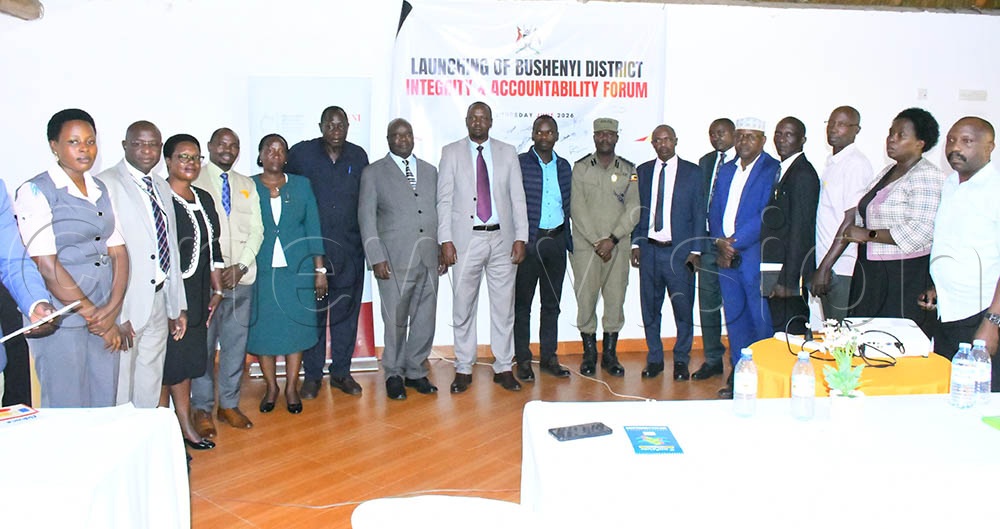
Ngambirano noted that concerns around the District Service Commission and reports of shoddy work implementation had increased the need for stronger local oversight. (Credit: Bruno Mugizi)
Leaders target corruption and poor service delivery
Ngambirano said the forum had existed previously but that the orientation and formal commissioning of the expanded membership had strengthened its effectiveness.
“Our objective is to review ethical issues, corruption, transparency and accountability across all sectors and stop corruption at the local level before cases reach national agencies,” he said.
“Because we are based here and understand our challenges, we can address many issues directly. Where matters cannot be resolved, we shall forward them with credible evidence to the relevant investigative bodies.”
Ngambirano noted that concerns around the District Service Commission and reports of shoddy work implementation had increased the need for stronger local oversight.
“This forum will bring stakeholders together to put our house in order and ensure service delivery supports socioeconomic transformation,” he said.
Bushenyi District LC5 chairperson Prosper Twebaze welcomed the initiative, describing it as an opportunity to restore confidence in district leadership.
“There are many challenges, including political disagreements and accountability concerns. We have recently heard allegations that some leaders are moving around with unresolved police bonds. This forum should create harmony and improve internal mechanisms for handling issues.”
However, some civil society leaders at the event argued that political leadership remains one of the biggest barriers to accountability.
Apollo Kakonge, the Executive Director of the Western Ankole Civil Society Forum (WACSOF), said the new arrangement gives citizens and civil society organisations a direct channel to raise concerns.
“Previously, civil society efforts were scattered. This forum gives us direct access through the RDC to address grievances,” Kakonge said.
“But many accountability challenges in the district are political. Council committees discuss corruption but often fail to resolve cases until they become public. Some politicians are complicit in the misuse of public resources.”
District Youth Councillor and Deputy Speaker Martin Arinaitwe said young people expect the forum to improve monitoring of government projects and prevent inflated contracts.
“We have cases where accountability documents are hidden,” Arinaitwe said.
“Some contractors receive tenders worth billions of shillings but deliver work of far lower value, and within weeks the infrastructure deteriorates. This forum should help ensure citizens receive services that match public expenditure.”
Forum members are expected to immediately begin joint field monitoring activities and public grievance hearings across the district.