
After 47 years in uniform, Otema returns home to a traditional cleansing
Ogal, the ceremonial curator, said the ritual is intended to cleanse the returnee of any presumed bad omen or negative spiritual encounters acquired while away and restore harmony between the individual, family and community.
Ogal, the ceremonial curator, said the ritual is intended to cleanse the returnee of any presumed bad omen or negative spiritual encounters acquired while away and restore harmony between the individual, family and community. (Credit: Christopher Nyeko)
NWOYA - After 47 years in the military, Lieutenant General (Rtd) Charles Otema Awany returned to his ancestral home in Tangi village, Purongo subcounty, Nwoya district, on August 22, 2026, not as a soldier reporting for duty, but as a son coming home.
At exactly 6:30 am, Otema arrived at the edge of his homestead, where Acholi elders had gathered since dawn to perform Nyono-tonggweno, or “stepping on the egg”, a traditional cleansing ritual.
The ceremony marked his cultural reintegration into the community after decades away in public service.
Otema, who officially retired from the Uganda People’s Defence Forces (UPDF) on August 20, 2026, alongside 19 other senior generals, was stopped at the entrance to his home and asked to remove his shoes.
Before him lay a fertilised egg, a freshly cut branch of the indigenous Pobo tree, and a layibi, a stick traditionally used to access a granary. Nearby, a goat had been slaughtered, with its blood and cud (wee) forming part of the ritual.
Otema was directed to step on and break the egg, walk through the goat's blood and cud and cross over the layibi and Pobo branch.
The ritual was conducted by a cultural leader from Payira Palami, one of the sub-clans associated with Otema’s lineage, under the watch of elder Ogal.
A son returns
For the Acholi, elders say Nyono-tonggweno is performed for a person who has spent a long period away from home, particularly in government service, military service or other circumstances that kept them separated from their community.
Ogal, the ceremonial curator, said the ritual is intended to cleanse the returnee of any presumed bad omen or negative spiritual encounters acquired while away and restore harmony between the individual, family and community.
He explained that the egg represents purity, peace, harmony and the potential of life.
Breaking it, therefore, symbolises breaking away from misfortune and opening a new chapter of health and well-being.
The Pobo branch also carries traditional significance, having historically been used by the Acholi for cleansing, while the layibi symbolises the return to the community's agricultural and family life.
For Otema, the ritual had a deeper meaning.
It was a return to the very place where his umbilical cord was buried and where his parents once sent him into the world, entrusting him to the military after he left home in 1979.
From Anaka to the army
Otema joined the military in 1979 shortly after completing his Primary Leaving Examinations (PLE).
Unable to continue to secondary school because of his family’s financial circumstances, the young Otema instead embarked on a journey that would keep him in uniform for nearly half a century.
He recalled walking from Anaka towards Olwiya, where he boarded transport to join the army.
He said his decision was partly driven by a desire to protect his family, which had faced threats from people associated with the Amin regime who had attempted to kill his late father, Savio Ojok Awany.
Otema attributed much of his eventual success to the blessings he received from his maternal uncle before leaving home.
He recalled that his uncle gave him a cock, which his mother prepared, and that he drank the soup on the morning he began his journey.
From a young recruit, Otema rose through the ranks to become one of Uganda’s senior military commanders.
He served in the UNLF era and later joined the National Resistance Army, which evolved into the UPDF.
Among his senior appointments were Commander of the UPDF Reserve Force and Chief of Logistics and Engineering.
He also played prominent roles in military operations and counter-insurgency efforts in northern Uganda.
Memories of war
He recalled participating in operations that contributed to the overthrow of Idi Amin and the capture of Gulu and Arua.
He said his intake initially had about 600 soldiers, but only an estimated 180 to 200 survived after fighting during the advance towards Arua.
According to Otema, Amin’s forces pushed them towards Pakwach Bridge before they were reinforced by Tanzanian troops and militia from Labworwong, allowing them to regroup and recapture Arua.
He also recalled encountering armed local youth around Opaka forest in Gulu who were fighting with traditional weapons.
Otema said he and his colleagues persuaded some of them to abandon the fighting after explaining that they had been misled.
He recounted finding Gulu largely deserted after its capture before going to Lacor Hospital, where he said many residents were hiding and pretending to be patients for fear of being killed by advancing forces.
Speaking to them in Acholi, he said he introduced himself and assured them that they could return home safely.
According to Otema, Amin’s forces pushed them towards Pakwach Bridge before they were reinforced by Tanzanian troops and militia from Labworwong, allowing them to regroup and recapture Arua. (Credit: Christopher Nyeko)
Saving civilians in West Nile
Otema also recounted an incident in Arua in which he said he intervened to protect civilians from armed militia members who were carrying out revenge attacks.
He recalled entering a church where a man was allegedly preparing to throw a grenade at people gathered inside.
Otema said he ordered the man to replace the grenade’s safety pin and threatened to shoot him if he refused.
He said the intervention saved the civilians inside the church.
Otema said his actions during the turbulent period earned him lasting friendships in West Nile.
‘My wives stood by me’
As he reflected on his career, Otema paid tribute to his family, particularly his wives, for remaining faithful and supportive despite the demands of military life.
He said his work frequently kept him away from home for long periods, sometimes without communication.
Yet, he said, his wives waited for him and continued praying for his safety.
His family members described him as a strict but loving father who places great emphasis on unity and the collective upbringing of children.
His children, led by Alan Olara Awany, described him as a responsible and fatherly man who has successfully managed a large extended family.
“Daddy knows the science of managing many wives; it is not about having money. It is a science,” one of the children said, drawing laughter from the gathering.
The wives, in turn, described Otema as a darling and responsible husband who insists on family unity.
‘He made me who I am’
Richard Todwong, the NRM secretary general and Otema’s younger brother, said the cleansing was important because it culturally restored Otema to his community after decades in the military.
Todwong also spoke emotionally about his relationship with his elder brother.
He said Otema did not merely act as a brother but helped raise and educate him, adding that much of what he has achieved is attributable to Otema’s support.
Catherine Lamwaka, the Omoro District Woman MP and Otema’s wife, also credited him for supporting her journey into public service.
She said she would not have become a Member of Parliament without Otema’s support.
‘Retired but not tired’
Although Otema has formally left active military service, his relatives believe his public service is not over.
Okot Arao, the chairperson of the Palami clan, appealed to President Yoweri Museveni to consider giving Otema another responsibility.
Arao argued that although Otema had reached the retirement age, he remained capable of serving the country.
Otema disclosed that Gen. Salim Saleh, the senior presidential adviser on defence and chief coordinator of Operation Wealth Creation, had discussed with him the possibility of serving as a provincial governor for northern Uganda.
Otema said justice and constitutional affairs minister Norbert Mao had pointed out that such a position is not currently provided for in the Constitution, but that a presidential executive order could lead to its creation through Parliament and subsequent gazetting.
The proposed provincial governors, he said, would oversee government programmes and operations across northern Uganda.
A new mission: wealth creation
With the uniform now behind him, Otema says his next mission is economic transformation.
He plans to invest in wealth creation, farming, hospitality and animal husbandry in northern Uganda.
He said he had already received a document from Gen. Salim Saleh outlining investment opportunities in Acholi under what is referred to as the Acholi Investment Plan.
Otema also praised President Museveni, describing him as “God-sent” and “a different man”, and said he would continue supporting the president's vision.
A thanksgiving for a safe return
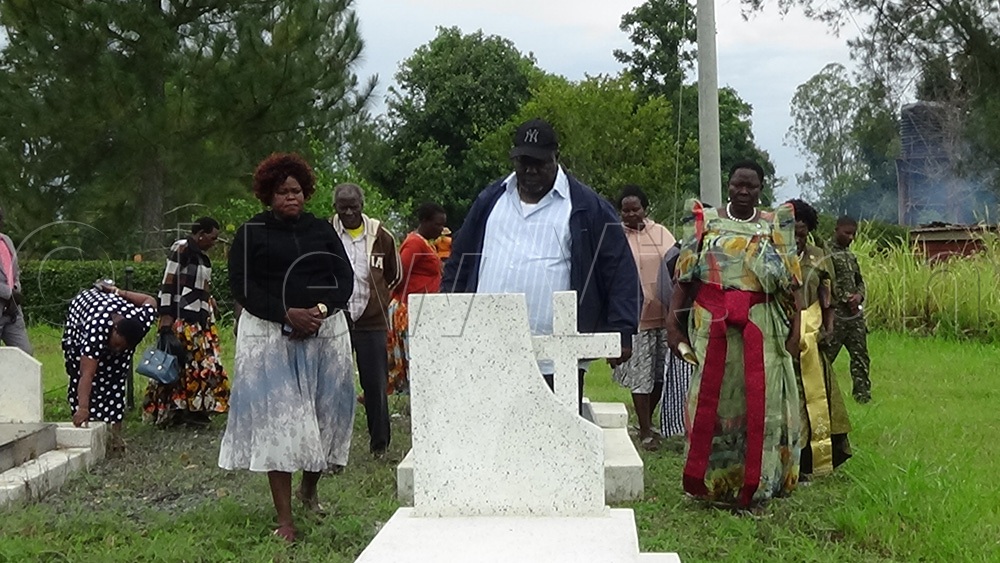
Following the cultural cleansing, Otema joined close family members, including his parents, siblings, children, relatives and spouses, for a thanksgiving prayer at his home, where they jointly visited their family graveyard and paid tribute to their fallen family members, including his father, Savio Ojok Awany.
The gathering offered the family an opportunity to reflect on his long military journey and give thanks for his safe return.
For a man who left Tangi in 1979 as a young recruit with little formal education beyond primary school, the homecoming carried the weight of a lifetime.
He left as a young man seeking to protect his family.
He returned 47 years later as a retired lieutenant general, having risen to one of the highest ranks in Uganda’s military establishment.
Grand homecoming awaits
The cultural welcome at Tangi was only the beginning.
Acholi paramount chief David Onen Acana II is organising a grand homecoming ceremony for Otema on August 28, 2026, at Kaunda Grounds in Gulu city.
The event is expected to bring together people from Acholi and neighbouring communities, including Lango, Teso, West Nile and Karamoja.
Organisers say the ceremony will provide an opportunity for people to share testimonies about Otema’s contribution to the region, particularly during the turbulent years of the LRA insurgency.
After nearly five decades in uniform, Otema has finally returned to the place where his journey began.
The egg has been broken. The blood has been crossed. The son of Tangi has been welcomed home.
Retired from the army, perhaps, but by the accounts of his family and elders, far from tired.