
African military leaders tasked to embrace development and economic transformation
The 160 officers are in Uganda for a seven-day study tour, which forms part of a broader programme designed to expose African military leaders to governance systems, economic management frameworks and post-conflict reconstruction strategies.
Chris Bagonza, Brig. Gen. Deputy Commandant Senior Command and Staff College, Kimaka (5th from left) flanked by Prof. Charles Kwesiga (dressed in Kauda suite), Executive Director of Uganda National Research Institute pose for a group photo with a cross a delegation of African senior staff after touring Namanve Industrial Park, March 2026. (Photo by Wilfred Sanya)
__________________
Senior military officers from across Africa have been urged to integrate national development into their strategic thinking, with experts arguing that economic transformation is central to sustainable peace and long-term security.
On Tuesday, Prof. Charles Kwesiga, the UNIRI Executive Director, challenged over 100 military officers to rethink traditional perceptions of military leadership and embrace broader intellectual and professional growth.
“It is not enough to be a soldier. You never know where fate will take you. I would not have remained relevant to this country after surviving the turbulent 1970s under Idi Amin if I had confined myself to one path,” Prof. Kwesiga stated on March 24, 2026, while hosting a group of senior military officers from different countries.
The 160 officers are in Uganda for a seven-day study tour, which forms part of a broader programme designed to expose African military leaders to governance systems, economic management frameworks and post-conflict reconstruction strategies.
Organisers said the objective is to cultivate officers who understand that security is closely linked to economic opportunity, employment creation and social stability.
At UNIRI in Nakawa, Kampala's suburbs, Kwesiga narrated that while in exile, he pursued further academic knowledge. Africa’s challenges are similar across borders and require leaders who think beyond the battlefield.
Cautioning African nations against superficial comparisons on development progress, he stated that most countries on the continent still rank low on global human development indices.
Prof. Kwesiga argued that although Africa is richly endowed with natural resources, many economies remain constrained by weak industrial bases, limited access to affordable capital and shortages of skilled labour.
“Our economies largely export raw materials and import finished goods. That model cannot deliver sustainable prosperity,” he stressed, adding that “Industrialisation is not optional - it is essential for countries such as Egypt, Rwanda, Tanzania, Malawi and Uganda to meaningfully participate in the Fourth Industrial Revolution.”
Prof. Kwesiga reiterated that Africa’s progress depends on leaders who recognise the interdependence between security and development.
“A secure nation without economic strength remains fragile,” he said. “When you combine discipline, innovation and industrial capacity, you lay a firm foundation for lasting peace and prosperity.”
During the guided tour, the officers explored UNIRI’s demonstration workshops and innovation centres, where they were introduced to locally developed technologies designed to boost domestic production.
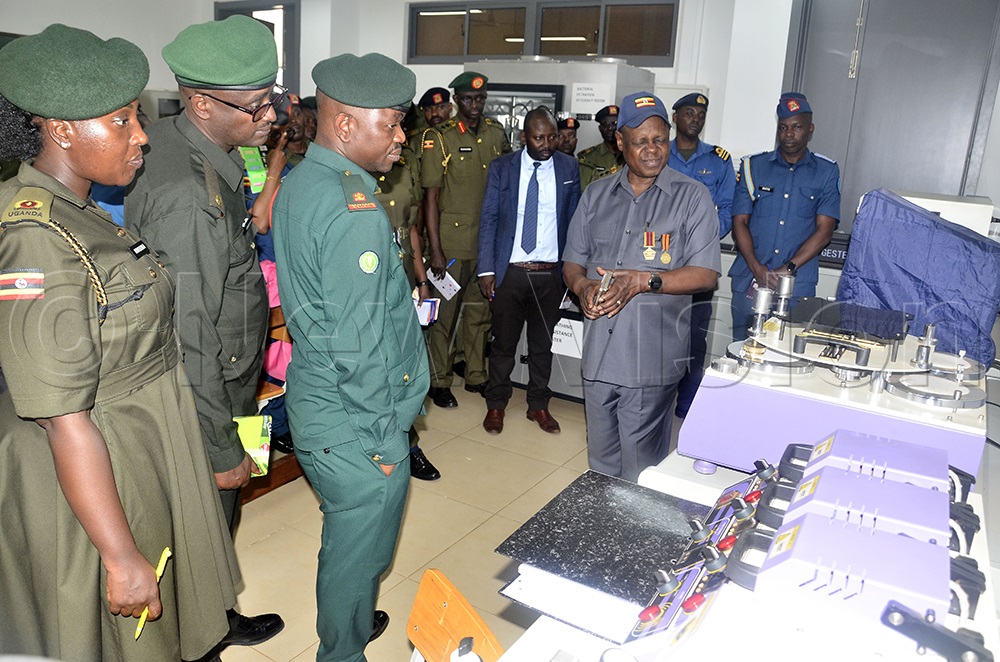
Prof. Charles Kwesiga Executive Director of Uganda National Research Institute (right) explains to African Defense forces in the lab how they use mechanized tools to create opportunities to promote the economy. This was during their tour at Namanve Industrial Hub from Senior Command and Staff College Kimaka Jinja where they are undergoing training to prepare after retirement, March 2026. (Photo by Wilfred Sanya)
The facilities showcased carpentry and wood-processing equipment, modern electrical engineering systems, tailoring and textile production lines, and machinery capable of producing cardboard and extracting fibre from pineapple leaves for value-added industrial use.
The officers learned how such technologies not only promote environmental sustainability but also create jobs and enhance value addition in agriculture.
A major highlight of the visit was a state-of-the-art structure and equipment donated by the Chinese government, valued at $30 million (sh112 trillion). Additional machinery support was provided by the German government to strengthen Uganda’s manufacturing capacity and reduce reliance on imported goods.
“This equipment is meant to move us from a consumption-driven economy to a production-oriented one. We cannot continue importing simple items such as toothpicks, matchsticks and spare parts that can be manufactured locally if we invest in the right molds and skills,” Prof. Kwesiga explained.
He added that industrial research institutions must act as bridges between innovation and market demand by supporting small and medium enterprises to scale up production, meet quality standards and compete within regional markets.
Several officers noted that industrial growth can play a stabilising role by addressing youth unemployment, reducing poverty and limiting the economic frustrations that often contribute to instability.
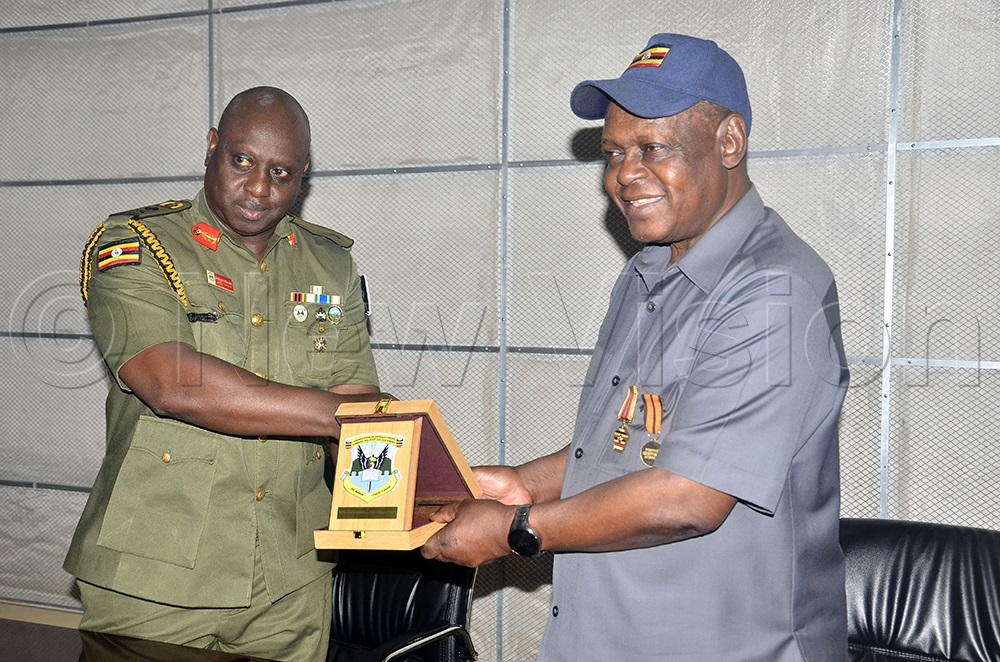
Chris Bagonza, Brig. Gen. Deputy Commandant Senior Command and Staff College, Kimaka Jinja, presents a gift to Prof. Charles Kwesiga (right), Executive Director of Uganda National Research Institute, during a visit by a delegation of Africa soldiers at Namanve Industrial, March 2026. (Photo by Wilfred Sanya)
In recognition of his contribution to professional military education, Brig. Gen. Chris Bagonza of the Uganda People's Defence Force (UPDF) presented Prof. Kwesiga with a plaque, acknowledging his role in mentoring and enlightening various course units from Kimaka Training Institute.
The visit underscored Uganda’s ambition to position itself not only as a contributor to regional peacekeeping missions but also as a model for integrating defence leadership with national development priorities.