
53 Congolese nationals deported after unlawful entry into Uganda
Speaking to New Vision on June 10, 2026, Twaib Achile, the deputy resident district commissioner of Pakwach, said Ebola response teams have continued to intercept and deport Congolese nationals who allegedly enter Uganda illegally through porous border points since the beginning of June 2026.
The Uganda border post at Goli connecting to Mahagi town in Eastern Democratic Republic of Congo. (Photo By Robert Ariaka)
________________
The number of Congolese nationals deported from Uganda has risen to 53 within a period of just over a week as security agencies and Ebola task force teams in Pakwach and Nebbi districts intensify border enforcement measures.
Speaking to New Vision on June 10, 2026, Twaib Achile, the deputy resident district commissioner of Pakwach, said Ebola response teams have continued to intercept and deport Congolese nationals who allegedly enter Uganda illegally through porous border points since the beginning of June 2026.
According to Achile, many of those intercepted originate from areas such as Koboko, Maracha, Arua city and Arua district, and are often ferried in private vehicles after crossing the border irregularly.
He said most interceptions are carried out at the Pakwach checkpoint, where security personnel have been deployed.
On June 8, at about 11:00 pm, security officers intercepted five Congolese nationals, while a further five were intercepted on Tuesday, June 9, which coincided with Heroes Day.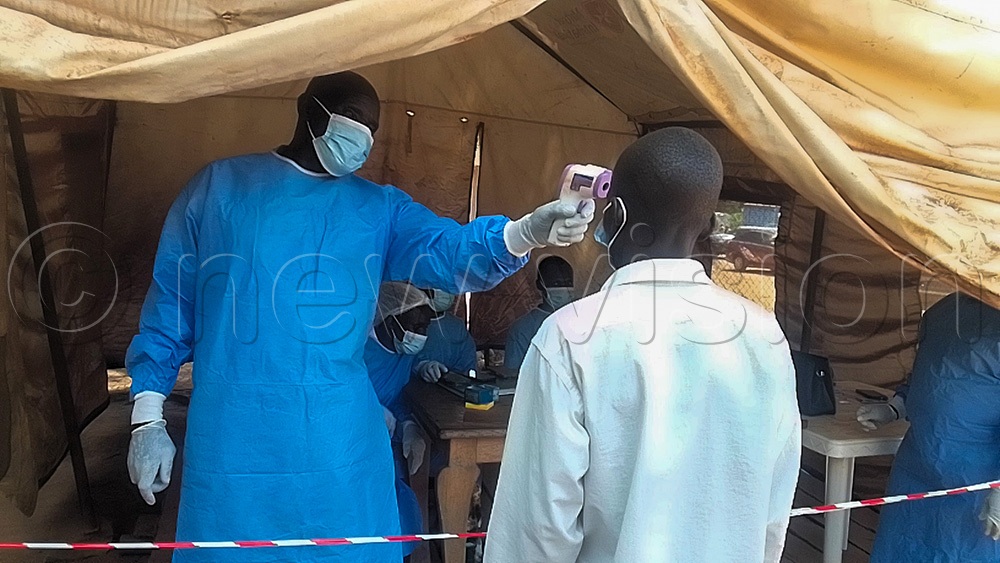
A health worker at Vurra Customs Border point checking the temperature a traveler. (Photo By Robert Ariaka)
Achile said that since the start of June, a total of 53 Congolese nationals have been intercepted and deported after testing negative for Ebola.
The Ebola task force teams in Pakwach and Nebbi agreed in a recent coordination meeting to intercept any Congolese nationals who enter Uganda illegally. Following briefings to local communities, residents have also become more vigilant and report suspected movements of Congolese travellers in vehicles.
Achile confirmed that the 10 individuals intercepted on Monday and Tuesday were deported, bringing the total to 53 within the reporting period.
He noted that the measure aligns with Ebola directives and standard operating procedures issued by the Ministry of Health and the national Ebola task force, which include temporary restrictions on cross-border movement involving Congolese nationals.
When asked about isolation procedures, Achile said all intercepted individuals are first tested, and those found negative are deported, while any positive cases would be referred for treatment. He confirmed that all deported persons tested negative.
“We do not want to waste time. For us, we took them to Goli and handed them over to the Congolese Authorities,” Achile explained.
On Wednesday, 11 more Congolese nationals were also returned, bringing the cumulative figure to 53 within a period of one week and three days, he added.
He said most of those intercepted use illegal crossing points and travel without official immigration documentation, although some present national identity cards without clearance papers.
“Our instruction is to intercept, check, and that is what we are doing. We have surveillance officers who help,” Achile said.
In Parombo, community members reportedly intercepted a woman and her child, who were later isolated for three days before being handed over to security teams.
Security operations have also been extended to waterways along the River Nile and Lake Albert, with coordination from counterparts in Buliisa district to prevent illegal crossings via water transport.
Under the current Ebola directives, only transit vehicles carrying goods and food supplies are permitted to cross between Uganda and the Democratic Republic of Congo.
The Ebola Bundibugyo strain broke out in the eastern DRC last month. On May 17, the World Health Organisation (WHO) declared the Ebola outbreak an international emergency.
According to the health ministry, Uganda has been managing 19 Ebola cases. Of these, 14 are members of the same family who entered Uganda from the DRC.
The five were Ugandans, including four health workers, who interacted with the Congolese patients.
To contain Ebola from the epicentre in DRC, Uganda has sent 160 health workers there, who will be deployed in four teams of 40 personnel each.