
NIRA Expo: What you need to know before saying 'I Do'
According to Naome Katushabe, Registrar of Marriages in NIRA’s Civil Marriages Department, the process starts with identification, with the requirements varying depending on whether the couple are Ugandans, foreigners or refugees.
Amanuel Tekle Gebreslassie shares a moment with his wife, Arsiema Kahsay Zeratsion, after taking their vows before Registrar of Marriages Anita Tumwine at the Kololo Ceremonial Grounds. (Credit: Ponsiano Nsimbi)
________________
For couples planning to say “I do”, the National Identification and Registration Authority (NIRA) has spelt out the requirements for a civil marriage, as the My Identity Expo and Symposium 2026 gets underway at Kololo Ceremonial Grounds.
The three-day expo, organised by NIRA and sponsored by Vision Group, Bank of Uganda, URA, KCCA, NITA-Uganda and Tahaluf, has brought a range of identity and civil registration services under one roof, with members of the public able to access the services free of charge. Among the services taking centre stage is civil marriage, with more than 10 couples lined up to be married during the expo on Tuesday.
According to Naome Katushabe, Registrar of Marriages in NIRA’s Civil Marriages Department, the process starts with identification, with the requirements varying depending on whether the couple are Ugandans, foreigners or refugees.
“We basically carry out civil marriages for Ugandans, non-Ugandans and refugees, among others,” she said.
For Ugandans, she said, a national identity card is required, while foreigners must present a passport with a valid visa. Refugees, on the other hand, are required to present an Office of the Prime Minister (OPM) identity card together with a letter from the OPM indicating their marital status. Couples must also declare their marital status through an affidavit, stating whether they have never been married, are divorced, or are widows or widowers.
Katushabe said the affidavit must also confirm that the couple are of legal age, have willingly consented to the marriage and are not related to each other. Under the civil marriage arrangement, couples must be at least 18 years old and must provide two witnesses, who can be either male or female, provided they are above 18.
For couples getting married at the Kampala office, Katushabe said at least one of the partners must have stayed in Kampala for a minimum of 15 days. They stay must also be confirmed by a letter from the local chairman indicating that the person is known in the area and has lived there for the required period.
“If both of them are foreigners, at least one of them has to come and be here for at least 15 days. If they are Ugandans, then it is okay, one of them or both of them must be within Kampala district,” she explained.
A marriage with a difference
Katushabe also highlighted an important feature of civil marriages that couples need to understand before taking their vows: they are strictly monogamous. “Once you get married under civil, you have to stick to one wife, one husband, you can't add,” she said. She explained that Uganda recognises several forms of marriage, including civil, Christian, Muslim and customary marriages, but people intending to have more than one spouse would have to marry under a form of marriage that legally permits polygamy, such as customary marriage or, for Muslims, Islamic marriage.
Katushabe said couples seeking a civil marriage are also required to pay the applicable fees.
For a local marriage involving two Ugandans, or a Ugandan and a foreigner or refugee, the fee is sh260,000, plus sh110,000 for registering affidavits, according to Katushabe.
For two foreigners, she said the marriage fee is $210, plus sh110,000 for the affidavits.
More than a ceremony
The first day of the expo saw couples not only seeking marriage services, but also accessing other NIRA services, under the broader theme of bringing identity services closer to the public. Among those who got married was Alain Frakoze, originally from Burundi and now living in Belgium, who married his fiancée, Michael Girimana. Alain said he chose to have the marriage conducted at the expo because of his circumstances as a refugee.
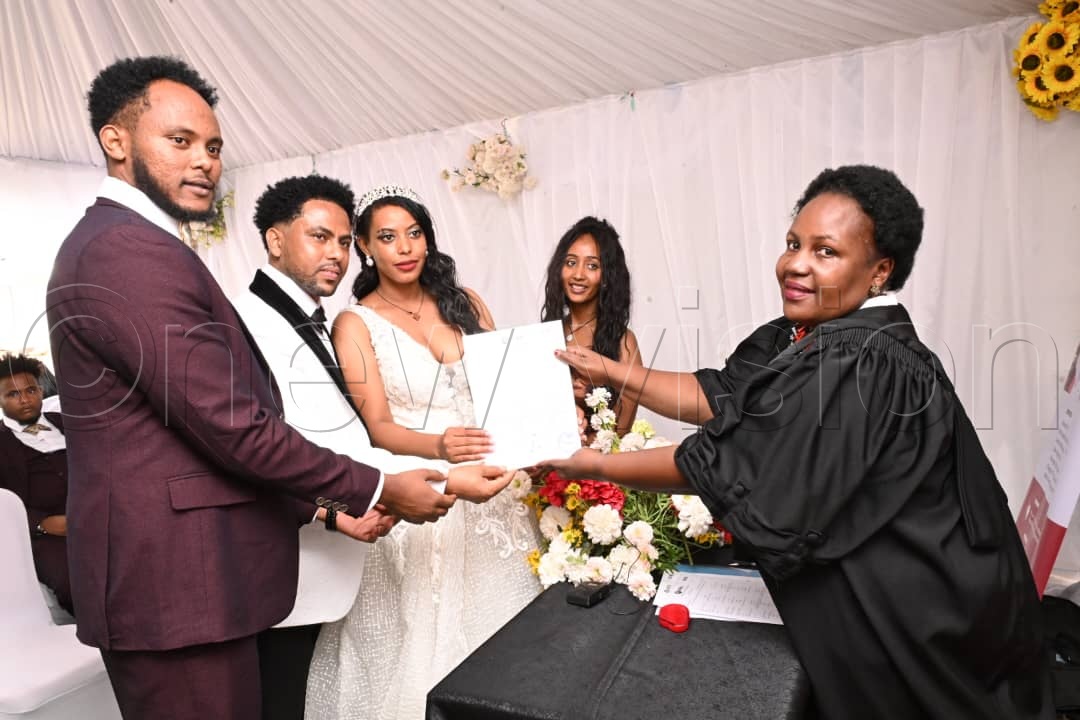
(Credit: Ponsiano Nsimbi)
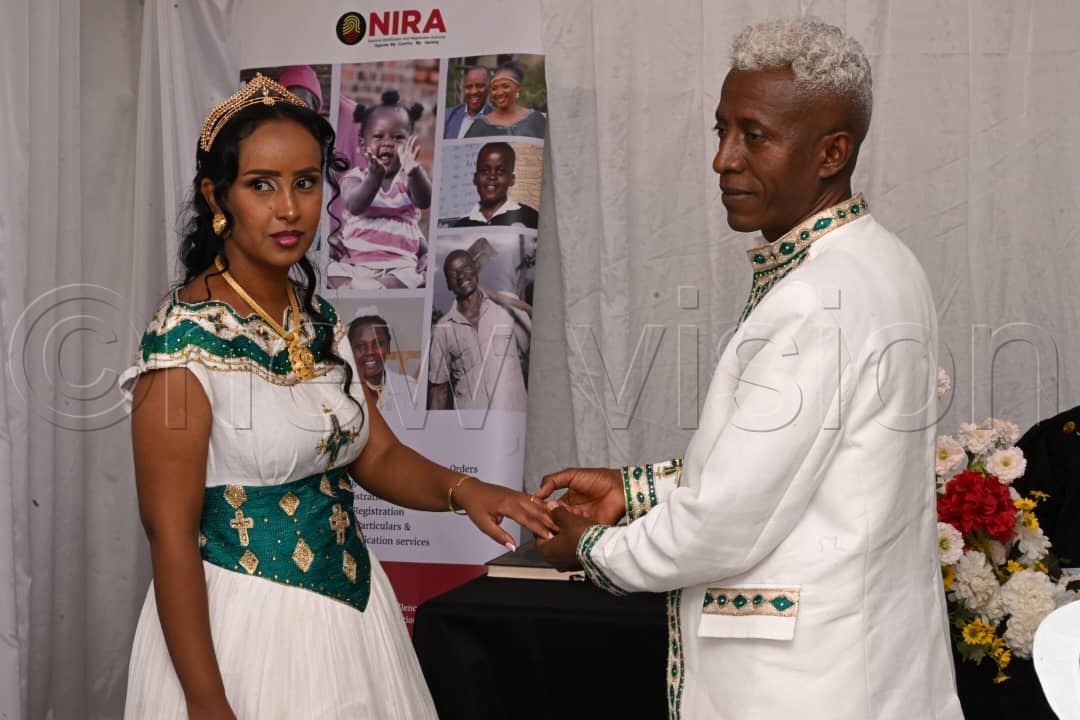
(Credit: Ponsiano Nsimbi)
“It’s a very good experience. The service is very good. We are appreciating,” he said.
Katushabe said NIRA usually conducts civil marriages, but the expo marks the first time the service has been incorporated into an event of this nature. “We have been doing civil marriages. It’s the first time we are doing it here in the expo, but we have been doing it,” she said, adding that NIRA had also previously offered the service at events such as Bride and Groom.
The marriage section is expected to remain active throughout the expo, with Katushabe saying the number of couples can range from 15 to 20 or even 25 on a typical occasion. “I’m calling upon everyone to come and get married here and then get the certificate,” she said.
Visitors put services to the test
Away from the marriage ceremonies, other visitors were taking advantage of the expo to address their identity documentation needs. Irene Nakitende from Ndejje arrived early to obtain a National Identification Number (NIN) for her son. She said she was attended to and encouraged others to make use of the expo. Her message to members of the public was simple: the process is easy and fast.
Joanita Beyeza, meanwhile, accompanied her sister to correct details on a previous identity document after discovering that the name on the ID differed from her actual name. She said they came to establish whether the correction had been effected, and the issue was addressed at the expo.
For the visitors moving between the different tents at Kololo, the expo is proving to be more than a showcase of identity services. It is becoming a one-stop point where people can obtain documents, correct information, register important life events and get guidance on services that affect their everyday lives.
With two more days to go, NIRA is using the expo to bring identity and civil registration services closer to the public while also sensitising Ugandans and other residents about the importance of having the right documentation.