
UNICEF boss says technology will boost Uganda’s immunisation coverage
“Digitalisation is something we are working on with the Ministry of Health to ensure wider vaccination coverage."
(L-R) Dr Robin Nandy, the UNICEF Uganda Country Representative, Bernard Tabaire, the Rotary Club of Kisugu Victoria View President and Rosie Kajumba, the president nominee of the Rotary Club of Kisugu Victoria View, during the inaugural fellowship of the Rotary Club of Kisugu Victoria View for the 2026/2027 Rotary year at Hotel International Muyenga in Kampala on July 07, 2026. (Photos by Lawrence Mulondo)
________________
UNICEF's representative in Uganda, Dr Robin Nandy, has urged the country to embrace digital vaccination systems to improve immunisation coverage, saying technology can help ensure that no child misses life-saving vaccines because of preventable barriers.
He said that although vaccine acceptance in Uganda remains high, logistical challenges continue to prevent many children from completing their immunisation schedules.
Vaccination services must be accessible, reliable and convenient for families, he added.
Nandy was speaking at the inaugural fellowship of the Rotary Club of Kisugu Victoria View for the 2026/2027 Rotary year at Hotel International Muyenga in Kampala on Tuesday.
He illustrated his point thus:
Imagine a parent in remote Karamoja spends money on motorcycle transport and travels for two hours to a health facility, only to discover that vaccines are out of stock or the health worker responsible for administering them is absent.
“If you were that parent, would you return a second time? You probably wouldn't. I know I wouldn't."
Nandy said health services should be designed to make vaccination as convenient as possible, especially because mothers and caregivers have many competing responsibilities.
In urban areas, for instance, many parents struggle to take their children for immunisation because they cannot afford to miss work.
Bernard Tabaire (extreme Left), the Rotary Club of Kisugu Victoria View President, handing sisters from Nsambya Babies’ Home a Rotary badge during the inaugural fellowship of the Rotary Club of Kisugu Victoria View for the 2026/2027 Rotary year at Hotel International Muyenga in Kampala on July 07, 2026. 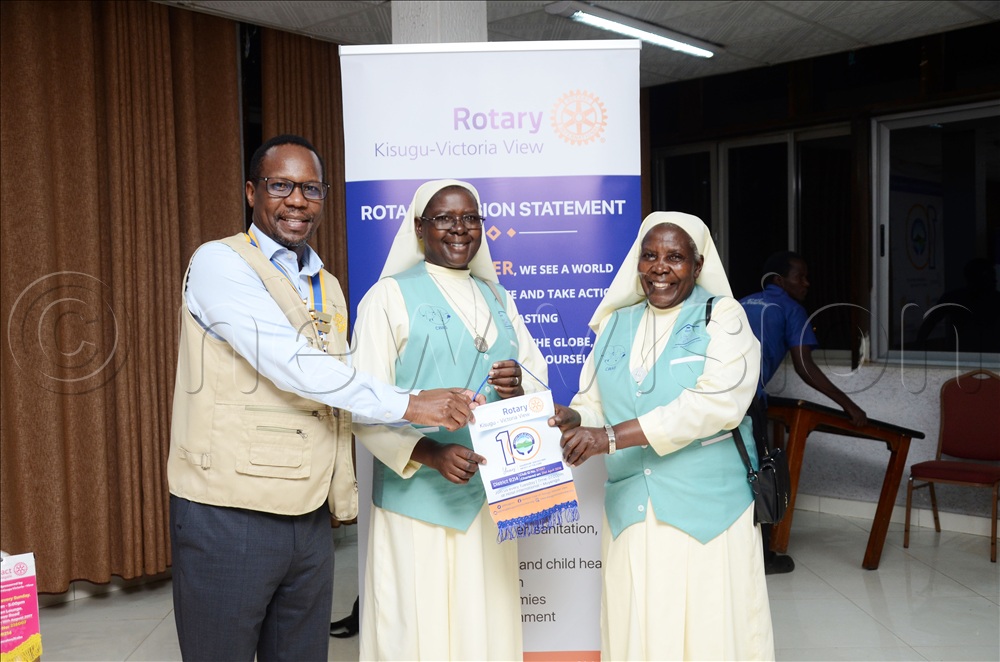
Nandy was also keen to underline the role of technology in all this, saying many developed countries use digital vaccination systems that automatically send reminders to parents through mobile phones or email whenever a child's vaccination is due.
“Digitalisation is something we are working on with the Ministry of Health to ensure wider vaccination coverage."
The resurgence of vaccine-preventable diseases, such as measles, came to the fore, with outbreaks reported across all the nine districts of Karamoja, and additional cases emerging in the West Nile region.
“Whenever diseases such as Ebola emerge, everyone wishes there was a vaccine. Yet we are not fully utilising the vaccines we already have against diseases like measles, hepatitis and others,” said the UNICEF country representative.
Call to Rotary
The emphasis is that availability of vaccines alone is not enough. Success depends on the commitment of governments, health workers, communities and parents alike.
Nandy challenged Rotary members to use their influence beyond financial contributions by advocating for immunisation at both national and local government levels.
He praised Rotary's global leadership in the fight against polio, recalling how Rotarians successfully challenged misinformation in countries such as Nigeria, where some communities believed polio vaccines were part of a Western conspiracy to sterilise children.
“You will not take advice from people you do not trust. Building that trust is essential, and once it is earned, communities must see the results."
Global evidence shows immunisation has been one of the biggest contributors to reducing child mortality.
Uganda has made encouraging progress in maternal and child health.
Maternal mortality has declined from 336 deaths per 100,000 live births in 2016 to 289, while under-five mortality has dropped from 64 to 52 deaths per 1,000 live births. Newborn mortality has also fallen from 27 to 22 deaths per 1,000 live births.
Vulnerable communities, including residents of Kampala's informal settlements and people living in remote districts, continue to face significant barriers to accessing quality maternal and child healthcare.
Another concern is the declining international funding.
UNICEF is increasingly focusing on testing innovative approaches before transitioning successful models to government financing.
The UN agency is calling for increased investment in emergency obstetric services, skilled health workers, blood collection, medicines, newborn care units and antenatal care to reduce maternal and newborn deaths.
Malnutrition is also a major concern despite Uganda's agricultural potential.
“Uganda has enough food, yet malnutrition remains high because of poor feeding practices and poverty. These issues must be addressed,” said Nandy.
Committed
Rotary Club of Kisugu Victoria View president Bernard Tabaire said the club deliberately chose maternal and child health as the focus of its first fellowship because July is Rotary's maternal and child health month.
“We wanted someone with deep experience in this field to inspire us and challenge us to do more,” said Tabaire.
The club hit the ground running with a major blood donation drive and plans to participate in the World Polio Day activities on October 24.
The club is also looking to partner with Kangaroo Child Care in Kawempe to support premature babies.
Maternal and child health remains one of Rotary International's key areas of focus.
With that in mind, Tabaire said the organisation will continue to support initiatives that improve the survival and well-being of mothers and children across Uganda.