
Uganda starts 42-day Ebola-Free countdown as last patient is discharged
Health Minister Dr Chris Baryomunsi cautioned that while the discharge represents a major victory, it does not mark the end of the outbreak.
Health Minister Dr Chris Baryomunsi presents a certificate to the last Ebola survivor at the Mulago Isolation Unit on Thursday, July 16, 2026. (Credit: Mpalanyi Ssentongo)
___________________
Uganda has entered the final phase of its fight against the latest Ebola disease outbreak after the Ministry of Health discharged the country's last confirmed patient, triggering the official 42-day countdown required before the World Health Organisation (WHO) can declare the country Ebola-free.
The last patient, a Congolese national who had been receiving treatment at the Mulago National Isolation Centre in Kampala, was discharged today (July 16) after fully recovering. During the ceremony, health ministry officials handed the survivor a certificate of discharge, marking a significant milestone in an outbreak that started in the Democratic Republic of Congo (DRC) and claimed two lives, but was contained before spreading widely.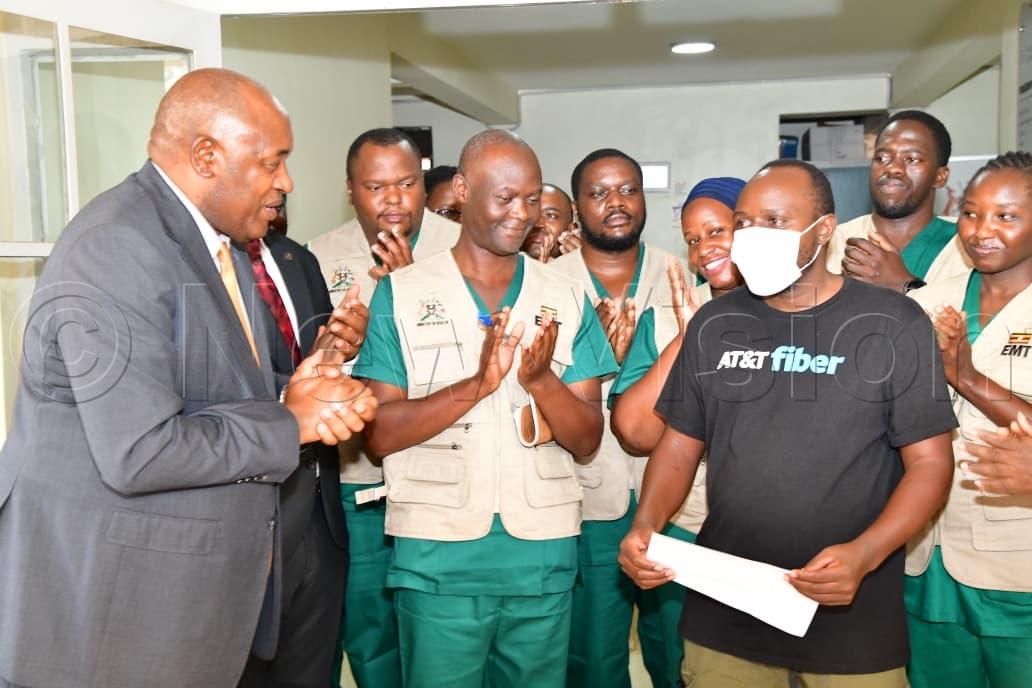
Health Minister Dr Chris Baryomunsi presents a certificate to the last Ebola survivor at the Mulago Isolation Unit on Thursday, July 16, 2026. (Credit: Mpalanyi Ssentongo)
According to international guidelines, a country can only be declared Ebola-free after completing 42 consecutive days equivalent to two maximum incubation periods of 21 days each without recording a new confirmed case.
Health Minister Dr Chris Baryomunsi cautioned that while the discharge represents a major victory, it does not mark the end of the outbreak.
"Discharging the last patient does not mean that we are now Ebola-free. The international guidelines require us to begin a countdown. If we do not register any positive case during the next 42 days, Uganda will then be declared Ebola-free," Baryomunsi said.
He urged communities to remain vigilant, particularly in border districts with the DRC, where the outbreak continues to spread.
"This is an imported outbreak. What we are celebrating here is different from what is happening in the DRC. There are still thousands of confirmed cases and hundreds of deaths there, which means Uganda remains at risk," he said.
The minister said Uganda's surveillance systems, screening teams and community sensitisation activities would remain fully operational throughout the countdown period.
Baryomunsi noted that the National Task Force will review some of the public health restrictions imposed during the outbreak, including limitations on markets and public gatherings in border communities, but stressed that any easing of measures would be done cautiously.
Health officials attributed Uganda's successful response to years of investment in epidemic preparedness, rapid case detection and specialised treatment capacity. The Mulago National Isolation Unit, which has now managed patients through three separate Ebola outbreaks, treated both confirmed and suspected cases during the latest response.
"This will be the third time we are using this unit during an epidemic, and we have kept improving it," he said.
Kaggwa explained that although there is no universally approved cure for Ebola, noting that patients receive intensive supportive treatment, including intravenous fluids, nutrition, monitoring of vital organs and, where appropriate, experimental medicines administered on compassionate grounds.
"We don't only take care of confirmed Ebola patients. During this outbreak, more than 160 suspected patients have passed through this unit. Many of them had other serious illnesses that also required urgent treatment," he said.
Kaggwa said managing suspected cases remains a critical component of outbreak response because many patients initially present with symptoms similar to Ebola, but are eventually diagnosed with malaria, typhoid or other infectious diseases.
Uganda's frontline medics hailed
The WHO hailed Uganda's response as evidence that preparedness can dramatically reduce deaths during Ebola outbreaks. WHO Country Representative Dr Kasonde Mwinga said Uganda's impressive treatment outcomes were a result of investments made long before the outbreak began.
"Preparedness saves lives. The treatment unit was already in place before the outbreak. The emergency medical teams had already been trained, and the Government had pre-positioned supplies that could quickly be deployed," she said.
Mwinga noted that Uganda recorded a case fatality rate of less than 10% during the outbreak, which is among the lowest ever reported in an Ebola epidemic.
"That is not by luck, it is because people invested in preparedness," she said.
Mwinga encouraged the public to seek medical attention immediately whenever Ebola symptoms appear. "The earlier people seek care, the better their chances of recovery. People should trust the country's health services and not fear coming to health facilities."
The Ministry of Health also praised the strict infection prevention measures that protected frontline workers throughout the response. The Director General of Health Services at the health ministry, Prof. Charles Olaro, said protecting healthcare workers remained one of their biggest priorities.
He attributed this achievement to rigorous infection prevention protocols, continuous training and strict adherence to standard operating procedures by frontline teams.
Olaro appealed to journalists and the public to communicate responsibly during the countdown period.
"The discharge of this patient does not mean the end of the outbreak. We need to continue giving the correct message that people must remain vigilant," he said.
Uganda, DRC collaboration
Minister Baryomunsi said Uganda's success has also been strengthened through close collaboration with the DRC authorities. He revealed that Presidents Yoweri Museveni and his DRC counterpart, Félix Tshisekedi, agreed on a joint cross-border strategy, leading to the signing of a memorandum of understanding between the two countries to strengthen surveillance and response efforts.
Uganda has since deployed health experts into eastern DRC to support local response teams and helped establish Ebola treatment centres there in an effort to contain infections before they reach the Ugandan border.
"We hope there will be no more Congolese patients crossing into Uganda seeking treatment because we have taken the healthcare closer to them," Baryomunsi said.
He added that health authorities continue to work with local leaders, community health workers and radio stations along the border to disseminate Ebola prevention messages in languages understood on both sides of the frontier.
The minister acknowledged that some public health measures introduced during the outbreak had disrupted livelihoods, particularly businesses operating in border districts.
"I have received petitions from bar owners in West Nile saying their businesses suffered because of the restrictions. Those measures were necessary to protect lives," Baryomunsi said.
He said government is engaging countries that imposed travel advisories against Uganda during the outbreak, expressing optimism that restrictions would be lifted as the country progresses through the Ebola-free countdown.
"Once we defeat Ebola, the success belongs to all of us. This outbreak has shown that Ebola is defeatable when communities, health workers, government and partners work together," Baryomunsi said.