
One in three female sex workers has HIV, new study
Musinguzi noted that the findings also indicate that HIV transmission remains active within commercial sex networks despite decades of targeted HIV interventions.
The principal investigator of the latest study, Dr. Geoffrey Musinguzi, speaking during the workshop held on Wednesday, July 22, 2026, at the Makerere University School of Public Health Auditorium in Kampala. (Photos by Agnes Kyotalengerire)
________________
Female sex workers still carry a huge burden of HIV infections in Uganda, a new study has revealed.
The study dubbed “the Crane 4 Biomedical Sentinel Surveillance (BSS) survey" revealed that one out of every three (31%) female sex workers is living with HIV.
The survey was conducted between 2024 and 2025 by the Makerere University School of Public Health in collaboration with the Ministry of Health and the US Centers for Disease Control and Prevention (CDC), with funding from the United States President’s Emergency Plan for AIDS Relief (PEPFAR).
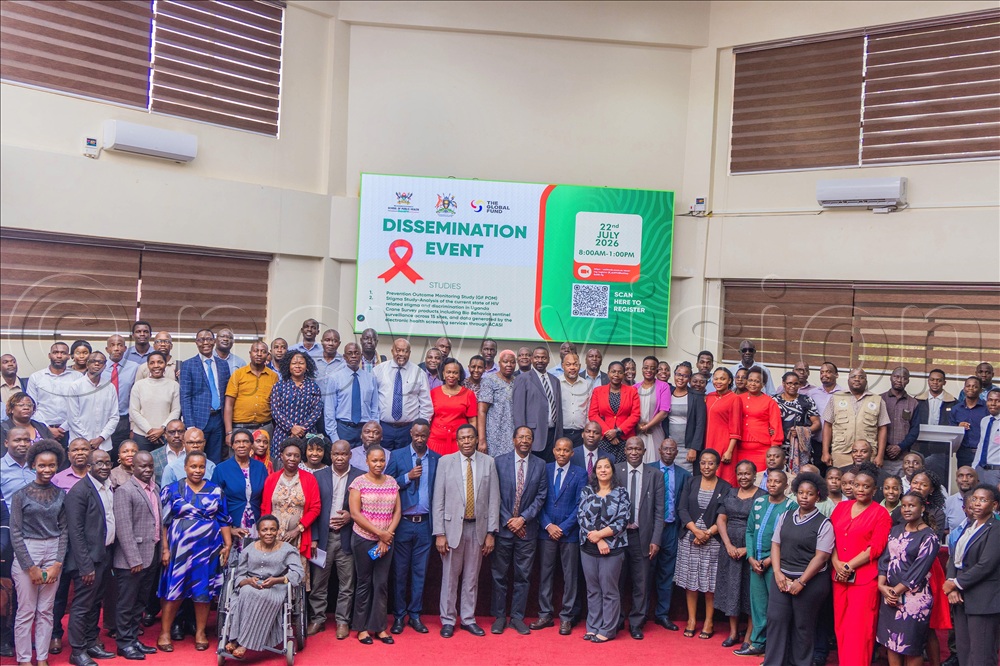
The new data was unveiled during a dissemination workshop that was held on Wednesday, July 22, 2026, at the Makerere University School of Public Health Auditorium in Kampala.
The meeting attracted key stakeholders, including government officials, policymakers, development partners, researchers, and representatives from civil society, to discuss the survey findings and their implications for public health programming and resource allocation.
The principal investigator of the latest study, Dr. Geoffrey Musinguzi, said the persistently high HIV burden reflects continued exposure to multiple HIV risk factors, including multiple sexual partners, inconsistent condom use, high population mobility, transactional sex, structural stigma, violence, limited economic opportunities, and barriers to accessing comprehensive HIV services.
Musinguzi noted that the findings also indicate that HIV transmission remains active within commercial sex networks despite decades of targeted HIV interventions.
The findings in this latest study are way above the national average of 5.8% among the adult population, according to the Uganda Population-Based HIV Impact Assessment (UPHIA) 2020-2021 report. It is also above the 2025 HIV estimates report that put the national HIV average prevalence figure at 4.9%.
The survey enrolled 8,304 female sex workers in 15 districts of; Kampala, Lira, Masaka, Mbale, Mbarara, Tororo, Jinja, Arua, Busia, Buvuma, Fort Portal, Gulu, Hoima, Buliisa, and Mbale.
This is a slight drop from 33% in the Crane 3 HIV Bio-behavioural Survey that was conducted in 2024. The survey was conducted in 12 districts of; Arua, Busia, Buvuma, Fort Portal, Gulu, Jinja, Kampala, Lira, Masaka, Mbale, Mbarara, and Tororo. Under the survey, a total of 7,947 female sex workers aged 18 to 49 as well as sexually exploited minors aged 15 to 17 were interviewed using Audio Computer-Assisted Self-Interviews.
However, the latest survey indicates that the HIV prevalence among female sex workers was highest in Mbarara at 42%, followed by Fort Portal at 41%, Busia at 40%, and Masaka at 38%. Meanwhile, the prevalence was lowest in Buliisa at 21%, followed by Arua with 22%. HIV prevalence refers to the total number or percentage of people living with HIV in a specific population at a given time. It includes both new and long-standing infections.
HPV infections
The same survey also discovered that the prevalence of Human Papillomavirus (HPV) infection among female sex workers stood at 41% for variants 16 and 18, consequently indicating a substantial burden of cervical cancer risk among women engaged in commercial sex.
Active syphilis remains an important public health concern because untreated infection increases HIV acquisition and transmission.
According to the Crane 3 HIV Bio-behavioral survey, the HIV prevalence among People Who Inject Drugs (PWIDS) into their bodies stood at 9.4%. The survey was conducted among 805 PWIDs in five major urban sites in Uganda, including Kampala, Fort Portal, Gulu, Lira, and Mbale, to generate strategic evidence on HIV, viral hepatitis, sexually transmitted infections, injecting practices, access to health services, stigma, and harm reduction needs.
This implies that about 1 in 11 PWIDs were living with HIV, and the figure rose to 17% at ages 35 and higher among women, at 27% compared to men whose prevalence stood at 6%.
The Dean of Makerere School of Public Health, Prof. Rhodah Wanyenze, who gave opening remarks, noted that as researchers move towards integrated service delivery, it is important to pay attention to the needs of young people.
"Is it going to help us do better in terms of delivering services for the young people? Or is it going to be complex?" she wondered.
The Director General of Health Services at the Ministry of Health, Dr. Charles Olaro, said although there is remarkable progress, a lot more needs to be done, specifically among adolescent girls and young women, female sex workers, and people who inject themselves with drugs.
"These risky populations remain a major driver of transmission of HIV, and if not addressed, the country will register a spike in new HIV infections,” Olaro noted.
He said the health ministry is committed to working with stakeholders to translate these findings into local policies and better programmes to improve health outcomes for every Ugandan.