
New sh11b boost targets teenage pregnancy, fistula prevention in Uganda’s poorest regions
The initiative targets vulnerable populations in Acholi, West Nile, Bukedi, Karamoja and Busoga, regions that continue to face deep-rooted gaps in access to reproductive health services.
From left, Deputy Head of Mission Embassy of Iceland Sveinn Gudmarsson; Head of Mission Embassy of Iceland, Hildigunnur Engilbertsdottir; Dr Richard Mugahi from health ministry, Kristine Blokhus, representative UNFPA Uganda, Daniel Alemu, deputy representative UNFPA Uganda in a group photo with 2 women from eastern Uganda that survived fistula on April 16, 2026. (Credit: Sharon Nabasirye)
________________
A new $3m (sh11.1b) funding boost is set to scale up efforts to tackle teenage pregnancy and obstetric fistula in Uganda’s most underserved regions, as donor partners push a decisive shift from treatment to prevention in addressing the country’s persistent reproductive health challenges.
The three-year funding (March 2026–2029) came as the Government of Iceland joined the United Nations Population Fund (UNFPA), alongside Denmark and Sweden, under the Strengthening Adolescents and Youth Empowerment and Rights (SAY Plus+) programme.
The initiative targets vulnerable populations in Acholi, West Nile, Bukedi, Karamoja and Busoga, regions that continue to face deep-rooted gaps in access to reproductive health services.
Signed in Kampala on April 16, the agreement underscores a growing urgency among partners to confront the structural drivers of teenage pregnancy and obstetric fistula, rather than relying solely on treatment after the damage is done.
Fistula, a childbirth injury caused by prolonged, obstructed labour without timely medical care, leaves women incontinent and often socially isolated. While surgical repair has long been the focus of interventions, health officials now say that approach alone is not enough.
“Fistula happens when a health system lacks the capacity to meet the full spectrum of reproductive health needs of women and girls. It is a human rights and gender equality issue,” said Hildigunnur Engilbertsdóttir, Iceland’s Head of Mission in Uganda.
Officials during the signing of the funding agreement in Kampala. (Credit: Sharon Nabasirye)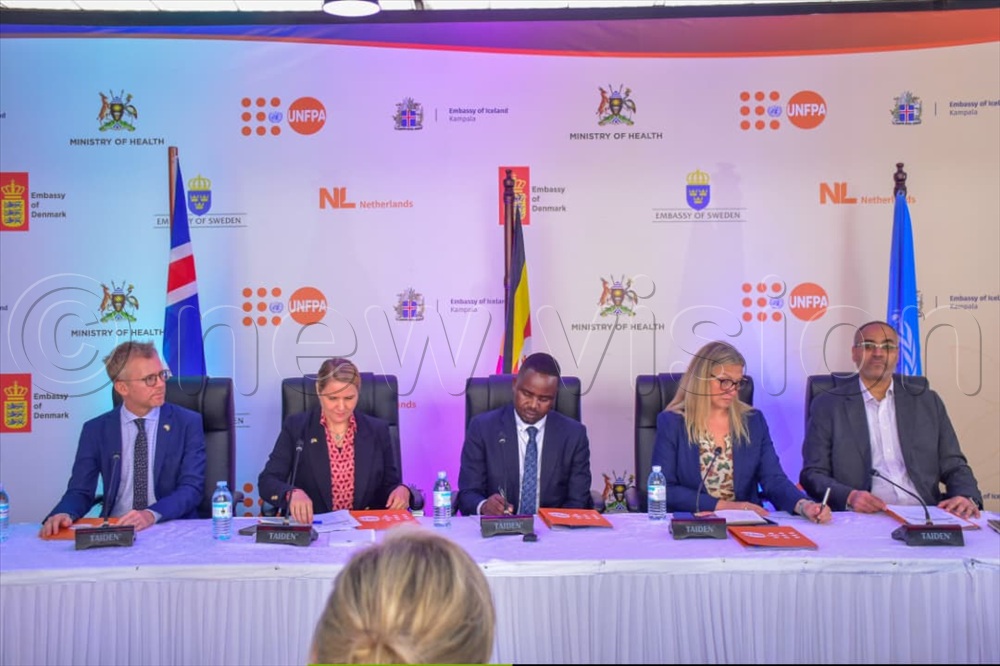
The SAY Plus+ programme seeks to move beyond episodic medical interventions toward a more holistic model that combines prevention, treatment and reintegration, including expanding access to family planning, improving adolescent-friendly health services, and addressing harmful social norms that drive early pregnancies and limit healthcare access.
Kristine Blokhus, the UNFPA Representative in Uganda, highlighted that the initiative is a shift in thinking to preventing fistula and teenage pregnancy before they occur.
“Sometimes we focus too much on surgery, fixing the problem after it has already happened. But prevention means access to contraception, education, and non-judgmental services for young people. That is how we stop these cases from happening in the first place,” Blokhus emphasised.
Uganda has one of the youngest populations in the world, with more than 70% under the age of 30. This demographic reality is placing increasing pressure on the health system to deliver youth-friendly reproductive services at scale.
Dr Richard Mugahi, the Commissioner for Reproductive and Child Health at the Ministry of Health, who witnessed this boost signing, noted that the new funding comes at a critical time.
Mugahi also pointed to recent funding gaps in reproductive health, particularly following shifts in international support, which have forced the country to rely more heavily on multilateral partnerships.
The SAY Plus+ programme operates under a pooled financing model, bringing together multiple donors under one framework, one budget, and a unified results system. This approach is designed to reduce duplication, improve coordination, and strengthen government ownership of programmes.
Daniel Alemu, Deputy Representative of the United Nations Population Fund (UNFPA) in Uganda, said the expanded SAY Plus+ programme reflects a growing commitment to ensure that no woman or girl is left behind in accessing sexual and reproductive health services.
He noted that the initiative builds on earlier efforts to scale a proven model into a broader, multi-partner platform, bringing together governments and development partners under a single framework to expand access to services and improve coordination.
“This programme represents our promise as government, UNFPA and partners to advance and expand universal access to sexual and reproductive health services, ensuring that none of our women and girls is left behind,” Alemu noted.
Alemu said the programme goes beyond geographic expansion, focusing instead on deeper systemic change through integrated health and gender-based violence services, economic empowerment for young people, and targeted efforts to address obstetric fistula and restore dignity for affected women.
In the previous years, the programme has helped women rebuild their lives after surgery, with some starting businesses, others becoming community advocates in Eastern Uganda.
The new funding aims to scale up these efforts, ensuring that survivors are not only treated but reintegrated into society with dignity, according to the multi-donor partnership.