
New mobile lab to cut Uganda’s outbreak diagnosis delays
The mobile laboratory, acquired at US$500,000 (about sh1.8 billion), was handed over to the Ministry of Health by the World Health Organisation (WHO) in the presence of UN partners on August 26, 2026, with funding from the African Development Bank (AfDB).
The mobile laboratory, acquired at US$500,000 (about sh1.8 billion), was handed over to the Ministry of Health by the World Health Organisation. (Courtesy photo)
__________________
Uganda is set to reduce delays in diagnosing deadly infectious diseases after the Ministry of Health received a truck-mounted Biosafety Level 3 (BSL-3) laboratory designed to take advanced testing closer to outbreak hotspots.
The mobile laboratory, acquired at US$500,000 (about sh1.8 billion), was handed over to the Ministry of Health by the World Health Organisation (WHO) in the presence of UN partners on August 26, 2026, with funding from the African Development Bank (AfDB).
Health officials said the laboratory will strengthen Uganda’s ability to detect, investigate and respond to outbreaks by reducing the time needed to transport samples from remote and hard-to-reach areas to specialised laboratories.
The intervention comes after recent outbreak experiences showed that delays in obtaining laboratory confirmation can hamper the speed of public health responses.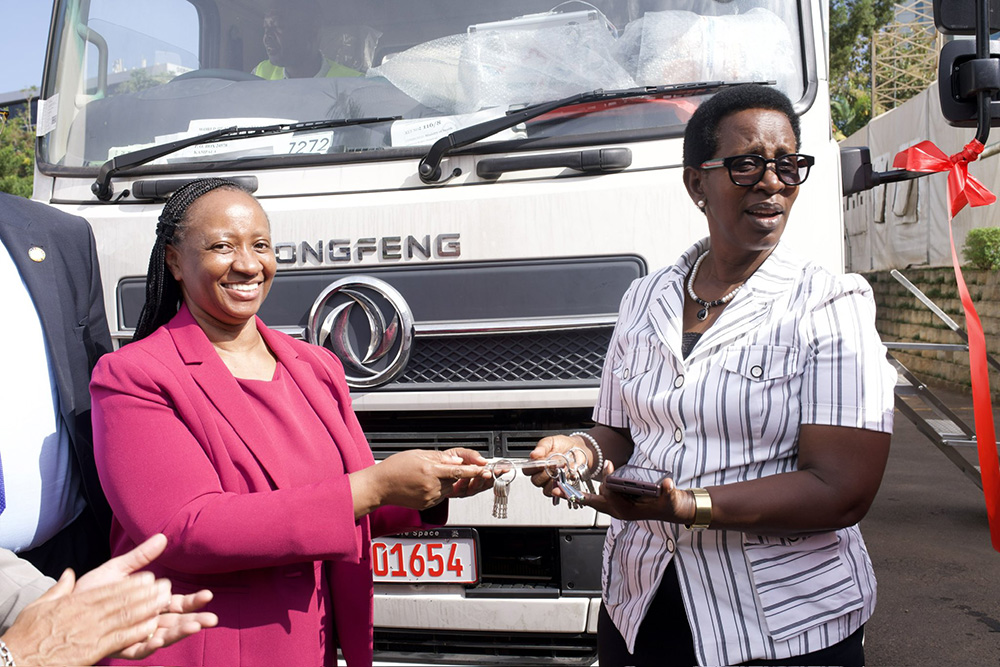
World Health Organisation (WHO) Country Representative hands over the keys of the newly acquired mobile laboratory to the PS, Ministry of Health, Diana Atwine. (Courtesy photo)
WHO Uganda representative Dr Kasonde Mwinga said timely and accurate diagnosis is at the heart of effective disease surveillance and outbreak response because it enables health authorities to identify outbreaks early and guide appropriate interventions.
“The speed with which laboratories can confirm cases often determines the effectiveness of the response,” Mwinga said.
He said the mobile laboratory will allow advanced diagnostic services to be deployed closer to communities, particularly in remote areas where access to specialised laboratory facilities is limited.
The laboratory is equipped to operate under Biosafety Level 3 conditions, enabling trained laboratory personnel to handle infectious agents that pose a serious health risk while maintaining strict containment and safety measures.
The need for faster testing was highlighted by Health Ministry Permanent Secretary Dr Diana Atwine, who said some areas had previously taken up to one week to receive results during the Ebola response.
She said the mobile laboratory would be particularly important in situations where samples have to travel long distances before reaching a facility capable of conducting high-level testing.
“Even now as we set up mobile labs in DRC, this is the only important thing that can quickly help us to get tests, because in some areas, results were taking up to one week to get results,” she said.
Atwine said bringing laboratory capacity closer to an outbreak site would strengthen Uganda’s ability to respond quickly.
“When we get such a resource, and we put it in the epicentre, and we test, that is the strength,” she said.
The laboratory is expected to support testing for Ebola and other infectious diseases, adding another layer to Uganda’s outbreak surveillance and response system.
Atwine said Uganda had learnt from successive outbreaks and that its systems were becoming more flexible and responsive.
“Every time we get these outbreaks, our systems get better and better,” she said.
She described the latest Ebola outbreak as particularly challenging but said the flexibility of Uganda’s response systems helped the country contain it.
The handover comes as Uganda marks 42 consecutive days without a new confirmed Ebola case, a milestone that WHO said marks the end of the country’s latest outbreak.
Mwinga said Uganda had successfully interrupted transmission of Ebola and congratulated the Government and health workers for containing the outbreak.
However, he said the new laboratory would remain important beyond the current Ebola response because Uganda continues to face different infectious disease threats.
“Strong laboratory systems are at the heart of effective disease surveillance and outbreak response,” Mwinga said.
He said the mobile facility would help Uganda sustain gains made in diagnostics and strengthen preparedness for future public health emergencies.
The laboratory is part of a broader investment in Uganda’s health security by development partners.
According to WHO, the AfDB provided US$500,000 specifically for the procurement of the mobile BSL-3 laboratory, as part of a wider US$1 million contribution to Uganda’s health work between June 2023 and August 2025.
Atwine thanked the AfDB, WHO and other development partners for supporting Uganda’s epidemic preparedness, saying the equipment would be put to use to strengthen the country's ability to respond to outbreaks.
“We have now completed the required 42-day countdown without any single case. We ask countries that had travel restrictions to open borders for people because Uganda is safe and has been safe,” Atwine said
The mobile facility is expected to be particularly valuable during outbreaks occurring in remote locations, where transporting samples to central laboratories can create delays in confirming suspected cases.