
New machines to close Uganda’s gap in early HIV testing for exposed babies
The Ministry of Health says the country needs to take HIV early infant diagnosis closer to mothers and babies, particularly at health centre IIIs, where many women receive maternity services.
(L-R): Susan Nabadda, the Executive Director, National Health Laboratory and Diagnostic Services, with Daniel Kyabayinze, the Director of Public Health, Hanifah Kawooya (centre), the Health State Minister for General Duties, Mikel Cleverley, the United States Deputy Ambassador and Hassan Segujja, the Regional Sales Director for East Africa at Abbott, at the handover ceremony of the M-PIMA Machines at National Health Laboratory and Diagnostic Services in Butabika on9th Sept 2026. (Photo by Nicholas Oneal)
________________
Uganda is scaling up point-of-care HIV testing at lower-level health facilities in a move aimed at reducing delays in diagnosing babies exposed to HIV and ensuring those who test positive start treatment as early as possible.
The Ministry of Health says the country needs to take HIV early infant diagnosis closer to mothers and babies, particularly at health centre IIIs, where many women receive maternity services.
The move has received a boost after Abbott, through LifeCare Diagnostics Uganda, donated 100 m-Pima point-of-care molecular diagnostic machines to the Ministry of Health.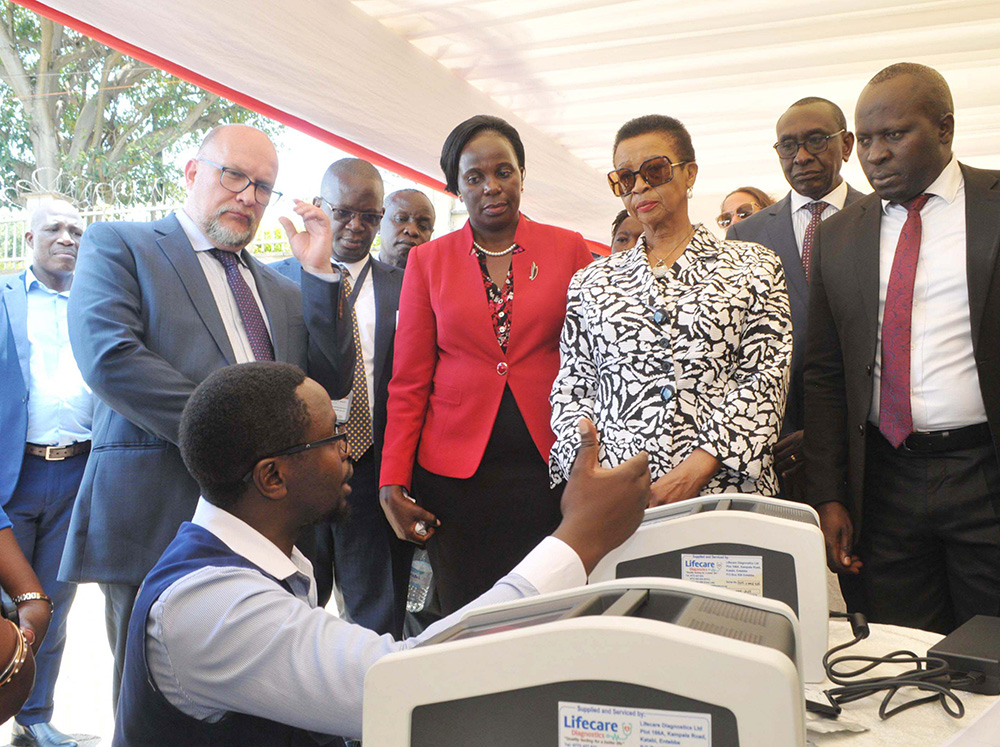
Mikel Cleverley (left), the United States Deputy Ambassador, with Susan Nabadda, the Executive Director, National Health Laboratory and Diagnostic Services and Hanifah Kawooya (Right), the Health State Minister for General Duties, at the handover ceremony of the M-PIMA Machines at the National Health Laboratory and Diagnostic Services in Butabika on9th Sept 2026. (Photo by Nicholas Oneal
The machines will enable health workers to conduct HIV early infant diagnosis (EID) and viral load testing closer to where patients receive care, reducing reliance on transporting samples to central laboratories.
Dr Daniel Kyabayinze, the director of public health at the Ministry of Health, said Uganda has more than 3,000 health centre IIIs but does not yet have enough point-of-care machines to provide early infant diagnosis at these facilities.
“We want to be able to go as close as every subcounty or where there is a health centre III to be able to do early infant diagnosis,” Kyabayinze said.
He said the need is urgent because some mothers still reach delivery without knowing their HIV status, missing an opportunity to prevent transmission of the virus to their babies during pregnancy and childbirth.
“Having and passing HIV to a newborn child is a sign of failure for having failed to detect that the mother was HIV positive,” Kyabayinze said.
He explained that when a mother is diagnosed during pregnancy, health workers can immediately provide interventions to reduce the risk of passing HIV to the baby.
Uganda has made progress in expanding access to HIV testing among exposed infants, with 92% of HIV-exposed babies now receiving their first PCR test within two months of birth.
However, health officials say the remaining gap must be closed if the country is to eliminate mother-to-child transmission of HIV.
Kyabayinze said delays in this process can mean mothers do not return in time to receive results, potentially delaying treatment for babies who have acquired HIV.
“The mothers don't come back in time to receive [the results],” he said.
The m-Pima machines are designed to bring molecular testing closer to the point of care, allowing health workers to obtain results faster and make clinical decisions sooner.
For babies who test positive, early diagnosis is particularly important because treatment can be started before the virus causes severe damage to the child's immune system.
The machines will also support HIV viral load testing, which helps health workers determine whether antiretroviral treatment is working effectively in people living with HIV, including pregnant and breastfeeding women.
Dr Susan Nabadda, the commissioner of national health laboratory and diagnostic services, said Uganda currently has a network of 315 m-Pima instruments supporting decentralised testing.
With the planned expansion, the network is expected to grow substantially.
Abbott regional sales director Hassan Segujja said the company has committed to supporting the deployment of 500 additional m-Pima platforms, which would bring Uganda's total installed network to 815 machines.
He said the investment, once fully deployed, is valued at approximately $10.5 million (about sh39.7 billion) in diagnostic infrastructure.
But officials stressed that the success of the expansion will not be measured by the number of machines installed.
Nabadda said the Ministry must also ensure that health workers are trained, reagents and other supplies are consistently available, facilities have reliable power and infrastructure, and equipment is maintained.
She also pointed to the importance of connectivity, data systems, quality assurance, supervision and sustainable financing.
The machines are expected to be strategically distributed to facilities where they can have the greatest impact, particularly underserved areas.
The Abbott representative said the machines will also be connected through a gateway system to the Ministry of Health's central laboratory information system, allowing data from tests conducted on the platforms to be transmitted to the central system.
This, he said, will enable health authorities to monitor testing and respond to results and trends more quickly.
The expansion comes as Uganda continues to confront persistent HIV transmission, particularly among young people.
Kyabayinze said recent HIV data showed that prevalence among young girls remains a concern, warning that the country must continue increasing HIV prevention and testing among young people.
He said the continued presence of HIV among young people shows that prevention efforts cannot be relaxed simply because treatment has improved.
“Everybody on ARVs is looking okay, and so they think HIV infection and AIDS disease is a myth,” he said, calling for renewed efforts to communicate the risks of HIV infection.
For infant diagnosis, however, officials say the immediate priority is to ensure that no HIV-exposed child is left waiting for a test or treatment because of distance from a laboratory.
Kyabayinze said Uganda's long-term ambition is to have sufficient point-of-care testing capacity to reach Health Centre IIIs across the country.
He said decentralising testing will bring Uganda closer to the goal of eliminating mother-to-child transmission by ensuring exposed babies are tested early, and those who are infected receive treatment promptly.
The United States Embassy also welcomed the expansion, with the Chargé d'Affaires at the US Embassy Uganda, Mikael Cleverley, describing the initiative as an example of how partnerships can translate investment in health technology into services closer to communities.
“For a mother waiting for her infant's HIV test, that means no second visit, just faster answers, faster treatment, and a healthier future,” he said.
He said the United States remains committed to supporting Uganda's laboratory systems, disease surveillance and health information systems while encouraging greater Ugandan leadership and ownership of health programmes.