
National HIV and AIDS Symposium opens with call for sustainable funding
The three-day symposium, organised by the Uganda AIDS Commission in partnership with MUST, is taking place at the university's Pharmacology Grounds from November 16 to 18, 2026.
Jackie Makokha, the UNAIDS country director, addresses the gathering during the opening of the three-day 5th National HIV/AIDS Symposium 2026 at Mbarara University of Science and Technology (MUST) Pharmacology grounds in Booma, Mbarara City, North Division, on Monday, 16 November 2026. (Photo by Fred Turyakira)
________________
The fifth National HIV and AIDS Symposium has opened at Mbarara University of Science and Technology (MUST) in Mbarara city, bringing together stakeholders to discuss strategies for sustaining Uganda's response to the epidemic and achieving the goal of ending AIDS as a public health threat by 2030.
The three-day symposium, organised by the Uganda AIDS Commission in partnership with MUST, is taking place at the university's Pharmacology Grounds from November 16 to 18, 2026.
Held under the theme, “Sustainable Interventions to end AIDS as a public health threat by 2030,” the symposium has brought together researchers, policymakers, cultural and religious leaders, health advocates and other stakeholders from across the country and beyond.
Minister for the Presidency, Milly Babirye Babalanda, is expected to officiate at the closing ceremony on Wednesday (November 16).
Experts call for new strategies to address HIV epidemic
Speaking at the opening of the symposium, Uganda AIDS Commission chairperson Dr Ruth Ssenyonyi called for strategies to mobilise resources to sustain the national HIV response, alongside efforts to eliminate stigma and discrimination.
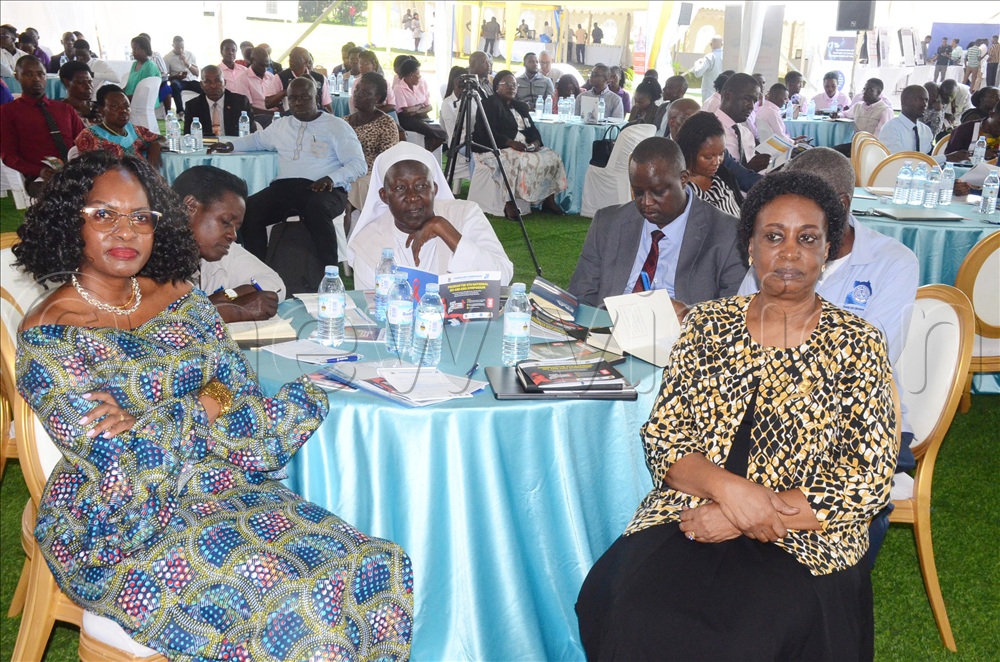
Prof. Pualine Byakika (left), the Vice Chancellor at Mbarara University of Science and Technology, Canon Dr Ruth Ssenyonyi, (right) the Board chairperson Uganda AIDS Commission (UAC) and other UAC board members listening to the speaker during the opening of a- three-day of the 5th National HIV /AIDS symposium 2026 at Mbarara University of Science and Technology (MUST) Pharmacology grounds in Booma, Mbarara City North Division on Monday 16 November, 2026.
She noted that Uganda had made significant progress in reducing HIV prevalence, from more than 18% in the 1990s to about 5.9% currently.
She attributed the progress to strong political commitment, spearheaded by President Yoweri Museveni, and the multi-sectoral approach he encouraged in responding to the epidemic.
According to the 2025 National HIV Estimates, Uganda has an estimated 1.5 million people living with HIV, of whom more than 1.4 million are receiving treatment.
The 2025 Uganda Population-Based HIV Impact Assessment puts national HIV prevalence at 5.9%, with women recording a higher prevalence of 7.3%, compared with 4.1% among men.
Ssenyonyi expressed concern that HIV prevalence in the Ankole sub-region of south-western Uganda stands at 8%, above the national average.
“Am glad that we are in the area where we can talk about it and something needs to be done. We need to fight hard to reduce the new HIV infections in the region and in the country,” Dr Ssenyonyi added.
Experts identify factors driving HIV infections
Ssenyonyi identified multiple sexual partnerships, sexual and gender-based violence, and negative social and cultural norms and values as among the factors contributing to HIV infections in the country.
In her keynote address, MUST Vice-Chancellor Prof. Pauline Byakika-Kibwika commended the Uganda AIDS Commission and its development partners for convening the national platform.
She said the symposium would provide an opportunity to review the country's response, share evidence and confront the decisions that would determine whether Uganda achieves its 2030 target.
Presenting on the role of science and the missing links in attaining Uganda's 2030 goal of ending AIDS as a public health threat, Byakika-Kibwika urged leaders to look beyond short-term gains and build resilient health systems capable of sustaining disease prevention, treatment and health security for future generations.
She called for a robust domestic financing framework to safeguard the health sector, saying funding must be aligned closely with national priorities.
She also emphasised the need to protect funding for essential commodities, disease prevention, laboratory services, community health programmes and health workforce capacity.
Byakika-Kibwika further said Uganda would only achieve its 2030 health targets by placing local communities and human rights at the centre of its response.
Govt increases domestic HIV financing
Speaking at the symposium, Vincent Bagambe, the Uganda AIDS Commission's director of planning and strategic information, said the Government had increased domestic financing for the national HIV response to more than sh400 billion through a supplementary budget allocation.
Bagambe added that the Government had finalised a bilateral memorandum of understanding with the United States Government covering the wider health sector and establishing a framework to safeguard and stabilise long-term resources for the HIV response. He said the agreement would help bridge domestic funding gaps.
He also said the Government had continued to strengthen HIV mainstreaming, through which about sh13.5b was generated last year.
Bagambe said the target was for domestic sources to contribute at least 60% of HIV financing by 2030.
UNAIDS official highlights global progress
UNAIDS country director in Uganda Jackie Makokha highlighted the scientific advances, political leadership, community activism and international solidarity that had transformed HIV from a once-fatal disease into a manageable chronic condition.
Giving a global perspective, she said approximately 41 million people were living with HIV at the end of 2025.
She said new HIV infections had declined to 1.2 million annually, representing a reduction of approximately 52% since 2010. Eastern and Southern Africa had recorded a greater decline of 62% over the same period.
AIDS-related deaths had fallen by 57% globally since 2010, reaching approximately 570,000 in 2025, the lowest level in more than three decades of the HIV response.
Makokha said 32 million people globally were receiving antiretroviral therapy (ART). She added that 88% of people living with HIV knew their status, 89% of those diagnosed were receiving treatment, and 95% of those on treatment had achieved viral suppression.