
Medics push for expanded NICU, modern equipment at Kiryandongo hospital
The hospital, which serves thousands of patients from Kiryandongo and neighbouring districts, including refugees from Kiryandongo Refugee Settlement, currently has a small NICU with limited beds and outdated equipment.
A doctor and nurses attending to one of the babies in the Newborn Intensive Care Unit (NICU) at Kiryandongo general hospital in Kiryandongo district. This was on September 17, 2025. (Photos by Lawrence Mulondo.)
________________
Medics at Kiryandongo General Hospital have raised the alarm over the growing pressure on the hospital’s newborn intensive care unit (NICU), calling for its expansion and modern equipment to save the lives of premature and critically ill babies.
The hospital, which serves thousands of patients from Kiryandongo and neighbouring districts, including refugees from Kiryandongo Refugee Settlement, currently has a small NICU with limited beds and outdated equipment.
Doctors say this leaves many newborns at risk due to overcrowding and inadequate care.
During a visit on September 17, 2025, the youth and children affairs state minister Balaam Barugahara, toured the hospital as part of his Youth Wake Up Call Rally in the district.
It was here that acting district health officer, Dr Irene Nabitaka, also an associate consultant in paediatrics and child health, highlighted the dire state of the NICU.
“The unit has only 11 incubators and two radiant warmers, yet we admit at least 20 babies a week who face breathing difficulties or are born with complications,” Dr Nabitaka said.
She explained that most newborns admitted suffer from congenital abnormalities, heart defects, or infections, and must be closely monitored, fed, and supported with oxygen and antibiotics. But the limited equipment makes it hard to provide timely care.
“All babies sent here need to be on monitors, but the unit has only five small digital monitors, far fewer than the demand,” she said, adding that preterm births are rising due to increasing teenage pregnancies in the area.
Dr Nabitaka further noted that essential medicines such as caffeine citrate and surfactant, critical for premature babies, are not available since the hospital is a general facility and such drugs are reserved for referral hospitals.
Overwhelmed staff, urgent calls for upgrade
“We have no Intensive Care Unit, yet we handle patients from many districts. Most of the time, we are forced to refer them to Hoima, Gulu, or Lira hospitals, and many risk losing their lives on the way,” she said.
She revealed that the hospital is understaffed, with just 70 nurses across about 20 departments, many of whom are on study leave.
“We do not have a physician in medicine, nor a surgeon in the surgery department. Right now, we are relying heavily on medical students from Kampala International University to fill the gaps.”
Hon. Balam Barugahara, Minister of State for Youth and Children Affairs and other officials interacting with the patients in line waiting for the x-ray services at Kiryandongo general hospital. This was during his Youth Wake Up Call tour to Kiryandongo district on September 17, 2025. 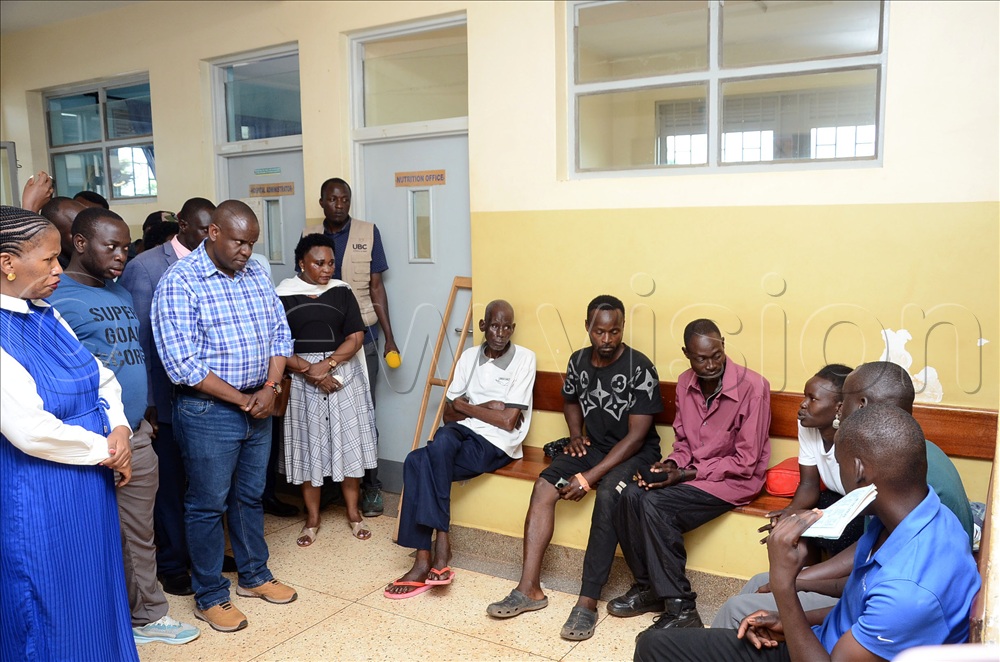
Aying also appealed for the hospital to be upgraded to referral status to ease staffing and funding shortages.
Other departments told similar stories. Ophthalmic clinical officer, Zena Ezatiru, said she is the only one handling both eye and ear, nose and throat cases.
“I have to welcome patients, examine them, test their vision, consult, counsel, and prescribe. This delays services, and patients often complain,” she said.
Her clinic handles an average of 30 patients a month but requires at least five specialised staff to deliver quality care. She added that the eye clinic has no functional equipment, further straining services.
In the antenatal department, Gorreth Mukhaye, the in-charge, said they urgently need tools for cervical cancer screening, family planning, and antenatal and neonatal care.
She also called for fair promotions for health workers.
Infrastructure, power and refugee pressure
Senior hospital administrative officer, Sam Tumwesige, said intermittent power further disrupts services, especially since vital machines depend on electricity.
“When there is no power, we resort to a generator, which is costly and cannot run the X-ray machine,” he explained.
He added that most buildings, constructed in the 1970s, are now dilapidated, yet the hospital continues to serve not only locals but also refugees and internally displaced persons, putting additional pressure on limited facilities.
“The numbers we handle here deserve referral hospital status. We have land to expand, but we need financial support,” he emphasised.
Leaders pledge to push for change
Kiryandongo chief administrative officer Anselm Kyaligonza told the minister that since the hospital was elevated to general status in 2010, there has never been a wage increment.
“We cannot promote staff because promotions come with salary adjustments. We have lobbied the Ministry of Health and hope to see changes in the next financial year,” he said.
Minister Barugahara applauded medical personnel for their dedication despite the challenges, but expressed concern over the poor hygiene at the hospital, especially in the emergency and maternity wards.
“The maternity ward was stinking, and fluids were flowing on the floor in the emergency department. This is unacceptable because instead of healing, patients may contract more diseases,” he said.
While thanking the Ministry of Health for supporting the hospital within limited resources, the minister stressed that health must remain a national priority. “As we chase youth empowerment, we cannot empower people who are not healthy,” he said.