
Measles vaccination gaps expose Ugandan children to risk — ministry
Rita Atugonza, the deputy manager of the Uganda National Expanded Programme on Immunisation (UNEPI), said the continued outbreaks are largely being driven by gaps in routine immunisation, particularly the second dose of the measles-rubella vaccine.
Dr Charles Ayume, the Minister of State for Health in charge of Primary Health Care, speaking during the measles vaccination high-level engagement at Kabira Country Club. (Photo by John Musenze)
______________
Uganda is battling recurring measles outbreaks after 66 districts were declared outbreak areas in 2025, with the health ministry warning that inadequate vaccination coverage is leaving thousands of children vulnerable to the disease.
The outbreaks have prompted the government to plan a nationwide measles-rubella vaccination campaign this year targeting about 7.5 million children between 9-59 months.
The five-day campaign will run from October 1 to 5, across all 156 local governments, with a target of vaccinating at least 95% of eligible children.
Rita Atugonza, the deputy manager of the Uganda National Expanded Programme on Immunisation (UNEPI), said the continued outbreaks are largely being driven by gaps in routine immunisation, particularly the second dose of the measles-rubella vaccine.
“Every week, we get an email from the Uganda Virus Research Institute confirming yet another outbreak and most of the cases are those that have never been vaccinated," she said at a high-level stakeholder engagement on the national measles-rubella vaccination campaign on Wednesday (August 12) at Kabira Country Club in Kampala.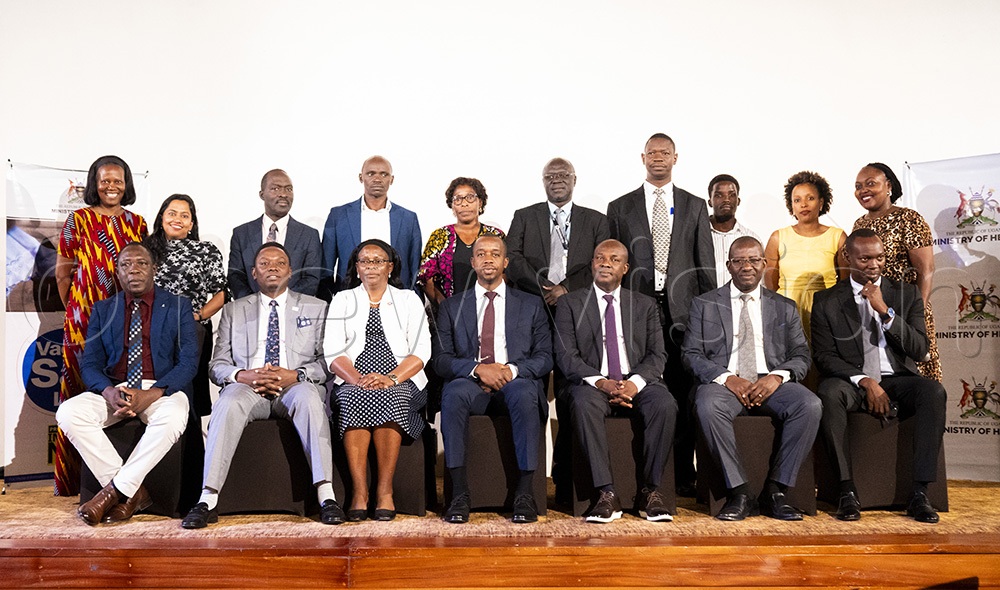
Minister Charles Ayume in the centre takes a group photo with other health stakeholders during the measles vaccination high-level engagement at Kabira Country Club. (Photo by John Musenze)
"In this campaign, whether your child was vaccinated against measles or not, they must be vaccinated again. There is no overdose for this vaccine and the more you get it, the safer your body is."
Atugonza said some districts have experienced repeated outbreaks even after conducting localised vaccination campaigns, demonstrating that Uganda is yet to achieve sufficient population immunity.
The country's first dose of the measles-rubella vaccine, which is administered at nine months, has reached about 95% coverage, but uptake of the second dose given at 18 months remains at only 72%.
“As long as these lines remain below 95%, we expect measles outbreaks to keep occurring in the country because we shall not have sufficient immunity in our children, especially the under-fives who are very vulnerable,” said Atugonza.
The vaccination gap means children who should have been protected remain susceptible to infection despite measles vaccines being available through the routine immunisation system.
Surveillance data shows that most of the children detected with measles had never received a measles vaccine, raising concerns over missed opportunities to vaccinate children.
With that in mind, the national campaign will target every eligible child, including those who may have previously received a measles-rubella vaccine.
October's campaign will not involve door-to-door vaccination. Instead, district health teams will establish fixed vaccination posts based on the location of children and accessibility of services.
The government has set an ambitious target of reaching 105% of the estimated eligible population, with officials saying the target is intended to ensure that children missed in population estimates or routine services are also reached.
Atugonza said the repeated outbreaks are not only a result of vaccine availability but also gaps in demand and access to immunisation services. She said parents often bring children for vaccines when they are younger but gradually stop interacting with the health system as the children grow older.
UNEPI reported that coverage of several vaccines that require children to return for subsequent doses remains below the desired 95% level. The third dose of rotavirus vaccine is at 88%, injectable polio vaccine at 90%, hepatitis B birth dose at 84%, while yellow fever vaccination stands at 67%.
The malaria vaccine, which has recorded strong uptake for the first dose, also experiences a decline as children progress through the four-dose schedule.
Other challenges include weak community surveillance, delayed detection of outbreaks, inadequate mobilisation during outbreak responses and insufficient district ownership of outbreak control activities.
The health ministry also raised concerns about infection prevention in health facilities, where some facilities lack adequate isolation spaces for children with measles.
Beyond administering vaccines, the upcoming campaign will also be used to strengthen Uganda's immunisation and disease surveillance systems.
The campaign will involve the ministries of health, education and sports, gender, labour and social development and local government, alongside district leaders, schools, faith-based organisations, civil society and development partners.
State Minister for Primary Health Care Dr Charles Ayume urged local governments to ensure that children in schools and urban communities are not missed.
He also called on Kampala Capital City Authority (KCCA) and other urban local governments to establish vaccination spaces in places such as markets to reach children whose parents may find it difficult to take them to health facilities.
Urban centres are increasingly becoming an area of concern because children can miss routine immunisation when families have limited time or face difficulties accessing health facilities, officials said.
The campaign is scheduled to be launched in Wakiso district on October 1.
The long-term objective is to eliminate the need for repeated mass vaccination campaigns by strengthening routine immunisation.
“If 95% of our children have received both doses, then we expect that the country will be protected from measles and we shall not have to look for those additional resources which could go elsewhere for campaigns,” said Atugonza.