
Lango leaders decry severe staffing gaps, absenteeism in health facilities
Dokolo and Alebtong districts reported a severe shortage of human resources, with most health centre IIIs having only one laboratory technician, contrary to Ministry of Health staffing norms.
Lira Hospital Director Dr Andrew Odur addressing the leaders at the Lango Regional Health Assembly in Lira City on Wednesday. (Photo by Joseph Ekol)
__________________
Stakeholders in Lango have raised concern over critical staffing gaps in lower-level health centres, which are significantly affecting health service delivery in the region.
The concern was raised during the third Lango Regional Health Assembly, convened by Lira Regional Referral Hospital at Gracious Palace Hotel in Lira city. The two-day assembly attracted leaders, including RDCs, DHOs, LC5 chairpersons, health centre IVs and hospital in-charges from nine districts and Lira city.
Dokolo and Alebtong districts reported a severe shortage of human resources, with most health centre IIIs having only one laboratory technician, contrary to Ministry of Health staffing norms.
The leaders suggested the need for accelerated recruitment, which they said would be achieved by requesting the Ministry of Health to approve the wage budget.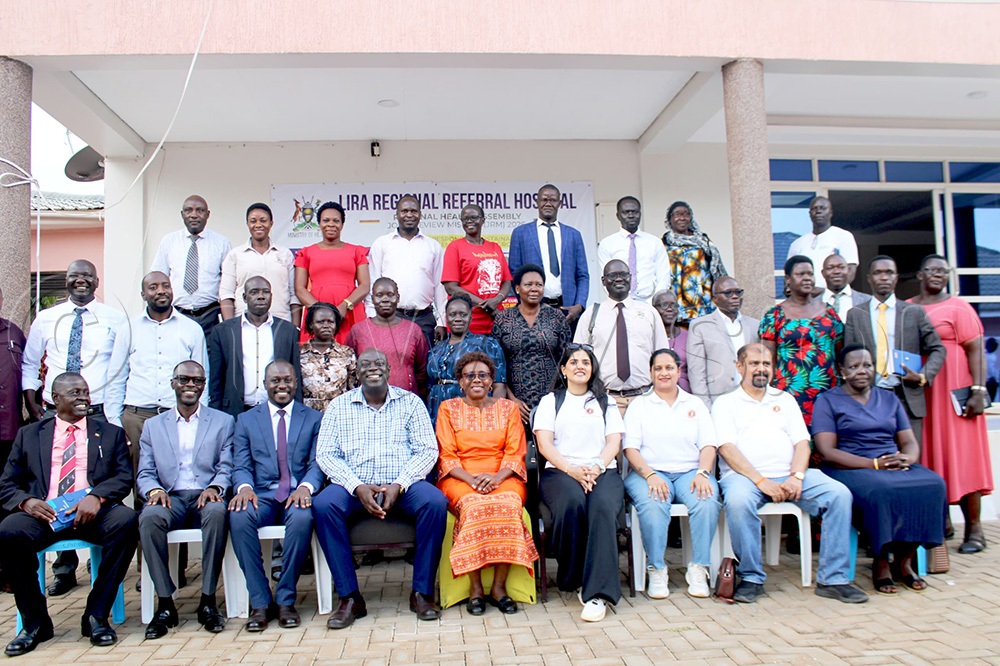
Dr Jane Aceng, the Government Chief Whip (C), poses for a photo with Ambrose Agec, the Chairperson of the Lango LCV and Mayor's Association (3rd L), Lira Hospital Director Dr Odur, other leaders and partners at the Regional Health Assembly in Lira. (Photo by Joseph Ekol)
Staff absenteeism, misconduct and extortion also featured prominently in the two-day discussions. The assembly suggested strict disciplinary and administrative action against culprits, as well as enforcement of attendance tracking and monitoring.
He said that, as one way of improving staff availability at Lira Hospital, they had started paying staff according to the number of times they report to work, based on records tracked by the system, and that the workers had all accepted the arrangement.
Dr Odur also informed the leaders that the Permanent Secretary of the Ministry of Health had asked them, as regional health coordinators, to file a response to a report implicating facilities in the region in the theft of Government drugs.
“We have been tasked by the permanent secretary to respond to why drugs are stolen, and she is expecting the report to be taken back to the President,” Dr Odur noted, encouraging the in-charges and other stakeholders to file their responses within two weeks so he can submit them to the permanent secretary for further submission to the President.
Dr Jane Aceng, the Government Chief Whip, while officiating at the closing of the assembly, said health needs, population and disease burdens are growing, while resources are dwindling, requiring teamwork to address the challenges.
“Resources are dwindling; donors all have challenges, and they are also trying to mobilise resources. Government cannot have enough resources for a rapidly growing population at a rate of 3 percent annually. The entire World Health Organisation system was disorganised, and yet we must survive, thrive and ensure our statistics improve and we are healthier, and this can be achieved through teamwork; we must work together,” Dr Aceng explained.
She said it is every leader's responsibility to ensure that the population is healthy, adding that “if each and every one of us puts effort into what we are doing, within the limited resources, we can make progress, and we must do it”.
Dr Aceng said no one else would perform wonders to improve healthcare services in Lango and that not even the Government could do everything, but this required Lango leaders to ‘lobby strategically’ for resources.
However, with support from partners, she said the ministry had made headway in addressing the public health situation by starting a programme for community health extension workers (CHEWs), who are also facing challenges with remuneration.
She urged the leaders to encourage the CHEWs to serve with their hearts because if they sit back, their relatives will be the ones to suffer the disease burden.
Dr Aceng said the facilities currently have specialists to carry out the work, but the problem is recruitment, which requires lobbying for resources. According to her, the people in the region opposed the sitting Government for a long time and therefore remained underdeveloped.
“We are serving a population with the highest population than Acholi, Teso, West Nile and its true, we are the most underserved. Gulu sub-region has seven hospitals, and they still want more; West Nile has more hospitals than Lango, and they still want more. So, you are going to ask, But Jane Aceng, you were a minister; why didn’t you add hospitals? When did you start voting wisely?”
About inadequate drug supplies, which were emphasised by the leaders, Dr Aceng said the Government would never have adequate medicine for everyone because the population is too large. She said this required people to embark on disease prevention, which would relieve a large portion of expenditure that could then go towards providing medicine for non-communicable diseases, which remain the biggest burden in the country.
Other challenges raised by the leaders at the regional assembly held September 9, 2026, included inadequate infrastructure, non-functional operating theatres and cold-chain facilities in public facilities, among others.
Ambrose Agec, the chairperson of the Lango LC5 and Mayors' Forum, who also doubles as the Apac district chairperson, pledged commitment to follow up on the resolutions of the assembly and ensure continued lobbying for the people of Lango to improve service delivery in the region.