
Korea govt earmarks sh719b towards Uganda's cancer fight
Kim explained that the project will run for five years under phase two, following a two-year pilot phase that ran from 2023 to 2025.
The country director of KOFIH, Dohoon Kim, addressing participants during the cancer project meeting at Golden Tulip in Kampala on Thursday, Feb. 26, 2026. (Photo by Francis Emorut)
_______________
The Government of South Korea has earmarked $20 million (approx. sh719b) towards cancer prevention and treatment in Uganda.
The revelation was made by the country director of the Korean Foundation for International Healthcare, KOFIH, Dohoon Kim, during the first Project Management Committee meeting for the National Cancer Management and Capacity Building Project in Uganda, held at the Golden Tulip Hotel in Kampala on February 26, 2026.
Kim explained that the project will run for five years under phase two, following a two-year pilot phase that ran from 2023 to 2025.
"We are submitting a proposal in the amount of $20 million for five years to KOFIH headquarters in April this year," Kim told cancer experts, Ministry of Health officials and Uganda Cancer Institute officials.
He added that the proposed phase two funding is a result of the impact registered during the two-year pilot project.
Kim informed the meeting that the project was initially designed to strengthen Uganda's national cancer management system in alignment with Uganda's National Development Plan III. The project focuses on strengthening governance, improving cervical cancer prevention and treatment systems, modernising infrastructure, and enhancing the capacity of health professionals.
He said the initiative will be incorporated into National Development Plan IV.
To qualify for the funding, Kim appealed to stakeholders at the Ministry of Health and the Uganda Cancer Institute to demonstrate strong performance under the pilot phase through solid and accountable reporting mechanisms, as well as effective implementation, in order to attract the attention of decision-makers at KOFIH headquarters.
Kim emphasised that cancer control cannot be achieved through equipment alone or short-term interventions.
"It requires policy leadership, system design, trained professionals, community engagement, and continuous monitoring. KOFIH remains fully committed to cooperating on this journey together with mutual respect, shared ownership, and accountability," he said.
He commended the Ministry of Health, the Uganda Cancer Institute, frontline health workers in Kampala and Mbarara, the National Cancer Centre of Korea, and other partners who have contributed to the progress of the project.
"Let us use this PMC meeting as a strategic platform to review achievements, address challenges honestly, and agree on clear priorities for the coming year," stated.
Kim further informed participants that South Korean technology using Artificial Intelligence-assisted cervical cancer screening devices has been introduced for adoption in Uganda to provide digitalised and more accurate screening services for women.
He said that in April 2025, the organisation conducted joint monitoring with the Ministry of Health Non-Communicable Diseases department and the Uganda Cancer Institute, reinforcing shared accountability. From July to August, an international gynaecologic oncology expert from the United States National Cancer Institute provided on-site technical assistance. The mission supported the cervical cancer validation study, strengthened clinical training, and provided policy consultation to the Uganda Cancer Institute and the Non-Communicable Diseases department.
He added that KOFIH successfully organised a high-level invitation programme to the Republic of Korea, hosting eight senior officials, including the Ministry of Health Permanent Secretary Dr Diana Atwine and the Executive Director of the Uganda Cancer Institute, Dr Jackson Orem.
He noted that during the visit, a memorandum of understanding was signed between KOFIH, the National Cancer Centre of Korea, the Ministry of Health and the Uganda Cancer Institute, aimed at institutionalising and strengthening the partnership.
Dr Orem welcomed the proposed phase two funding, saying it will go a long way in cancer prevention and management.
"This will improve access to cancer services countrywide," Dr Orem said.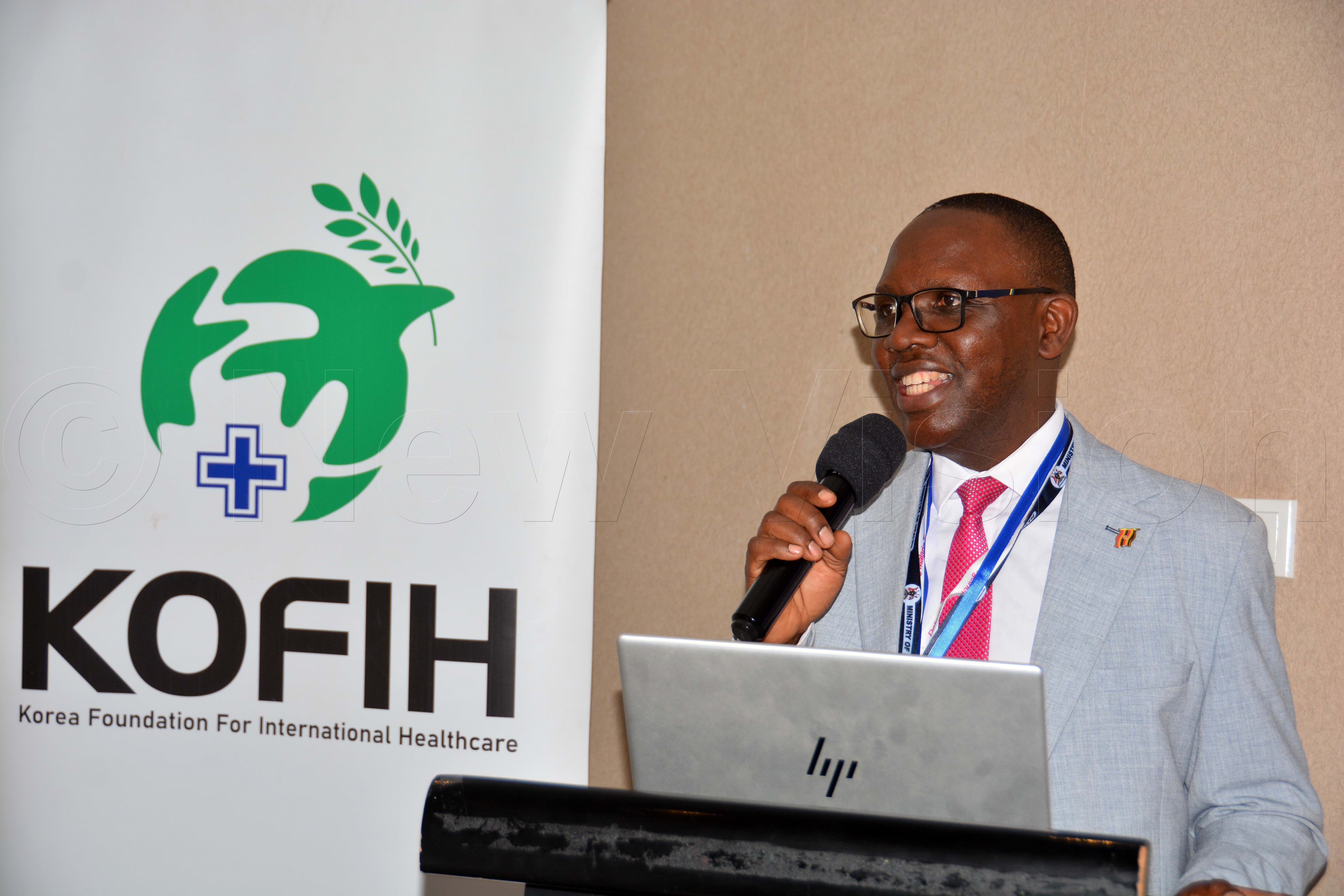
The director of public health, Dr Daniel Kyabayinze, addressing participants during the cancer project meeting at Golden Tulip in Kampala on Thursday, Feb. 26, 2026. (Photo by Francis Emorut)
The director of public health, Dr Daniel Kyabayinze, commended KOFIH for providing AI equipment that will scale up screening and early detection.
He appealed to parents to take their children aged 9 to 12 years for the Human Papillomavirus (HPV) vaccination.
He warned parents, especially those who resist HPV vaccination in schools, that early detection of cervical cancer is key and that the disease is treatable.
Cancer statistics in Uganda
Recent cancer reports indicate that in 2020, Uganda recorded 34,008 new cancer cases and 22,992 deaths. Cervical cancer remains the most common cancer, followed by Kaposi sarcoma, breast cancer, prostate cancer and non-Hodgkin's lymphoma.
Incidence rates are rising, with projections suggesting over 70,000 new cases annually by 2035, driven by infection-related factors and lifestyle changes.