
Kabale receives 170,000 mosquito nets as district intensifies malaria fight
The mosquito nets were officially received at the district headquarters on July 21, 2026, after being delivered by the National Medical Stores (NMS) under the Ministry of Health's nationwide Long-Lasting Insecticidal Nets (LLINs) Mass Distribution Campaign.
Kabale District Health Officer Dr Gilbert Mateeka and Deputy Resident District Commissioner Michael Muramira Kyakashari, alongside other district officials, receive the delegation. (Courtesy)
________________
Kabale district has received 170,000 long-lasting insecticide-treated mosquito nets that will be distributed to households across 79 parishes in Kabale municipality and the district as part of the government's intensified efforts to eliminate malaria and reduce preventable deaths.
The mosquito nets were officially received at the district headquarters on July 21, 2026, after being delivered by the National Medical Stores (NMS) under the Ministry of Health's nationwide Long-Lasting Insecticidal Nets (LLINs) Mass Distribution Campaign.
The consignment forms part of the Ministry of Health's nationwide exercise to distribute 25.8 million mosquito nets across 130 districts. According to the World Health Organisation (WHO), one insecticide-treated mosquito net is recommended for every two people to ensure adequate household protection against malaria.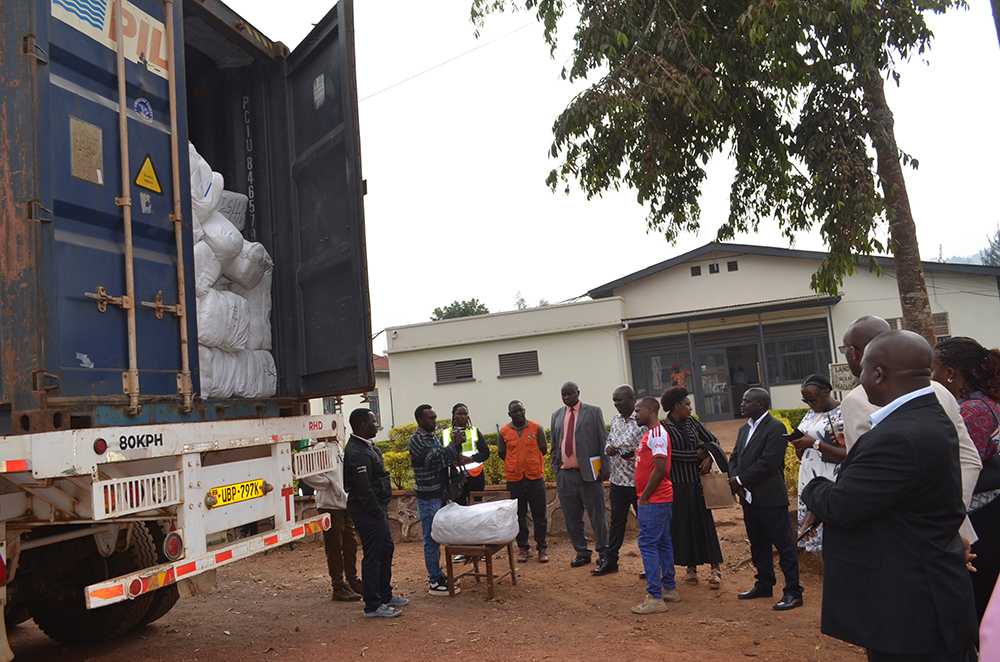
Mosquito nets are delivered to the Kabale District Health Offices. (Courtesy)
Leading the National Medical Stores team during the handover, Raymond Kawalya said the institution had begun delivering 3,404 bales of MedNet mosquito nets to all 79 parishes in Kabale ahead of the official household distribution exercise scheduled for August.
Kawalya explained that each parish will temporarily store the mosquito nets under the custody of the respective parish chief until the Ministry of Health officially launches household distribution.
He said every handover will be witnessed by the respective LC1 or LC2 chairperson, together with village health team (VHT) members, to ensure transparency, accountability, and proper documentation throughout the exercise.
"Our responsibility is to ensure every parish receives its full allocation before the official distribution begins. We shall remain in Kabale until every bale has been delivered to the designated parish stores," Kawalya said.
He appealed to local leaders to safeguard the mosquito nets and ensure they reach the intended beneficiaries without diversion.
Distribution plans begin
Speaking during the launch, Rukia Nakamatte, the communication specialist at the National Malaria Elimination Division, called upon district leaders to intensify community mobilisation and sensitisation ahead of the mass distribution campaign.
Nakamatte explained that the Ministry of Health is implementing the nationwide campaign in five phases, with Kabale among the 38 districts included in the fourth phase.
She noted that although the mosquito nets are already being delivered to districts, the actual household distribution will commence simultaneously across all fourth-phase districts in August.
She added that the nationwide campaign will conclude in September with the distribution of mosquito nets in Kampala and Wakiso districts.
Campaign enters next phase
Nakamatte announced that district leaders will participate in a regional coordination meeting in the first week of August, during which Ministry of Health officials will brief them on implementation guidelines, budgets, logistics, and the specific roles of stakeholders.
She urged the resident district commissioner (RDC) to establish a district coordination committee that will supervise the entire exercise and ensure effective collaboration among health workers, local leaders and security agencies.
Nakamatte also called upon village health teams (VHTs), LC1 chairpersons, religious leaders and community mobilisers to educate residents on the importance of sleeping under mosquito nets every night.
She expressed concern that in some districts where mosquito nets have already been distributed, some beneficiaries have misused them by covering poultry houses, fencing gardens, drying crops and fishing instead of protecting their families against malaria.
"We are not only distributing mosquito nets but also promoting behaviour change. Every household must understand that these mosquito nets are meant to save lives by preventing malaria," Nakamatte said.
She revealed that the Kigezi sub-region is among the first regions where Uganda will begin implementing its malaria elimination strategy, a key milestone towards achieving a malaria-free Uganda by 2035.
Nakamatte stressed that the success of the campaign will depend not only on the number of mosquito nets distributed but also on whether households consistently use them correctly.
The Kabale district health educator and HIV focal person, Alfred Besigensi, described the distribution exercise as a major milestone in strengthening malaria prevention within the district.
Although Kabale has historically recorded lower malaria prevalence than many other districts, Besigensi said the disease remains a significant public health concern, with sporadic infections still being reported.
He reminded residents that malaria remains one of Uganda's leading causes of illness and death despite being preventable.
Besigensi urged every household to sleep under insecticide-treated mosquito nets every night and appealed to parents to ensure children and pregnant women are prioritised.
Besigensi further appealed to security agencies, local leaders and the RDC's office to discourage misuse and illegal sale of mosquito nets.
He said households that do not intend to use the mosquito nets should allow them to be redistributed to families that genuinely need them.
Kabale district principal assistant secretary, Gordon Manzi, warned against the illegal sale and smuggling of government-issued mosquito nets to neighbouring countries.
Manzi noted that previous campaigns had registered cases where mosquito nets were diverted for commercial purposes instead of benefiting vulnerable households.
He urged Gombolola Internal Security Officers (GISOs), parish security officers (PSOs) and other security agencies to work closely with local leaders to prevent theft and diversion of the mosquito nets.
Manzi also tasked the district health department with conducting regular monitoring and post-distribution follow-up visits to ensure that beneficiaries are using the mosquito nets correctly.
He further emphasised the importance of comprehensive household registration and mapping to ensure that every eligible household receives the recommended number of mosquito nets.
Kabale district vice chairperson Prima Hellen Kemanzi urged residents, particularly pregnant women and caregivers of young children, to consistently sleep under mosquito nets as one of the most effective ways of preventing malaria.
She warned residents against using the mosquito nets for fishing, fencing gardens, protecting poultry houses or any other unintended purposes, saying such practices undermine government efforts to eliminate malaria.
Launching the distribution exercise, Kabale deputy resident district commissioner Michael Muramira Kyakashari said the arrival of the mosquito nets demonstrates the government's commitment to protecting communities from preventable diseases.
Kyakashari acknowledged that although Kabale has traditionally experienced relatively low malaria transmission compared to many parts of Uganda, changing weather patterns and increased movement of people have contributed to isolated malaria outbreaks in recent years.
He described the intervention as timely and urged residents to embrace the programme by ensuring every household sleeps under the insecticide-treated mosquito nets.
Kyakashari also warned traders against buying or smuggling government-issued mosquito nets for resale across Uganda's borders, saying security agencies would take firm action against anyone found diverting the free government supplies.
He directed local government officials, security personnel, village committees and health workers to closely supervise the distribution exercise to ensure that every mosquito net reaches its intended beneficiary.
The Ministry of Health hopes that the nationwide mosquito net distribution campaign will significantly reduce malaria infections, lower malaria-related deaths and accelerate Uganda's journey towards eliminating malaria as a public health threat by 2035.