
Joint Clinical Research Centre commends US support for Uganda’s health systems
“One of the things in discussion was how to sustain the JCRC beyond the funding that has been received from the US government," said Dr. Kityo.
The US embassy team also toured an exhibition telling a story of JCRC since its inception, including achievements of the first PEPFAR grant they received in 2003. (Credit: Simon Peter Tumwine)
KAMPALA - The US Chargé d’Affaires to Uganda, Mikael Cleverley, has visited the Joint Clinical Research Centre (JCRC) in Lubowa, Kampala, to assess the progress following the partnership with the US government.
Cleverley's team during the visit on Monday included: the deputy country director of the US Center for Disease Control and Prevention (CDC), Susan Theroux, plus the senior health project management specialist of the Department of State, Jackie Calnan.
The US Embassy Uganda officials were welcomed by the JCRC’s executive director, Dr. Cissy Kityo Mutuluuza, the deputy executive director of finance and operations, Dr. Drolla Nabukenya Ssebagala, and the JCRC's board chairperson, Prof. Charles Ibingira, among others.
During the visit, Dr. Kityo and her visitors discussed future partnerships under US government funding and PEPFAR.
“One of the things in discussion was how to sustain the JCRC beyond the funding that has been received from the US government," said Dr. Kityo.
She added that as part of that support and partnership, JCRC has been able to develop into an international centre of excellence.
Cleverley applauded JCRC over the 30 years of outstanding partnership. “It is not just partnership but rather productive work, and we are proud to be part of it,” he noted.
During the visit, Dr. Kityo and her visitors discussed future partnerships under US government funding and PEPFAR. (Credit: Simon Peter Tumwine)
Areas toured
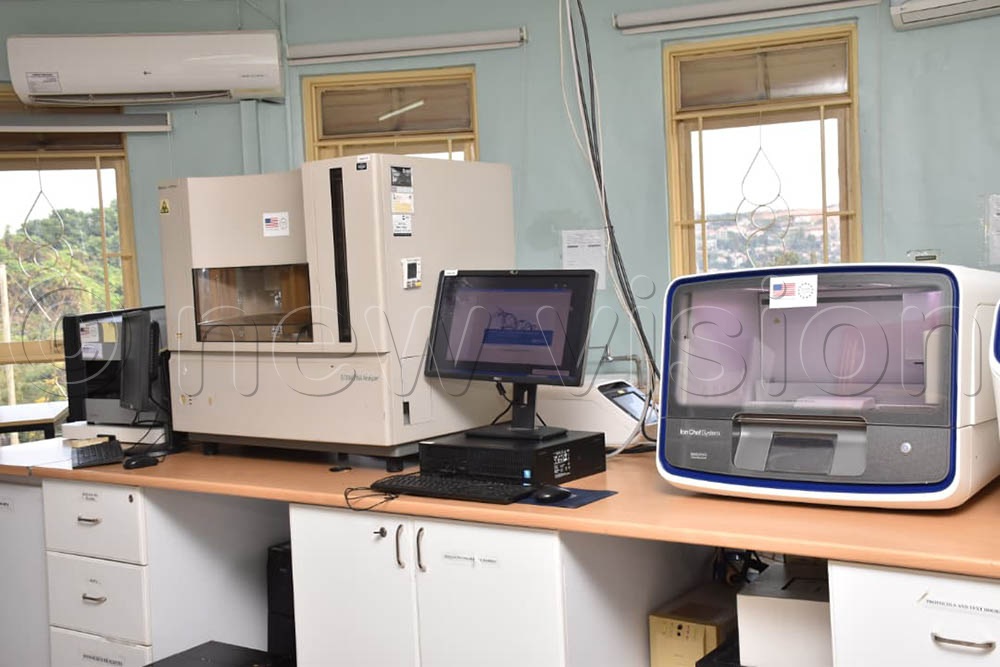
While in Lubowa, Cleverley's team inspected various facilities, including the new building to house the gene therapy building, the bone marrow transplant unit, plus the radiology unit, whose equipment includes Uganda's only "irradiator," used in bone marrow transplants.
The US embassy team also toured an exhibition telling a story of JCRC since its inception, including achievements of the first PEPFAR grant they received in 2003.
The exhibition also highlighted how JCRC has expanded while working with the Ministry of Health.
After the tour, Cleverley planted a symbolic tree, emphasising the strong partnership.
JCRC has been receiving US government support since 2003 under PEPFAR.
For more than 30 years, JCRC has led HIV/AIDS research, prevention, care, and treatment in Uganda and across sub-Saharan Africa, pioneering antiretroviral therapy in the region in 1992.
The development generated evidence that helped shape global treatment guidelines and inform the design of the U.S. President’s Emergency Plan for AIDS Relief (PEPFAR).
In 2003, JCRC became the first recipient of a seven-year PEPFAR grant to expand access to lifesaving treatment in Uganda.
Three decades of U.S. and JCRC partnership, at a glance:
• 105 laboratories accredited to international standards nationwide—65 supported directly by JCRC.
• A national quality-assurance dashboard linking more than 1,000 health facilities.
• HIV, TB, and maternal health services delivered across 439 facilities in 35 districts and three cities.
• Rapid outbreak response from Mpox to Crimean-Congo hemorrhagic fever.