
Information gap hampers Uganda’s menstrual hygiene progress
Statistics indicate that 66% of adolescent girls in Uganda lack prior knowledge about menstruation, and up to 84% of adolescent girls in rural areas practice unsafe menstrual hygiene management (MHM) due to the unavailability of menstrual products.
Kedrace Turyagyenda, the Permanent Secretary Ministry of Education and Sports speaks at the celebrations to mark the Menstrual hygiene day at the UNICEF offices on 28th May 2026. (Photo by Nicholas Oneal)
_______________
Limited efforts of knowledge dissemination have stifled menstrual hygiene management (MHM) efforts in Uganda, leading to increased stereotypes that pose several challenges to girls.
Statistics indicate that 66% of adolescent girls in Uganda lack prior knowledge about menstruation, and up to 84% of adolescent girls in rural areas practice unsafe menstrual hygiene management (MHM) due to the unavailability of menstrual products.
Additionally, 23% of adolescent girls drop out of school when menstruation begins.
On average, school-going girls miss four to five days every month due to menstruation, causing a huge academic deficit in the long run.
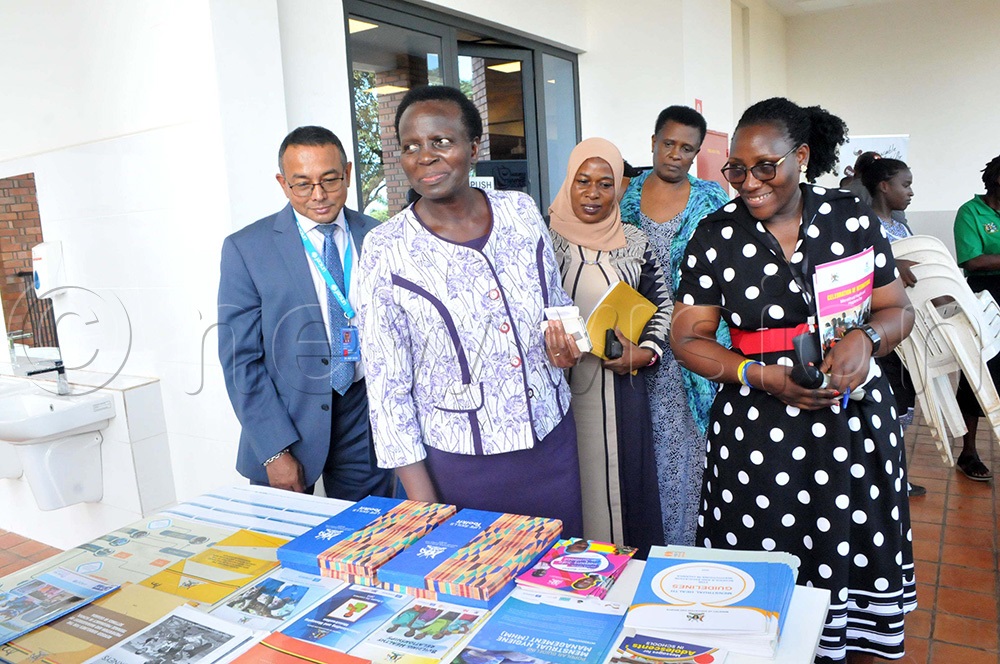
(L-R) Robin Nandy, the UNICEF Representative with Kedrace Turyagyenda, the Permanent Secretary Ministry of Education and Sports, Safina mutumba, the Principal Education Officer Ministry of Education and Angela Nansubuga, the Gender Mainstreaming Unit at the Ministry of Education touring stalls. (Photo by Nicholas Oneal)
The event, which attracted government officials, civil society organisations and development partners, was themed: 'Together for a Period Friendly World'.
Dr Kedrace Turyagenda, the permanent secretary of the Ministry of Education and Sports, pointed out the four focus areas to address MHM challenges amongst school girls.
“The child’s development of the body has all these aspects of being clean, neat, managing life and oneself during such times. So, every teacher, apart from the senior woman teacher, should be concerned that the child develops properly in the body,” she said.
Turyagenda spoke of the need to revive the setting up of small spaces where girls can go and change, with the presence of a first aid kit also being crucial, so that girls feel safe and comfortable while at school.
Angella Nansubuga, who works under the Gender and Mainstreaming Unit at the education ministry, said the ministry has a menstrual hygiene and strategic plan which gives key guidelines to schools on how to go about the issue.
“Some of the issues we have addressed is that the wash facilities have to be gender-inclusive, taking on the needs of all learners, including disposable facilities,” she said.
The Global MHM goals include eliminating school and economic absenteeism, embedding menstrual health directly in the national curricula and development plans, as well as securing tailored assistance for refugees and displaced populations.