
Govt urges stakeholders to integrate health services into unified system
According to the director of health services at the Ministry of Health, Dr Charles Olaro, the integration process is already underway, beginning with primary healthcare under a single management framework.
Director Health Services Ministry of Health (MOH), Dr Charles Olaro, addressing during the Uganda Protestant Medical Bureau. (Photo by Wilfred Sanya)
_____________
The government has urged stakeholders to integrate health services into a unified system in order to strengthen the delivery of effective healthcare.
According to the director of health services at the Ministry of Health, Dr Charles Olaro, the integration process is already underway, beginning with primary healthcare under a single management framework.
Dr Olaro made the remarks during the annual symposium of the Uganda Protestant Medical Bureau and its stakeholders, held under the theme “Integrated systems for sustainable universal health coverage” in Kampala on Thursday.
He explained that the ministry expects immunisation and disease management services to be handled under one coordinated system, noting that this approach is effective across all categories of care.
Dr Olaro urged stakeholders to reflect on the new journey towards integration as a strategic approach, while also identifying barriers and challenges that may hinder its implementation.
“The ministry is committed to building a resilient, efficient and people-centred health system for all. Decentralisation and Sector Wide Approach (SWAp) services should be under one national vision, a strong foundation to improve on what used to be donor-driven programs”, he said.
He emphasised the need for unity and collaboration in addressing integration challenges, adding that stakeholders must reinforce their commitment to building a resilient and comprehensive healthcare system.
“We appeal to you to continuously engage and leverage the strength of the National Policy on Private Partnership in Health with the Ministry of Health to support implementation of the National framework”, he said.
Dr Olaro acknowledged that government is aware of the challenges faced by private not-for-profit (PNFP) facilities in advocating for health equity, influencing policy and accessing resources. He noted that PNFPs continue to face funding constraints, particularly in priority programmes such as HIV and tuberculosis.
He said the presence of PNFPs has helped to extend essential healthcare services to underserved communities, complementing government efforts.
He added that in areas where PNFPs operate, healthcare workforce capacity has been strengthened, skills enhanced, and the quality of care improved. He noted that collaboration between government and stakeholders in resource mobilisation could yield positive results.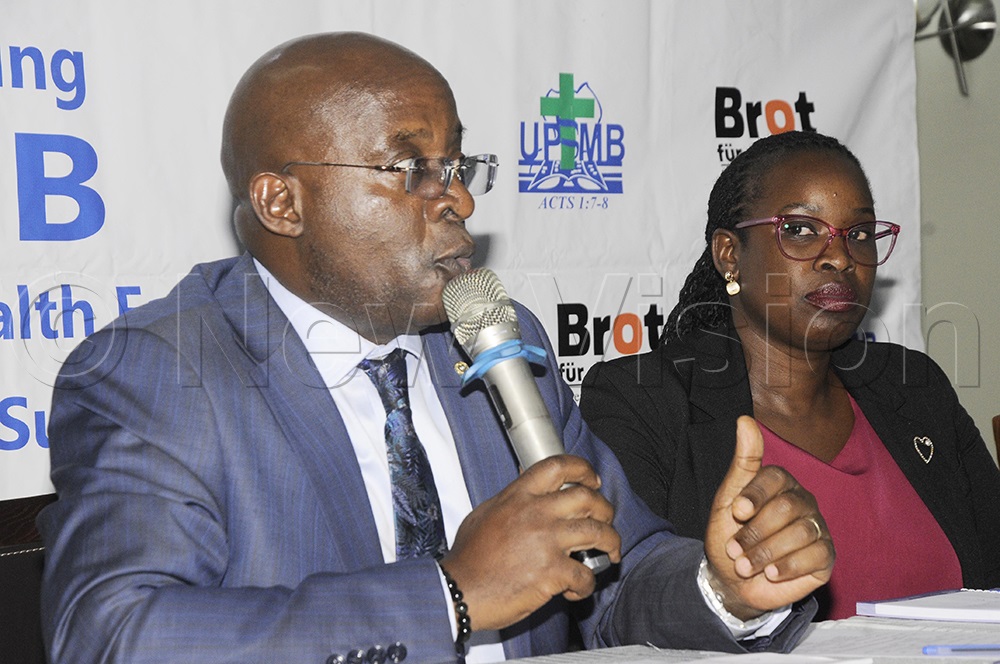
Executive Director Joint Medical Stores (JMS) Buldard Baguma (left) and Dr Charlottee Ongom, Executive Director Bwindi Community Hospital, during the Medical Bureau symposium in Kampala. (Photo by Wilfred Sanya)
The executive director of Joint Medical Stores, Buldard Baguma, said PNFPs stand to reduce financial losses arising from expired drugs through the adoption of improved supply chain systems.
“With the new innovation, we anticipate not having expired drugs on our shelves, and we shall expect to have required drugs in a timely manner, Baguma said.
Baguma noted that Joint Medical Stores supplies certain medicines at a lower cost than other suppliers, adding that partnerships would increase bargaining power with suppliers.
He said this would also create an opportunity to engage the government on policies that hinder effective health service delivery.
He reminded stakeholders of their responsibility to ensure no one is left behind, emphasising that universal health coverage must reach children aged zero to 59 months in both urban and rural communities.
“We should make use of the vulnerable populations to address the financial ability amidst financial pressures that affect the health sector. We need to increase the volumes of the drugs into the country through collaboration that can only be possible in resource sharing”, he said.
Baguma revealed that Ngora Hospital had previously struggled in performance, but has since become one of the best hospitals in the country following intervention, with practices that should be adopted by other health facilities.
He said Joint Medical Stores has developed a new strategy expected to guide operations over the next 50 years, built around five pillars, including customer centricity, to ensure health providers receive the right supplies in the required quantity and quality.
He added that the strategy prioritises partnerships and advocacy, while cautioning stakeholders to maintain proper records, particularly during drug distribution.
The board chairperson of the Uganda Protestant Medical Bureau, Rhobert Korutaro, said building integrity is not the responsibility of a single entity, profession or sector.
Korutaro noted that UPMB was established in 1957 by a small group of individuals operating nine hospitals at the time and has since expanded to cover 330 health facilities. However, she expressed concern that preventable deaths from malaria persist due to misdiagnosis.
He said, “Looking at today’s theme integration, what will the future be like? For our children and grandchildren, think about it”.
He added that the symposium theme encourages stakeholders to explore improved approaches to data collection, clinical services, supply chains, data platforms, human resources and community-level structures.