
Govt says to use cultural, religious leaders to prevent blood disorder-linked diseases
“We need to screen pre-marital couples through religious leaders and cultural institutions,” Muhanga emphasised.
Primary health care state minister Margaret Muhanga speaking during the closure of the three-day continental workshop at Speke Resort Munyonyo in Kampala city on May 13, 2026. (Courtesy photos)
________________
In a bid to prevent and limit the effects of sickle cell disease and other inherited blood disorders, the Government is going to work closely with both religious and cultural leaders to ensure that all couples are screened before they are legally married, Primary health care state minister Margaret Muhanga has said.
Muhanga pledged on May 13, 2026, at Speke Resort Munyonyo in Kampala city during the closure of the three-day continental workshop to validate and launch the Africa CDC Continental Plan for Sickle Cell Disease and other inherited blood disorders. The continental conference was organised by Baylor College of Medicine in partnership with the health ministry and the Africa CDC.
“We need to screen pre-marital couples through religious leaders and cultural institutions,” she emphasised.
Adding that: “If we speak to all those communities, we shall be able to lower the burden of sickle cell disease.”
The three-day continental event focused on the validation and launch of the Africa Centre for Disease Control (CDC) continental plan aimed at a co-ordinated, equity-driven, and sustainable response in Africa.
Health ministry permanent secretary Dr Diana Atwine said in a social media post that it is time sickle cell disease receives the attention it deserves. While diseases like HIV attracted major global support and investment, many families affected by sickle cell disease have continued to suffer silently despite the enormous emotional, social and economic burden. In Uganda, Sickle cell disease remains one of the major contributors to under-5 mortality.
"Any parent understands the pain of seeing a child sick, but families living with sickle cell disease endure this pain repeatedly and for a lifetime. This is why we must strengthen community awareness, screening and prevention efforts. We commit to ensuring Hydroxyurea is accessible in public health facilities through the essential medicines list, while also strengthening premarital counselling, newborn screening and public education to help reduce the burden of sickle cell disease," she said.
During the event, Atwine pledged that, as the government, “we commit to talk about premarital counselling and testing.”
Dr Atwine lauded the continental plan, saying it is technically sound and ready for implementation. She also encouraged the medical diplomats to tour Uganda and enjoy the scenic sights and sounds of the Pearl of Africa.
A united response to sickle disease
The convention attracted over 100 delegates and country representatives from over 50 member states from Africa, including Tunisia, Tanzania, Democratic Republic of Congo (DRC), Kenya, Gambia and Ghana.
Other countries, including Liberia, Nigeria, South Africa and Uganda, as well as global bodies like the World Health Organisation (WHO) and Africa Centres for Disease Control and Prevention (Africa CDC).
Muhanga, who oversees primary healthcare initiatives, including maternal health, sanitation, and community health worker services, also urged all the continental stakeholders and emphasised the urgency of addressing this public health condition.
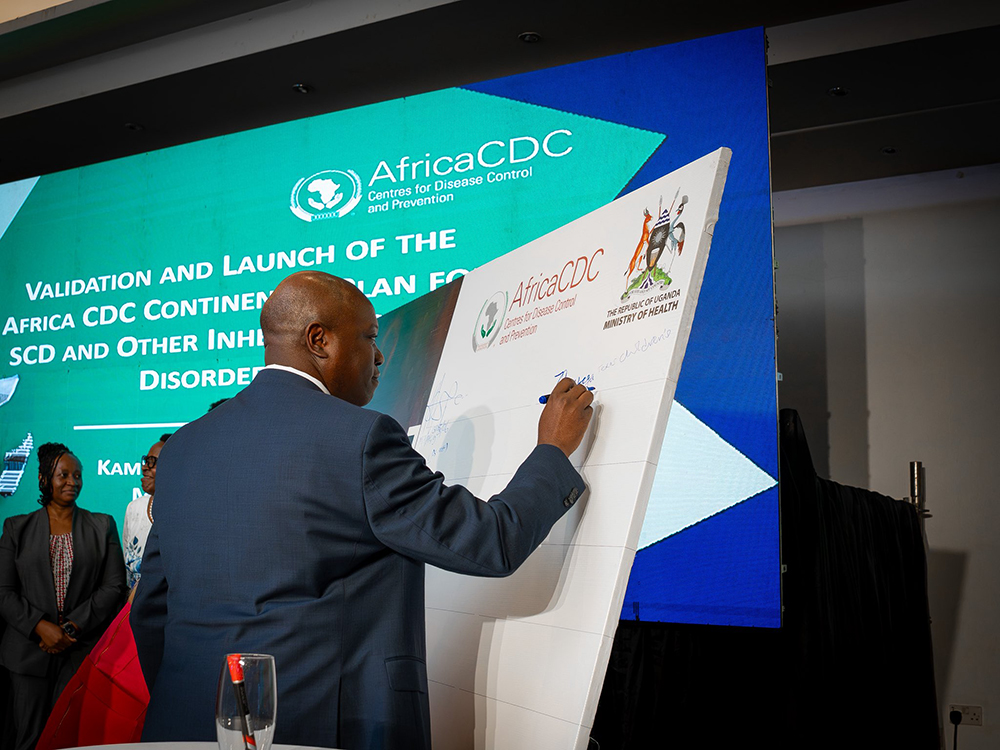
She appended her signature to the dummy board representing the collectively agreed-upon document on behalf of the Government of Uganda.
The Ugandan minister, who was the chief guest at the closing ceremony, was also joined by several other international delegates who also signed as a symbol of solidarity, which was an expression of their commitment.
Other notable speakers of the day included Dr Mohammed Abdulaziz, the Head of NCD, Injuries, and Mental Health Division, Africa CDC.
Health services director general Prof. Charles Olaro was among the high-profile guests, as well as Dr Hafisa Kasule, who represented the World Health Organisation (WHO).
Other public health specialists who attended were Dr Aishat Bukola Usman from the Western Africa Health Organisation (WAHO) and Dr Jane Ruth Aceng Ocero, who had been invited as the chief guest but had attended on Monday.
Dr Joseph Lubega, the director at Texas Children’s Global HOPE Program in the USA, acknowledged Baylor College and noted that this is a global movement that will definitely create the required impact.
Another US-based speaker, Catherine Grimes, President BMSF, USA and her colleague Dr Cristian Massacesi, the executive vice president and chief medical officer at BMS, USA, as well as Prof Johnny Mahlangu, Council Member NNHF, were part of the cast of presenters at the global conference.
Prof Kaushik Ramiaya, Chair of the Africa CDC Advisory Committee, also attended the event.