
Govt launches nationwide measles-rubella vaccination drive targeting 7.5 million children
The five-day exercise was launched at Wakiso Health Centre IV in Wakiso District on Thursday, with the Ministry of Health targeting at least 95% coverage to close existing vaccination gaps and prevent further outbreaks.
Diana Atwine (right), Permanent Secretary at the Ministry of Health, immunises one-year-old Ivy Amutuhire with the measles-rubella vaccine as her mother, Ritah Atukunda, looks on during the national measles-rubella immunisation campaign at Wakiso Health Centre IV on October 1, 2026. Photo by Mary Kansiime
The government has launched a nationwide measles-rubella vaccination campaign targeting 7.5 million children aged between nine months and five years, amid concerns over declining immunisation coverage and recurring disease outbreaks.
The five-day exercise was launched at Wakiso Health Centre IV in Wakiso District on Thursday, with the Ministry of Health targeting at least 95% coverage to close existing vaccination gaps and prevent further outbreaks.
Health minister Dr Chris Baryomunsi, who presided over the launch, said Wakiso was selected because of concerns that many children in the district had missed their second dose of the measles-rubella vaccine.
He said although many parents take their children for the first dose, fewer return for the second, leaving them vulnerable to infection.
“A big number of children in Uganda get the first dose, but those that receive the second are about 64%,” Baryomunsi said.
He attributed the recurring outbreaks partly to parents who abandon immunisation after the first dose, warning that children remain at risk when vaccination is incomplete.
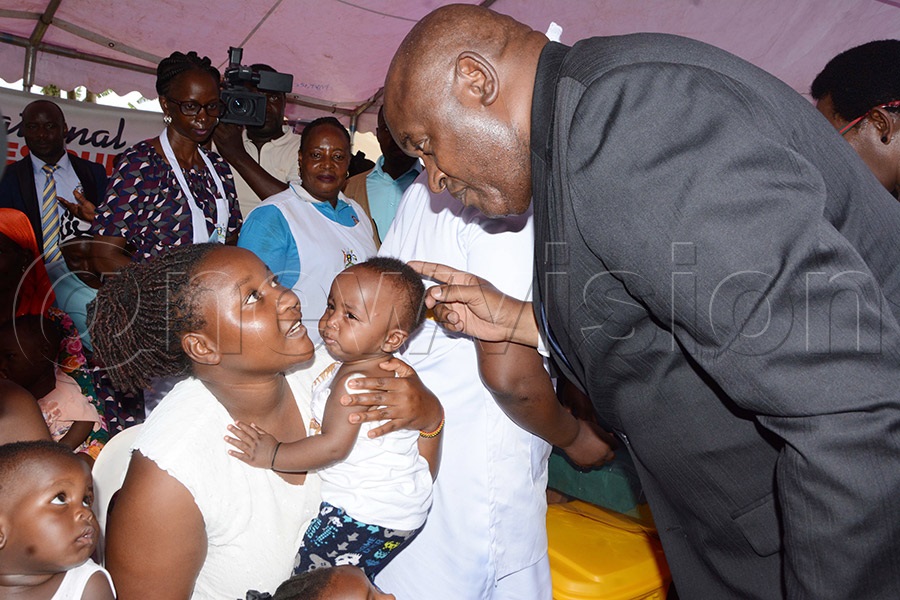
Diana Atwine (right), Permanent Secretary at the Ministry of Health, immunises one-year-old Ivy Amutuhire with the measles-rubella vaccine as her mother, Ritah Atukunda, looks on during the national measles-rubella immunisation campaign at Wakiso Health Centre IV on October 1, 2026. Photo by Mary Kansiime
Last year, according to the Ministry of Health, 66 districts recorded measles outbreaks, prompting the government to organise the nationwide campaign to reach children who may have missed routine immunisation.
“To disrupt that outbreak, we are launching this mass vaccination for all children in Uganda from nine months to five years,” he said.
However, Baryomunsi emphasised that the campaign does not replace routine immunisation, urging parents to continue taking their children for scheduled vaccinations after the five-day exercise.
He dismissed rumours that vaccines harm children, insisting that they have been tested and are safe.
“Bring all children for immunisation. Do not listen to anyone who might mislead you,” he said.
The minister also warned religious groups and individuals opposed to vaccination against discouraging parents from participating, saying those found deliberately obstructing the national exercise could face arrest.
“Once caught in the act, you will face arrest for distracting the national exercise,” he warned.
According to the final UBOS 2024 Census figures, Wakiso had 3,411,177 people, making it Uganda’s most populous district, compared with 1,797,722 in Kampala.
The ministry’s permanent secretary, Dr Diana Atwine, raised concerns about resistance from some schools, particularly private institutions, which she said sometimes hesitate to allow vaccination teams to immunise learners.
She urged all schools, both public and private, to cooperate with health workers, warning that denying children access to vaccination undermines the country’s efforts to protect the population.
Dr. Atwine described immunisation as an investment in human capital, saying healthy children are better positioned to learn, grow and contribute to national development.
She also called on parents to improve children’s nutrition and household hygiene, saying vaccination should go hand in hand with proper care.
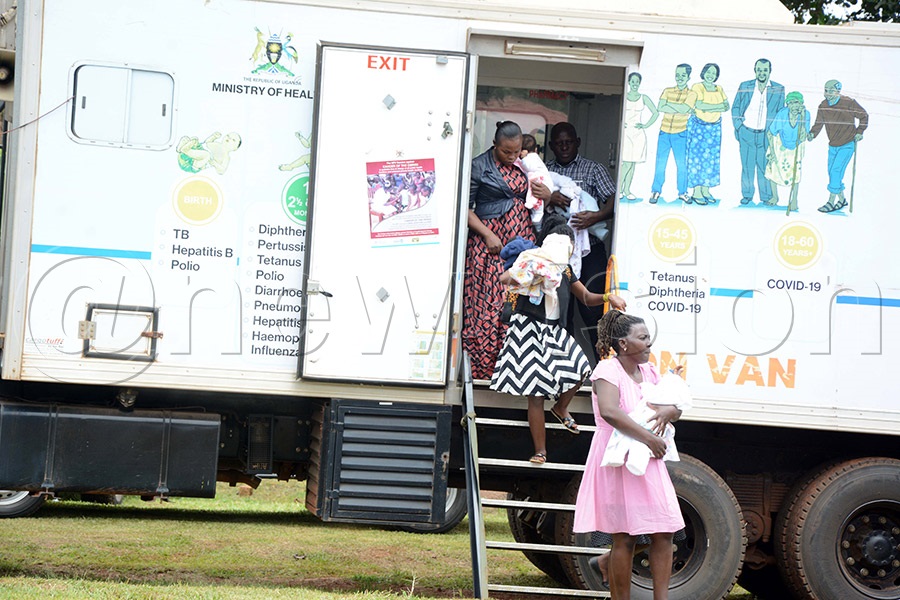
Mothers leave the immunisation van after getting their children immunised during the national measles-rubella immunisation campaign at Wakiso Health Centre IV on October 1, 2026. Photo by Mary Kansiime
Dr. Charles Olaro, the ministry’s director general of health services, said vaccination teams had been deployed across the country to ensure that no eligible child was left out.
He urged parents and guardians to present their children for vaccination without waiting for signs of illness.
In Fort Portal City, Omukama Edward Rukidi Nyabongo I of Tooro Kingdom launched the campaign at Karuziika Palace, urging parents to embrace the exercise. He also called on the media to intensify public awareness.
Declining coverage
The campaign comes against the backdrop of declining immunisation coverage, particularly for the second dose.
Rita Atugonza, head of the Vaccines and Immunisation Division at the Ministry of Health, said surveillance recorded 589 confirmed measles cases in 2025, with 70% affecting children below five years.
Of the 429 patients whose vaccination status was assessed, 64% had never received a measles-rubella vaccine, 33% had received one dose, while only 3% had completed both doses.
Michael Baganizi, the ministry’s deputy commissioner for immunisation, said 18 districts had recorded outbreaks since January 2026, compared with 66 districts in 2025.
Atugonza said 128 districts had not recorded outbreaks in 2026, compared with 80 in 2025, adding that only about two districts still had active outbreaks when officials reviewed the situation.
Funding pressure
However, the campaign is unfolding amid growing concerns about the sustainability of Uganda’s immunisation programme as international funding declines.
Jimmy Ameny, the ministry’s Gavi coordinator, said Gavi, the Vaccine Alliance, had allocated $5.6 million (Shs21.8 billion) to support the exercise, while the Government would contribute through financing, health workers, health facilities and outreach services.
He said the Government’s financial contribution was about 7% of the Shs21.8 billion support package.
Ameny warned that reduced international funding would increasingly require Uganda to finance vaccines previously supported by development partners.
Of the 14 antigens in Uganda’s immunisation programme, the Government fully funds six traditional vaccines, while Gavi has mainly supported eight newer vaccines through co-financing arrangements.
He added that the Government would progressively have to assume responsibility for immunising refugees, an activity previously supported by Gavi.
Despite the financial pressure, Ameny said the Government and its partners were adjusting campaign plans and integrating vaccination with other health interventions to ensure that eligible children are reached.