
Experts push for stronger investment in hepatitis diagnosis and care
Kabagambe said: “Today, the Government allocates sh10 bn annually to address hepatitis B, yet the estimated funding needed ranges between sh38b and sh57b. Today’s allocation covers 19% to 29% of the required funding. This is a drop in the ocean, especially considering that hepatitis does not have external partners providing financial support.”
Kenneth Kabagambe, National Organisation for People Living with Hepatitis ED addressing stakeholders during the 2nd National Annual Communicable and Non-Communicable Diseases and 20th Joint annual scientific health conference 2026 held at Speke Resort Munyonyo on October 29, 2026. (Photo by Juliet Kasirye)
______________
Health experts have expressed concern over stagnant funding for hepatitis, saying it is crippling service delivery amid rising cases.
Since 2015, funding for hepatitis has remained stagnant despite an increase in positive cases, even as government interventions to strengthen prevention and linkage to care continue.
In addition to funding constraints, doctors are grappling with stockouts of hepatitis commodities, gaps in post-partum follow-up and low uptake of the hepatitis B birth dose.
Although the government provides domestic funding for the procurement of medicines and vaccines, the Ministry of Health focal person for hepatitis, Doreen Ruth Akuno, said the allocation was inadequate given the rising number of cases countrywide.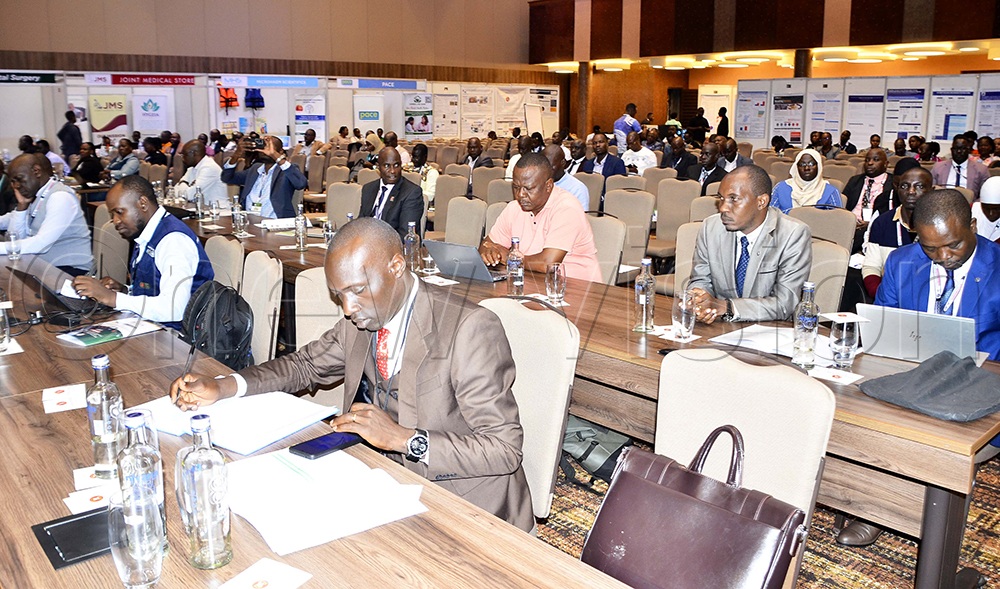
Stakeholders during the 2nd National Annual Communicable and Non-Communicable Diseases and 20th Joint annual scientific health conference 2026 at Speke Resort Munyonyo on October 29, 2026. (Photo by Juliet Kasirye)
Akuno called on the government to engage development partners to scale up financing for hepatitis. She also recommended that everyone who tests positive should be screened and initiated on treatment to suppress the viral load.
“We call for increased financing to procure medicines and other kits that support management of hepatitis patients, especially patients suffering from hepatitis B and C, which are very infectious. Since hepatitis C is curable, we should not accept someone to die of a disease which is curable,” explained Akuno.
The health ministry has also called on stakeholders to raise awareness about hepatitis B and C so that the public understands the situation in the country. Akuno said this would help address traditional beliefs and misconceptions that infected people are bewitched.
She raised the concern during the second National Annual Communicable and Non-Communicable Diseases and 20th Joint Annual Scientific Health Conference 2026, held at Speke Resort Munyonyo.
The three-day conference, which began on October 28 and ended on October 30, 2026, was held under the theme, Unified Action Against Communicable and Non-Communicable Diseases.
Organised by the Ministry of Health, Makerere University College of Health Sciences and the Uganda National Association of Community and Occupational Health, the conference brought together policymakers, researchers, health professionals, communities and partners to advance an integrated response to Uganda’s health priorities.
These priorities include making integrated, people-centred care a routine standard of service delivery by strengthening primary healthcare to provide coordinated services for prevention, screening, diagnosis, treatment, rehabilitation and referral.
Health experts also called for stronger systems to support integration by aligning diagnostic services, referral pathways, medicines and commodity supplies, health information systems and clinical workflows. They also called for research and innovation to be linked to policy and practice, with findings translated into clear recommendations for programme managers and policymakers.
According to the National Viral Hepatitis Prevention and Control Strategic Plan 2023-2028, an estimated 2.4 million adults and 230,000 children were living with chronic hepatitis B in 2019.
The Uganda Population-based HIV Impact Assessment survey (UPHIA) of 2016 found that the national prevalence of hepatitis B virus (HBV) was 4.1%, comprising 5.4% among men and 3% among women. The prevalence among children was 0.6%.
The executive director of the National Organisation for People Living with Hepatitis B, Kenneth Kabagambe, said that although Uganda had implemented several strategies to prevent the transmission of hepatitis B and C, including early childhood vaccination, many people continued to live with the diseases and die because of inadequate funding.
To illustrate the challenges faced by people living with hepatitis B, Kabagambe narrated the story of Joseph, a 28-year-old university graduate who had planned to travel to Arab countries in search of employment.
According to Kabagambe, Joseph had felt healthy before the test and had not experienced any symptoms. However, receiving the positive results marked a turning point in his life, leaving him frustrated and uncertain about his future.
Desperate to travel and secure employment, Joseph turned to someone he had encountered online who claimed to have a cure for hepatitis B. Seeking a quick solution, he sought treatment from the herbalist.
After taking herbal remedies for nearly two months without improvement, he began developing liver complications. By the time he sought medical attention at a hospital, his condition had deteriorated, leaving doctors with no option other than palliative care.
Kabagambe said Joseph’s story represented the plight of many Ugandans living with hepatitis B. He added that, of every 10 Ugandans who test positive, only one receives care.
Kabagambe said: “Today, the Government allocates sh10 bn annually to address hepatitis B, yet the estimated funding needed ranges between sh38b and sh57b. Today’s allocation covers 19% to 29% of the required funding. This is a drop in the ocean, especially considering that hepatitis does not have external partners providing financial support.”
Addressing stakeholders, health ministry permanent secretary Dr Diana Atwine described hepatitis B and hepatitis C as silent killers, noting that everyone is potentially at risk of hepatitis B infection.
According to Atwine, scientific evidence shows that health workers can prevent hepatitis through vaccination, adding that early initiation of therapy prevents complications.
To reduce the hepatitis burden in the country, Atwine urged stakeholders to embrace regular check-ups.
“All of us need to get into a culture of regular check-ups. I don't know how many in this meeting know their Hepatitis B and Hepatitis C status. The current statistics indicate that the trend is changing, and Hepatitis is now claiming more lives in our country than even HIV. Therefore, we cannot be complacent about prevention, diagnosis, and treatment.” Atwine concluded.