
Ebola: Yumbe authorities heighten surveillance
Among the measures put in place by the committee are increased security checks along the border of the district with neighbouring South Sudan, holding community sensitisation and awareness campaigns through radio talk shows and messages, road drives and using clerics in places of worship.
Yumbe district chairman Abdulmutalib Mahamoud Asiku lauded the committee for immediate response and the proactive steps taken. (Credit: Adam Gule)
__________________
Yumbe district local government, through its Epidemic Task Force Committee, has intensified surveillance to help curb the spread of the deadly Ebola disease in the district.
Among the measures put in place by the committee are increased security checks along the border of the district with neighbouring South Sudan, holding community sensitisation and awareness campaigns through radio talk shows and messages, road drives and using clerics in places of worship.
The district has also put in place standard operating procedures, especially at public places such as business terminals, markets, health centres, restaurants, hotels, schools and places of worship.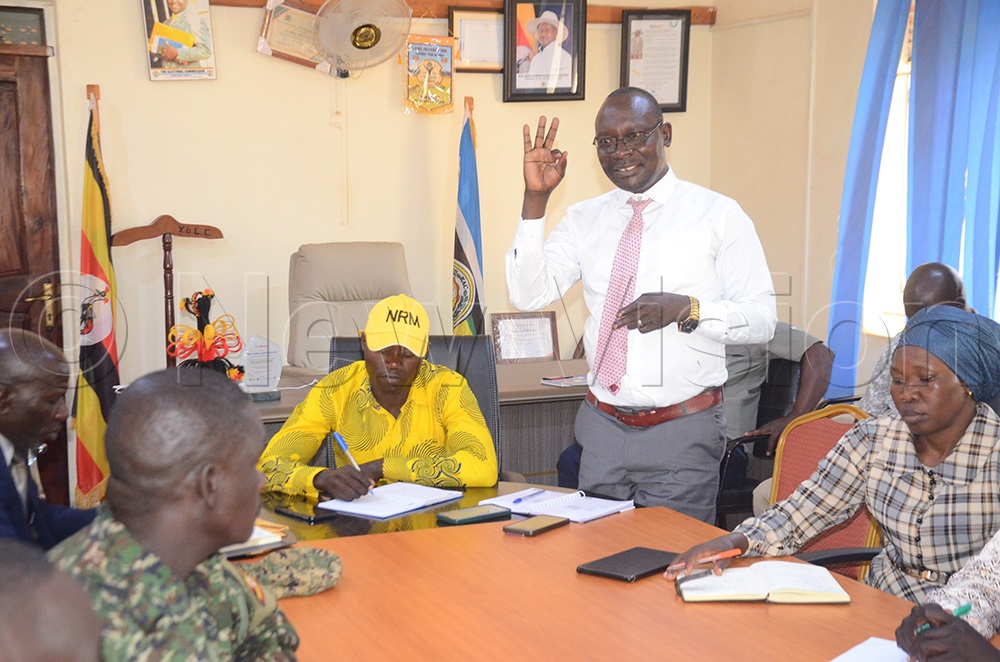
Dr George Okoboa Angupale, acting District Health Officer, Yumbe, addressing the stakeholders during the Ebola Task Force Committee in the district. (Photo by Adam Gule)
Dr George Okoboa Angupale, the Yumbe District Health Officer, said the district has not registered any case of Ebola, adding that the four suspected cases all turned negative.
According to Angupale, the four suspected cases were from Yumbe Health Centre IV, Jomorogo Health Centre III and Igamara Health Centre III. "All of them tested negative, offering us relief," said Angupale.
Angupale said there were many businesspersons from Yumbe who cross to purchase goods from DRC and South Sudan on a daily basis, exposing the residents to the risk of contracting Ebola. Ebola broke out in Eastern DRC in May this year, and so far, Uganda has registered 19 cases, 14 of them being Congolese nationals who travelled to Uganda to seek medical attention.
"Every day, our people go to DRC and South Sudan for business. Since the two countries have cases, we are sitting on a time bomb if we don't act now," he said.
Angupale revealed that they have identified and prepared a health centre to handle any case besides the Yumbe regional referral hospital.
Mansur Abasi, the Yumbe district Senior Health Educator, said seven sub-committees have been formed out of the main District Epidemic Task Force Committee to undertake different tasks such as information and risk assessment, water and sanitation, security, case tracking and management, among others.
He said they have also marked the high-risk groups in the district where special attention and awareness campaigns shall be directed.
"We are picking lessons from the COVID-19 pandemic, where some groups became high risk and spread the cases faster. We want to have special attention on them as a way to curb the disease," he said.
Yumbe district chairman Abdulmutalib Mahamoud Asiku lauded the committee for its immediate response and the proactive steps taken.
He said fighting the pandemic requires collective efforts regardless of position, organisation and roles performed in society.
He challenged the implementing partners in the district, such as managers of Bidibidi refugee settlement to support the Government in the fight against the pandemic.
Patrick Iranya, the Assistant Resident District Commissioner for Yumbe, who is also the chairperson of the Epidemic Task Force Committee, said there is no cause for alarm over the pandemic, as the Government is in full control of the situation.
He challenged the security operatives to be vigilant at the border and check persons entering the country with the help of medical experts.
"Our border is really stretched and porous. If the pandemic is to become high in the neighbouring South Sudan, then we would just be at risk. This means our surveillance along the border should be so serious," he said.