
Civil society urges Europe to back fair vaccine access in future pandemics
They warned that failure to do so could repeat the global inequalities witnessed during the COVID-19 pandemic.
Civil society organisations and health advocates have urged European leaders to support stronger equity provisions in the Pathogen Access and Benefit Sharing (PABS). (Photo by Nelson Mandela Muhoozi)
________________
Civil society organisations and health advocates have urged European leaders to support stronger equity provisions in the Pathogen Access and Benefit Sharing (PABS) Annex of the World Health Organisation (WHO) Pandemic Agreement.
They warned that failure to do so could repeat the global inequalities witnessed during the COVID-19 pandemic.
Speaking during a press briefing at the AHF Uganda Cares head office in Kampala on Monday (March 9), the advocates said the proposed rules must guarantee fair access to vaccines, diagnostics and treatments for countries that share pathogen samples and genetic data used to develop lifesaving medical tools during future global health emergencies.
“A pathogen anywhere is a threat everywhere. So, equitable access is not charity, it's prevention,” Anne Lumbasi, senior advisor, Resilience Action Network Africa (RANA), said while addressing the meeting.
The WHO Pandemic Agreement, adopted by member states in May 2025, seeks to strengthen global pandemic prevention, preparedness and response.
However, its implementation depends on finalising the PABS Annex, which establishes rules governing how pathogen samples and genetic data are shared globally and how resulting benefits, such as vaccines, diagnostics and treatments, are distributed.
Negotiations on the annex remain contentious, particularly over whether benefit-sharing provisions should be legally binding.
Lessons from COVID-19
Advocates said the urgency of strong equity measures is rooted in the experience of the COVID-19 pandemic. According to Lumbasi, African scientists were among the first to share genomic data that helped the world track dangerous variants of the virus.
However, she noted that when vaccines became available, the continent received less than three percent of global doses during the first year of rollout.
“This was not a failure of science. It was a failure of equity,” she said, further remarking that the PABS Annex seeks to address that imbalance by ensuring that countries that contribute pathogen samples and sequence data receive fair benefits when medical countermeasures are developed.
Among the proposed measures are binding benefit-sharing commitments requiring manufacturers to allocate 20 percent of pandemic products for WHO-led distribution, with 10 percent provided as donations and another 10 percent supplied at affordable prices.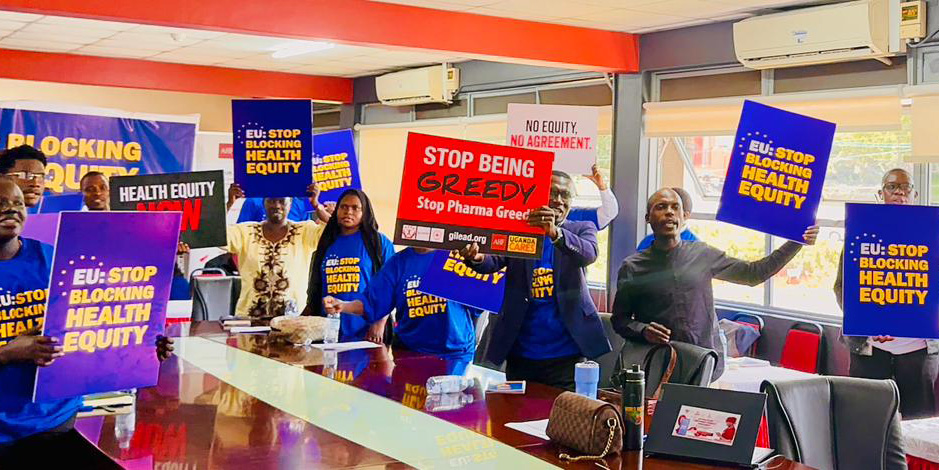
Civil society organisations and health advocates have urged European leaders to support stronger equity provisions in the Pathogen Access and Benefit Sharing (PABS). (Photo by Nelson Mandela Muhoozi)
The proposal also includes technology transfer and non-exclusive licensing arrangements to enable regional manufacturing, as well as recognition and inclusion of scientists from originating laboratories in research.
European negotiators have been criticised for resisting binding provisions. Lumbasi warned that such resistance weakens the legal framework and leaves room for delays or non-compliance. “We must stop extraction and start accountable cooperation,” she said.
Without enforceable technology transfer provisions, she cautioned, Africa’s efforts to build pharmaceutical manufacturing capacity risk stalling, leaving the continent dependent on external supply chains.
However, she added that Europe also stands to lose from weak equity measures. According to her, unequal access can prolong outbreaks and create new variants that eventually spread worldwide.
“Weak equity provisions leave Europe exposed to future supply shocks, uncontrolled transmission, and dangerous variants that will inevitably reach its populations,” Lumbasi said.
She said strong equity provisions would help build resilient and diversified supply chains capable of responding more quickly to global health emergencies.
Structural inequities
Denis Joseph Bukenya, executive director of the Human Rights Research Documentation Centre (HURIC-Uganda), said the PABS system aims to correct a longstanding imbalance in global health governance.
The Pandemic Agreement, he explained, provides a binding legal framework intended to strengthen preparedness for future pandemics.
Article 12 of the agreement establishes the PABS system to regulate the rapid sharing of pathogens with pandemic potential and their genetic sequence data while ensuring equitable distribution of resulting benefits. However, the negotiations have revealed deep structural inequalities.
“The inverse benefit law highlights a systemic inequity in global health security. Low and middle-income countries that quickly detect outbreaks and share pathogen samples are often the last to receive vaccines and treatments,” Bukenya said.
Although the agreement was originally motivated by the need to address this problem, Bukenya said it remains constrained by the national interests of high-income countries.
“With the USA having withdrawn from WHO and prioritisation of national interest and globalisation weakening, power and capital are becoming more concentrated in nation-states and in some global corporations,” he said.
Historically, experts note that some countries have withheld pathogen samples during outbreaks to retain leverage in negotiations over access to vaccines and other countermeasures.
The concept of viral sovereignty emerged from such disputes, reflecting countries’ desire to maintain control over biological samples originating within their borders.
Risks of an unequal system
Dr Lubanga Augustine, national medical director of AHF Uganda Cares, warned that the current draft of the PABS system could create a two-tier global health structure.
Under such a system, he said, less resourced nations would be required to share pathogen data rapidly but would have no guarantee of receiving vaccines or treatments in return.
“This imbalanced dynamic is a direct function of a global order that aims to impose social status and retain concentration of capital, resources, and innovation with resultant outputs in the hands of powerful nations and corporations,” he said.
He also raised concerns about the lack of clear mechanisms to track who uses pathogen data and how the resulting benefits should be shared.
Other experts noted that the proposed open science model could raise biosecurity risks, particularly related to gain-of-function research and other dual-use scientific work that could potentially enhance pathogens’ ability to infect humans.
They are also calling for mandatory contributions from manufacturers and commercial users that benefit from pathogen sharing.
According to Dr Lubanga, these contributions would include equitable access to vaccines, diagnostics and treatments, non-exclusive licensing for manufacturers in developing countries during health emergencies, and annual financial commitments.
Transparency measures are also essential, he said, including the registration and traceability of entities that access pathogen samples and genetic data. Without a clear identification of users, the system risks exploitation and unequal benefit distribution.
Africa’s manufacturing challenge
Despite accounting for roughly 25 percent of global vaccine demand, the continent represents only about 1.3 billion dollars of the 33-billion-dollar global vaccine market.
Dr Lubanga said millions of people across Africa remain underimmunised, and about 9.4 million children miss their recommended third and final dose of the diphtheria, tetanus and pertussis vaccine each year.
In addition, he said, regional manufacturing capacity remains particularly limited in East Africa. In the East African Community, more than 70 percent of pharmaceutical products are imported, while the region relies on imports for nearly all vaccines and active pharmaceutical ingredients.
He warned that without fair benefit-sharing mechanisms, efforts to strengthen regional production and achieve health sovereignty may remain out of reach.
Negotiators face a May 2026 deadline to finalise the PABS Annex. Dr Lubanga said any delay could stall ratification of the broader Pandemic Agreement and weaken global preparedness for future health emergencies.