
Burundi seeks Uganda support, partnership to strengthen cancer care
Uganda has made significant progress in building capacity and capability in fighting cancer. What we have learned over the years should benefit the region. There is no need for countries to reinvent the wheel when solutions already exist," Orem said.
According to Orem, Uganda currently offers some of the most advanced radiotherapy services in East Africa, with treatment provided free of charge to Ugandan nationals and at an affordable cost to patients from other countries. (Credit: Nancy Nanyonga)
Jackson Orem, the Executive Director Uganda Cancer Institute (center, blue suit), with officials from Burundi after a meeting at Uganda Cancer Institute on December 16, 2025. (Credit: Nancy Nanyonga)
KAMPALA - Uganda’s growing capacity in cancer prevention, treatment and research is increasingly attracting regional attention, with neighbouring countries looking to Kampala for practical solutions to shared health challenges.
This was evident as a high-level delegation from Burundi visited the Uganda Cancer Institute (UCI) to benchmark and explore formal collaboration in cancer care.
Speaking at the meeting on December 16, 2025, UCI executive director Dr Jackson Orem said Uganda is ready to share decades of experience built since the institute’s establishment in 1967.
Uganda has made significant progress in building capacity and capability in fighting cancer. What we have learned over the years should benefit the region. There is no need for countries to reinvent the wheel when solutions already exist," Orem said.
He added that UCI is now recognised as a regional centre of excellence and has made significant contributions to global cancer care, including the development of an essential cancer medicines package that has been adopted by the World Health Organisation.
According to Orem, Uganda currently offers some of the most advanced radiotherapy services in East Africa, with treatment provided free of charge to Ugandan nationals and at an affordable cost to patients from other countries.
Importantly, he said, outcomes at UCI continue to improve, with survival rates now higher than mortality rates among patients who access care at the institute, reflecting the impact of sustained investment in cancer treatment and systems strengthening.
Burundi’s young oncology programme looks to learn
The Burundi delegation was led by Dr Alexis Manirakiza, a paediatrician and an oncologist, who represents Burundi’s first oncology department, Centre Hospitalier Myrddin Camerun de Kigobe (CMCK Hospital, established in June 2020, a private hospital supported by government efforts).
“Our department is young, almost five years old; we are here to learn from Uganda’s experience in patient care, infrastructure development, and problem solving,” Manirakiza said.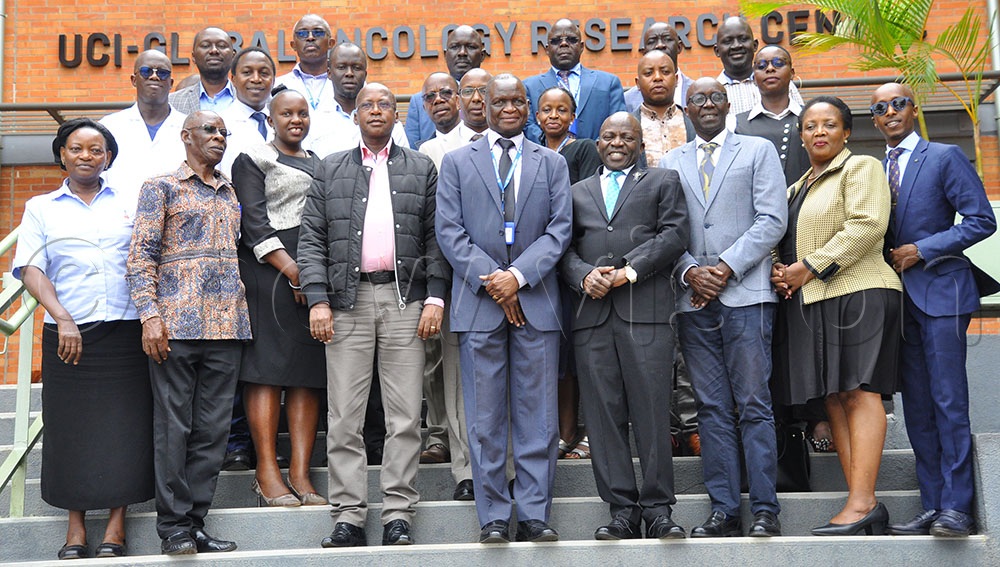
He added that while Burundi currently provides chemotherapy for some cancer types, comprehensive care remains a challenge due to the absence of radiotherapy services and limited specialised infrastructure.
“Chemotherapy alone is not a complete treatment package; we need complementarity. As we wait to establish our own radiotherapy system, collaboration with Uganda could allow patients to access this service at reduced cost,” he said.
Manirakiza added that late presentation remains a major challenge, with more than 80 per cent of patients arriving at advanced stages of disease. Burundi also lacks a national cancer registry, limiting accurate planning and response.
The visit was facilitated through diplomatic engagement, with Ann Babinaga, a representative of Uganda’s foreign affairs ministry stationed at the Uganda Embassy in Bujumbura, underscoring the importance of government-to-government collaboration.
“Uganda has been where Burundi is today. This is a really critical moment that requires dialogue, mutual understanding, and clear frameworks to help us start somewhere.”Babinaga said.
She stressed that progress in cancer care is gradual and requires coordinated action across sectors.
“Rome was not built in a day. Today marks the first step. Governments, private sector actors, Rotary clubs, and development partners from both countries are coming together to join the dots and create a common foundation," she said.
Babinaga revealed that Burundi’s health ministry is expected to send a full technical team to Uganda early next year to begin structured engagements aimed at shaping a long-term cancer control journey.
Rotary’s role in awareness and financing
Civil society also played a central role in the discussions. Happy Ntwari, a first assistant governor of Rotary District 9150 and public image lead in Burundi, said Rotary clubs were inspired by Uganda’s 14-year-old Rotary Cancer Run initiative.
“Through the Cancer Run, we realised there are disease areas we had not adequately addressed in our communities, and cancer is one of them,” Ntwari said.
Since learning about the programme in 2022 through the Uganda Embassy, Rotary clubs in Burundi have seen growing public interest and willingness to support cancer awareness and prevention initiatives.
“This visit is a starting point, we hope to build a sustainable programme that will one day have its own history,” Ntwari said.
Orem emphasised that while private sector and philanthropic initiatives are valuable, cancer control must remain a government-led responsibility.
“Cancer is too complex and too costly to be left to charity alone. Government must lead, while private sector initiatives supplement those efforts,” he said.
He highlighted Uganda’s ongoing work to decentralise cancer services through regional cancer centres and the development of population-based cancer registries to improve survival and reduce mortality.