
Buganda gets sh200m mobile lab to boost rural healthcare
Katikkiro Charles Peter Mayiga said the facility will strengthen the kingdom's efforts to improve people's health by extending services to communities that are often left behind.
Buganda Katikkiro Charles Peter Mayiga displays the key to the newly donated mobile health van during the handover ceremony. (Photos by Richard Ategeka)
________________
Thousands of residents in underserved communities are expected to benefit from faster and more accessible diagnostic services after Buganda Kingdom received a sh200 million mobile medical laboratory designed to conduct on-site testing during medical outreach programmes.
For many residents in remote parts of Buganda, a simple blood test can mean travelling long distances and waiting days for results, allowing treatable diseases to worsen. That could soon change.
The fully equipped mobile medical laboratory, donated by the Indo-Africa Charitable Society, was officially handed over on July 31, 2026, during a ceremony attended by Buganda Katikkiro Charles Peter Mayiga, India's High Commissioner to Uganda Anantha S.R. Iyer, government officials, development partners, religious leaders and health professionals.
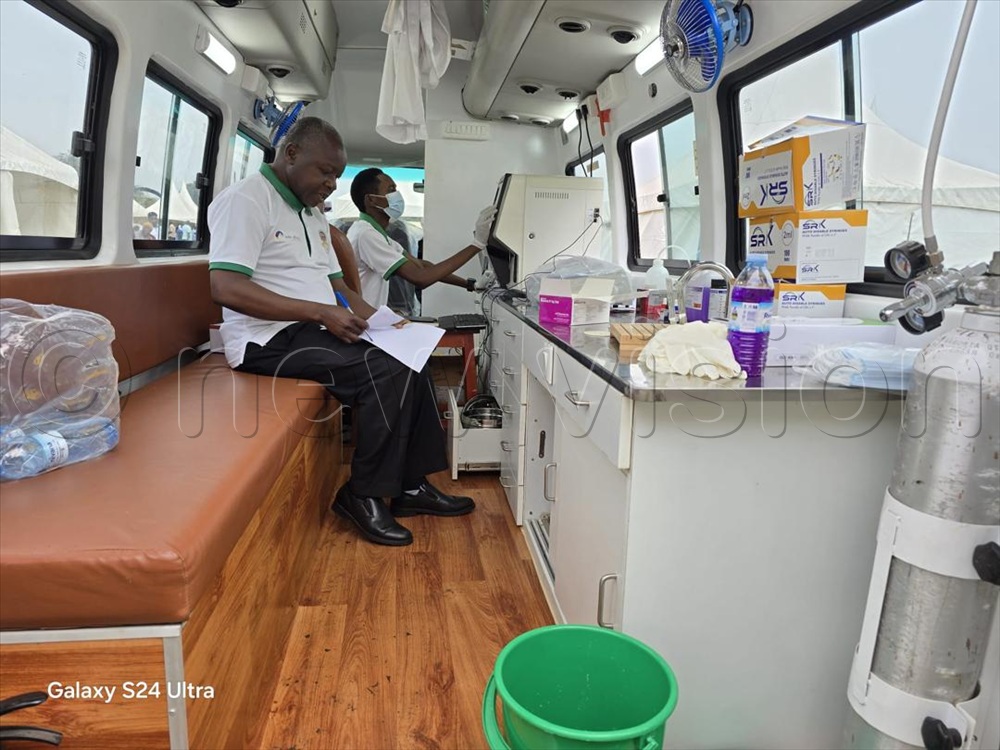
Unlike conventional outreach programmes that focus mainly on treatment, the mobile laboratory will enable healthcare teams to conduct blood tests and other diagnostic procedures on-site during medical camps, allowing patients to receive results and referrals without travelling long distances.
Speaking after receiving the donation, Katikkiro Charles Peter Mayiga said the facility will strengthen the kingdom's efforts to improve people's health by extending services to communities that are often left behind.
“Our vision is to place the people of the kingdom at the centre of social and economic development, but that is not realisable if people are not in good health,” he said.
“Diagnosis is very important. The people most affected are those in far-off areas where health centres are not easily accessible.”
“This mobile laboratory will go to those communities to take care of the health of the ordinary person,” he elaborated.
Mayiga said the kingdom will rely on its network of chiefs across the 18 counties to identify the communities most in need and coordinate outreach programmes.
The donation comes as Buganda commemorates the 33rd Coronation Anniversary of Kabaka Ronald Muwenda Mutebi II, with the donor describing the laboratory as a tribute to the King's legacy of promoting health, education and community development.
Representation of hope
Speaking on behalf of the Indo-Africa Charitable Society, coordinator Simon Mugerwa described the laboratory as more than a vehicle, saying it represents "hope, access and dignity" for communities that have long struggled to obtain reliable diagnostic services.
The organisation developed the mobile laboratory after years of witnessing patients fail to receive timely diagnoses during medical outreach programmes.
Mugerwa said many preventable deaths occur because people cannot access laboratory services early enough to detect diseases such as malaria, HIV, diabetes, hypertension, sickle cell disease and other infectious and non-communicable illnesses.
He added that the laboratory on wheels will extend quality diagnostic services to villages, islands and underserved communities, enabling thousands of Ugandans to know their health status earlier and begin treatment before illnesses become severe.
Meanwhile, Deepak Sharma, a representative of the Indo-Africa Charitable Society, said the project was inspired by the organisation's chairman, Vasant Lakhani, who was born in Jinja and has supported medical outreach programmes in Uganda for nearly two decades.
According to Sharma, previous medical camps faced major challenges because blood samples had to be transported to hospitals for testing, delaying diagnosis and treatment.
“This laboratory allows us to conduct most blood tests right at the medical camp. It is also fitted with a generator, making it suitable for remote areas without reliable electricity,” he said.
The customised laboratory van also incorporates ambulance capabilities and was designed specifically for Uganda's healthcare environment.
Medical intern from Masaka Referral Hospital, Dr Solomon Sekiranda, welcomed the donation, saying it will significantly improve patient management during outreach programmes.
“Previously, we could not process blood samples immediately during medical camps. Now we can run laboratory tests on-site, get results quickly and begin managing patients without unnecessary delays,” he said.
The Indo-Africa Charitable Society, a charitable organisation registered in Vancouver, Canada, has worked in Uganda for nearly 20 years, supporting free medical camps, humanitarian initiatives, borehole construction and specialised treatment for patients requiring cardiac surgery.
If successfully deployed, the mobile laboratory could reduce delays in diagnosis for thousands of people in remote communities, allowing patients to begin treatment earlier and improving outcomes for diseases that are often detected too late.
Health experts say timely diagnosis is key to reducing preventable deaths from both infectious and non-communicable diseases, particularly in communities where many patients seek treatment only after diseases have advanced.