
Broken CT scan, oxygen plant deepen service delivery crisis at Jinja hospital
The hospital is ferrying oxygen two to three times a week from Namanve or Kayunga Health Centre IV at a cost of sh750,000 per trip.
The Deputy Chairperson of the Health Committee and Mubende District Woman Member of Parliament, Hope Grannia Nakazibwe (2nd left), inquiring about the old oxygen plant of the Jinja regional referral hospital during inspection of the facility on September 07, 2026. Looking on is the Medical Director of Jinja regional referral hospital Dr. Alfred Yayi (2nd right) and Jinja City Town Clerk Guloba Choli (right). (Photos by Donald Kiirya)
________________
A non-functional CT scan and oxygen plant are among the major challenges hindering service delivery at Jinja Regional Referral Hospital, the hospital’s medical director, Dr Alfred Yayi, has revealed.
Yayi revealed this to members of Parliament’s Health Committee, led by its vice-chairperson and Mubende District Woman MP, Hope Grannia Nakazibwe, during their visit to the facility to assess service delivery.
“The CT scan, a Siemens 32-slice machine commissioned in October 2024, has been non-functional for about two months, while the oxygen plant has been offline for nearly four months. The contracts are not managed by us. And secondly, these service providers don’t seem to have in-house capacity within the country to do repairs. Whenever they are required to service or repair, they make orders outside the country,” Dr Yayi explained.
The hospital is ferrying oxygen two to three times a week from Namanve or Kayunga Health Centre IV at a cost of sh750,000 per trip.
Yayi told the Health Committee that Jinja Regional Referral Hospital faces severe understaffing, non-functional critical equipment, chronic medicine stock-outs and crumbling infrastructure.
He outlined the challenges in detail, noting that the hospital, which evolved from Kimaka Barracks into a general hospital in 1968 and a regional referral hospital in 1995, now operates with a 500-bed capacity across two campuses 1.5 kilometres apart: the main campus and Nalufenya Children’s Campus.
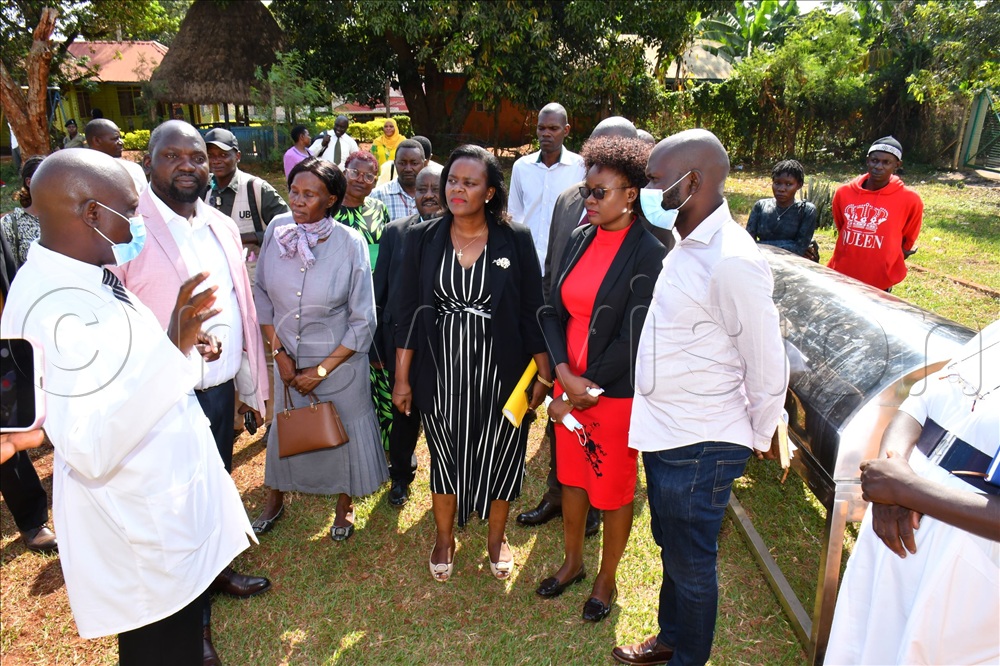
The Medical Director of Jinja Regional Referral Hospital, Dr. Alfred Yayi (left), explaining to the Deputy Chairperson of the Health Committee and Mubende District Woman Member of Parliament, Hope Grannia Nakazibwe (3rd right) and other Members of Parliament about challenges faced at the mortuary during inspection on September 07.
“In terms of staffing, we are at 32%. We have about 408 staff out of the 1,261 which the new structure gives us. Our prayer is that we increase this staffing level from 32% to about 50-60% in the next few years so that we can provide a better quality service for our people,” Yayi said.
The hospital serves 11 districts and Jinja city, with a population of 4.5 million. It records an average of 12,000 general outpatients, 9,000 specialised outpatients, 3,000 admissions, 500 deliveries and 300 major operations every month.
On infrastructure, he said many structures date from the 1920s to the 1950s and are inadequate for current demand.
“Sometimes the beds are shared, sometimes people can buy space on the floor because of the overwhelming numbers,” he said of the maternity and children’s wards at Nalufenya.
Staff accommodation covers only 22% of personnel. The hospital lacks a proper accident and emergency unit despite its location on the Kampala-Nairobi-Mombasa highway, operates with an ageing plumbing system prone to bursts, and has incomplete fencing that has allowed equipment theft.
The medicines budget stands at sh2.3bn against an estimated need of sh4bn.
Senior pharmacist Matthew Mayanja said: “We have been having a chronic shortage of hydroxyurea, which is the drug used for management of sickle cell anaemia. And it has been about 90 days of stock-out. We also have third-line medicine. We have about 120 days of stock-out. Storage space is also inadequate for the volume of supplies received every two months."
The hospital also faces operational challenges, including unreliable power supply, according to Yayi.
"Power instability compounds the problems. The backup generator consumes about 20 litres of fuel per hour. When UEDCL power goes off for, say, six hours, that means a lot to us,” Yayi said, noting the risk to ongoing surgeries and expensive equipment.
Despite these constraints, the hospital generates sh600-700m annually from its private wing and has improved medicines accountability through digitisation.
It has also reduced its water bill by half through rainwater harvesting and a motorised borehole.
Yayi listed key needs, including upgrading Nalufenya to an independent specialised paediatric hospital, which he said has already been captured in NDP4; a new OPD with an accident and emergency unit; a regional blood bank; cardiac, cancer and trauma centres; a dedicated power line; funding for dialysis amounting to sh2.2bn; perimeter fencing estimated at sh3bn; a plumbing overhaul; phase-two staff housing; and an increased medicines budget to about sh4bn.
He also urged support for the National Health Insurance Law.
MPs on the committee pledged to follow up on the challenges.
On hydroxyurea, he added: “It is now four months, 120 days, still counting, since Jinja Regional Referral Hospital had hydroxyurea. We’ve taken it on seriously. So, we shall now go and liaise with the management at National Medical Stores. And if need be, we shall proceed and have a discussion with the manufacturer.”
On power, he said the committee would recommend a dedicated supply line and explore solar options.
Sarah Lwansasula, Woman MP for Jinja city, said: “The challenges are still immense. We also found out that the essential equipment like the CT scan and the oxygen plant are currently out. These are very critical pieces of equipment that should not go for long when they are down.”
Lwansasula highlighted the burden on patients seeking dialysis in Mbale and the overcrowding at Nalufenya, where sickle-cell cases among children are high.
“There is an opportunity to upgrade that hospital to a national paediatric hospital. We shall agitate and press our feet down to see that we get such a service in the region, but to serve the entire country.”
Hope Grannia Nakazibwe, Woman MP for Mubende district and deputy chairperson of the Health Committee, focused on the hydroxyurea supply failure.
“The ministry has paid in money to get this drug, yet it is not being supplied by NMS. If that supplier they cannot meet the demand, let them change the supplier because we cannot afford to lose patients,” the MP said.
She praised health workers for handling overwhelming maternity numbers and said: “Us as Parliament, and through the Health Committee, we are going to ensure that we increase the budget for such supplies, for such commodities that are required to manage those theatre operations.”
The committee is expected to include the issues in its report and pursue the necessary budgetary and administrative interventions.
While at Jinja Regional Referral Hospital, members of the committee toured the private wing, dental ward, maternity ward, neonatal ward, oxygen plant, Samuel Leeds casualty ward and the ICU.
From Jinja Regional Referral Hospital, the committee toured Mpumudde Health Centre IV in Mpumudde, Jinja City, and Buwenge General Hospital in Jinja District.
Some of the legislators on the committee included Nakazibwe, the team leader; Robert Mugabi (Kitagwenda County); Sarah Kabokole (Bunyangabu County); John Paul Ninkusima (Ibanda South Constituency); Sarah Lwansasula (Jinja city); and Dr Timothy Batuwa (Jinja South West Constituency).