
Arua emergency dispatch centre to serve four million West Nile residents
The Arua facility is the first regional centre of its kind in the country, as the Government plans to establish eight more across the regions. Before its commissioning, Uganda had one emergency call and dispatch centre at Mulago National Referral Hospital.
Health Minister Dr Chris Baryomunsi with the Belgian Ambassador cutting the ribbon as they commissioned a sh2 billion ambulance call and dispatch center. (Photos by Robert Ariaka)
________________
Residents in West Nile will be able to access a coordinated ambulance response through a new regional emergency call and dispatch centre commissioned at Arua Regional Referral Hospital.
The sh2b facility, constructed with funding from the Kingdom of Belgium through its development agency, Enabel, is expected to serve approximately four million people across 13 districts. It will coordinate 19 ambulances and support the evacuation of an estimated 15,000 emergency cases annually.
The Arua facility is the first regional centre of its kind in the country, as the Government plans to establish eight more across the regions. Before its commissioning, Uganda had one emergency call and dispatch centre at Mulago National Referral Hospital.
Unlike the previous arrangement, in which ambulances were stationed at different locations and their deployment largely depended on hospital in-charges, the new centre will coordinate emergency calls and dispatch the nearest available ambulance.
The system will also enable emergency operators to identify the appropriate health facility for a patient and alert its medical team before the ambulance arrives.
This is expected to reduce delays in accessing emergency care, particularly for pregnant women experiencing complications, newborns requiring urgent treatment and victims of road traffic accidents.
Speaking at the commissioning on Thursday (November 19), health minister Dr Chris Baryomunsi said the centre would strengthen the country's emergency medical services and improve coordination between health facilities and emergency responders.
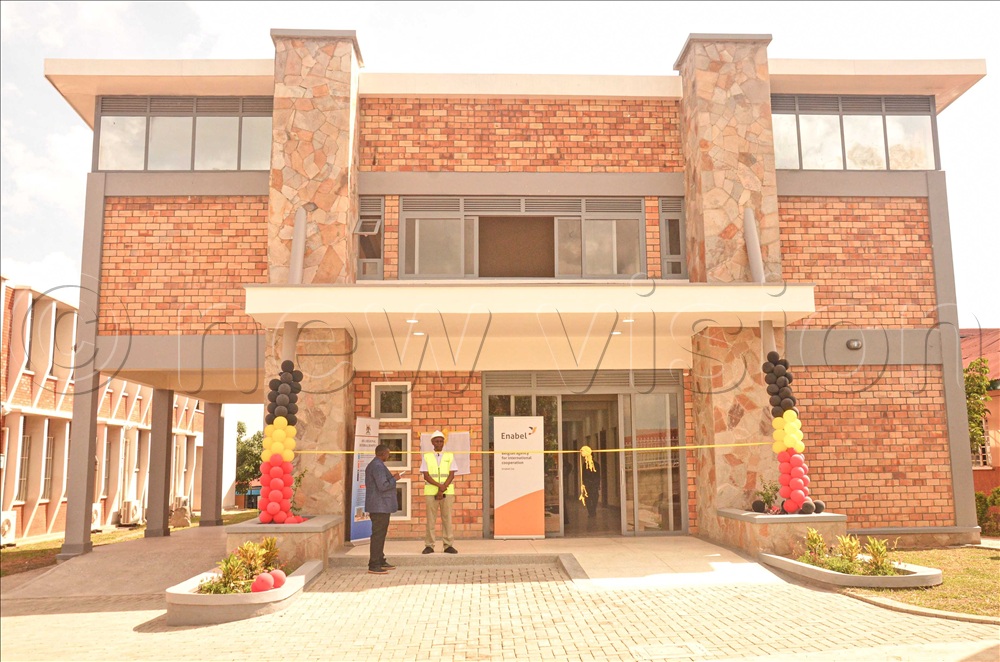
The sh2 billion Ambulance call and dispatch centre commissioned in Arua Hospital by Minister for Health Dr Chris Baryomunsi on Thursday
He said the facility would be linked to the National Ambulance Coordination Centre at Mulago National Referral Hospital through the proposed universal emergency access number, 912.
Baryomunsi said the government was establishing eight more regional ambulance call and dispatch centres as part of efforts to improve emergency response across the country. He said Arua had taken the lead, with other centres at different stages of development.
The minister said the government had established an ambulance system in 2015, which had since been institutionalised through the Department of Emergency Services. He said the growing complexity of emergencies, including road crashes, fires and disasters, made coordination and rapid deployment essential.
Recalling the region's earlier emergency response arrangements, Baryomunsi said: “I recall when we used to work in Arua Hospital, a local improvised bicycle was used to transport mothers and accident victims, but now we have moved to a modern system. Those days we had a rudimentary system in the early 1990s, but we are here launching an improved ambulance call and dispatch centre,” minister Baryomunsi said.
He said the ministerial policy was to establish national and regional ambulance call and dispatch centres to improve the management of emergency health services. He also said the region's population of more than 3.5 million people, in addition to its refugee population, faced considerable demand for emergency services.
The minister cited evidence from a World Health Organisation pilot project implemented in Uganda in 2020, which demonstrated that timely emergency response could reduce mortality by more than 50%.
Faster response, better access to emergency care
Belgian Ambassador to Uganda Hugues Chantry said the facility would help ensure ambulances reached patients quickly and transported them to appropriate health facilities.
"In an emergency, every minute counts. An ambulance, however well equipped, can save a life only if it reaches the patient on time," he said.
He, however, cautioned that the success of the investment would depend on the availability of qualified personnel, reliable communication technology, functioning ambulances, fuel and maintenance.
Chantry also stressed the importance of ensuring that the facility translated into better emergency services.
“Today we commissioned indeed an impressive piece of infrastructure, but infrastructure alone does not save lives; a functioning emergency system does.”
He said the centre would require qualified personnel, reliable communication technology, functioning ambulances, fuel, maintenance, appropriate protocols and predictable operational financing.
Hospital faces staffing, maternity challenges
Arua Regional Referral Hospital director Dr Gilbert Aniku said the facility would improve the coordination of patient care, including during mass casualty incidents such as road crashes and public health emergencies.
“We get 550 cases monthly that require emergencies, and of these, 115 are brought by ambulances,” he said.
Aniku said the hospital also admits about 60 patients daily on referral, adding to the demand for emergency services.
However, the hospital faces other service delivery challenges, including inadequate infrastructure and staffing.
“One area that is in dire need of infrastructural growth is maternity. There are over 650 deliveries per month, which are housed in the facility, which was when this hospital was in the existing structure as well, and in a limited size,” he said.
Hospital management said the institution handles more than 650 deliveries every month and appealed to the Government to construct a new maternity unit to provide a safer environment for mothers, newborns and health workers.
The proposed maternity complex is estimated to cost sh12 billion to construct and equip.
Baryomunsi acknowledged the staffing concerns, saying the hospital's staffing level stood at 23%. He pledged that the ministry would work with the hospital to address the gaps.
He said the Government was engaging on the wage bill to support the hospital's proposed upgrade to national referral status.
“Our plan is to upgrade Arua regional referral hospital into a national referral facility. We are engaging the government on the wage bill to ensure Arua is lifted into a national referral hospital and improve the services.” Minister Baryomunsi told Arua health workers.
He also urged health workers to ensure that the new facility translates into better services.
“Infrastructure alone does not guarantee success, but the commitment and service from the health workers translate to better health services. Let us move from a beautiful building to efficient health services and uphold the highest standards of professionalism and quality work,” Baryomunsi said.
The director general of health services, Prof. Charles Olaro, called on health workers to serve the public professionally and warned against extortion.
“There should be zero tolerance for extortion, and we know the people who extort money from the public, and this should stop. Let us serve the community, and the ministry will support the hospital,” he said.
Ebola concerns in West Nile
Baryomunsi also raised concerns about the risk of Ebola transmission in West Nile because of the region's proximity to the Democratic Republic of Congo (DRC) and South Sudan.
He said Uganda had agreed with the DRC government that Congolese seeking treatment should be managed in their home country. He cited 20 cases, 15 of whom were Congolese nationals, four health workers and one driver. Two of the patients had died, both Congolese nationals, he said.
The minister said Ebola treatment centres had been opened in the DRC, including one in Aru, to reduce the need for patients to cross into Uganda for treatment.
He also said border restrictions had been introduced, with travel limited to essential health workers and cargo drivers. Markets and mass gatherings in border communities had also been restricted.
Baryomunsi directed the Arua resident city commissioner and resident district commissioners in districts bordering the DRC to explain the measures to residents.
He referred to petitions over the closure of Odramachaku Market and an incident in which Ayivu division mayor Malon Avutia and deputy resident city commissioner Jona Mbigiti were attacked. He said the restrictions were intended to protect the country from further risk.
Local leaders call for improved services
Arua resident city commissioner, retired Maj. Betty Akello Otekat, said residents expected improved social services from the government, particularly in healthcare. She warned against the theft of medicines and absenteeism among health workers.
She said the ambulance call and dispatch centre demonstrated the Government's commitment to improving health services.
Arua city deputy mayor Jackson Dratibi said the hospital served patients from South Sudan, the DRC and the Central African Republic, in addition to residents of the 13 West Nile districts.
Baryomunsi urged Arua and Yumbe health facilities to work together to improve emergency response, save lives and protect property.
Uganda recorded 45,766 deaths among patients attended to in emergency units between 2020 and 2023, representing 18% of the 254,258 patients handled annually on average, according to the Uganda National Institute of Public Health (UNIPH).
The report shows that medical emergencies accounted for the largest proportion of deaths at 41%, followed by road traffic injuries at 23%, paediatric emergencies at 10%, surgical emergencies at 10% and burns at 7%.
Only 9% of emergency patients accessed ambulance services, while 80% received medical attention within one hour.