
19 years on, Fort Portal hospital still holds unidentified human remains
Dr Archabald Newton Sebahire, the facility’s senior executive consultant, said the case remains active and that the hospital cannot dispose of the remains until the relevant authorities conclude their investigations.
Fort Portal Regional Referral Hospital. (Photo by Jonan Tusingwire)
__________________
Nearly two decades after unidentified human remains were delivered to Fort Portal Regional Referral Hospital, the facility is still preserving the skeletal remains as authorities continue efforts to establish the identity of the deceased.
The remains were recovered in 2007 from a bush in Kasenda, Kabarole district, after police launched investigations into what was suspected to be a murder.
Since then, no relatives have come forward to claim the remains, while investigators have failed to establish who the deceased was.
Speaking during a press conference at the hospital last week, Dr Archabald Newton Sebahire, the facility’s senior executive consultant, said the case remains active and that the hospital cannot dispose of the remains until the relevant authorities conclude their investigations.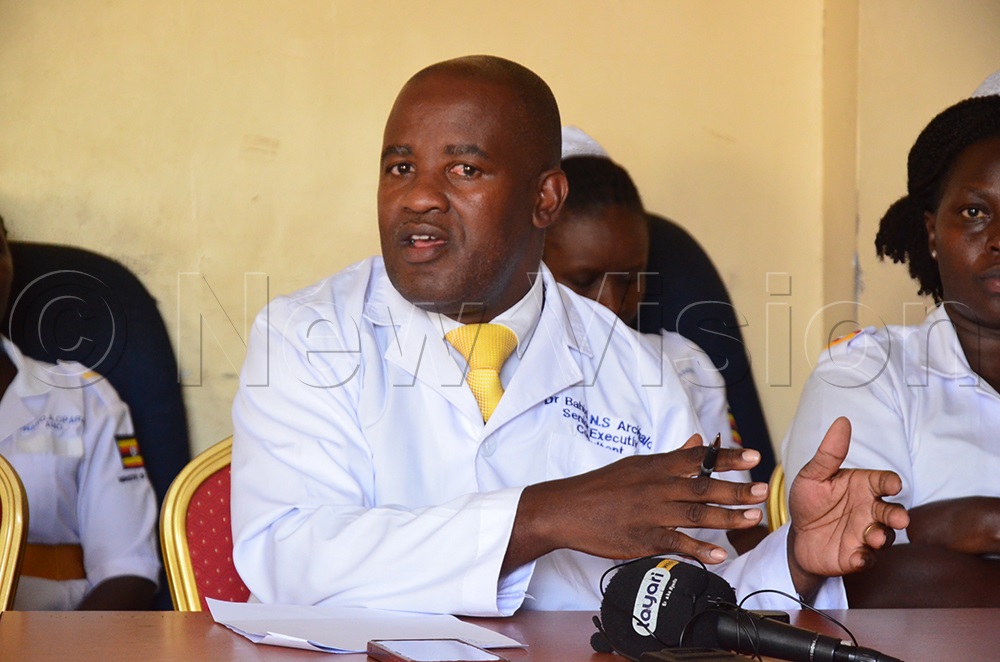
Dr Archabald Newton Sebahire addresses journalists at the health facility. (Photo by Jonan Tusingwire)
"The body is still under investigation. Samples were taken for forensic analysis; we cannot bury it before the conclusion is available," Dr Sebahire said.
"I want to make this clear. It is not that we are keeping the person. We are keeping the remains of a person suspected to belong to someone whose identity we do not know," he said.
According to Dr Sebahire, the remains decomposed long ago and now consist only of bones.
The remains were initially suspected to belong to Father Anthony Kiiza, the then parish priest of Kamwenge Catholic Parish, who disappeared on June 28, 2007. The body was recovered from a garden in Kasenda subcounty, Kabarole district, the same year.
Father Kiiza, who also served as chairperson of the Kamwenge District Service Commission, disappeared from the home of Peter Beyunga, a former Kasenda subcounty councillor in Kabarole district.
However, DNA tests conducted at a laboratory in London, United Kingdom, established that the remains did not belong to Fr Kiiza after samples were compared with those of his parents and returned negative results.
Two additional DNA tests conducted in South Africa also returned negative results, ruling out the possibility that the remains belonged to Fr Kiiza and leaving investigators without clues about the identity of the deceased.
Dr Sebahire said the hospital’s mortuary continues to face capacity challenges due to limited refrigeration space as it receives increasing numbers of bodies from across the region.
He, however, revealed that the government has provided funds to procure additional refrigerators to support the preservation of bodies.
The facility’s consultant maintained that the skeletal remains are being preserved in accordance with investigative procedures and that any decision to dispose of or bury them can only be made after the relevant authorities complete the forensic process and issue clearance.
In 2018, Vincent Ssekate, who was then spokesperson for the Directorate of Criminal Investigations, told journalists that police no longer had interest in the remains after DNA tests ruled out a link to Fr Kiiza.
“The DNA tests were made, and it was found that the body was not for Father Kiiza. So as police, we no longer have interest in that body,” Ssekate said
Although hospitals have authority to bury unclaimed bodies, Ssekate said police could legally order that remains be preserved for several years if investigations were still ongoing.