
Uganda losing its cultural roots, Bishop Muhirwa warns
Speaking during celebrations marking 20 years of the Cross-Cultural Foundation of Uganda (CCFU) at Hotel Africana in Kampala on May 20, 2026, Muhirwa said modernisation and changing lifestyles are steadily weakening the country’s cultural roots.
Handing over prizes for the National Heritage Awards 2026 during the celebrations marking 20 years of the Cross-Cultural Foundation of Uganda (CCFU) at Hotel Africana in Kampala. (Courtesy photo)
__________________
Bishop Robert Muhirwa of Fort Portal Diocese has warned that Uganda risks losing its identity and moral foundation as more young people grow up detached from their culture, language and traditions.
Speaking during celebrations marking 20 years of the Cross-Cultural Foundation of Uganda (CCFU) at Hotel Africana in Kampala on May 20, 2026, Muhirwa said modernisation and changing lifestyles are steadily weakening the country’s cultural roots.
“Our children these days are lost because we do not take the time to teach them our own culture.”
Held under the theme “Two decades of safeguarding Uganda’s heritage; sustaining our past, cultivating our future, the anniversary attracted cultural leaders, museum curators, tourism officials, educators, artists and grassroots cultural groups from across Uganda.
The celebrations featured exhibitions by community museums, cultural enterprises and heritage clubs, showcasing traditional artefacts, indigenous foods, local fashion, music and storytelling traditions from different parts of the country.
But beneath the colourful displays and performances was a deeper national conversation about identity, memory and the future of culture in Uganda.
Muhirwa stressed many parents today take children to urban schools where speaking English is seen as sophistication, leaving many unable to speak their mother tongue or communicate with elders back home.
“Some children cannot speak their local language. Worse still, when they visit their grandparents in the villages, they cannot talk to them,” he said. “A tree without roots cannot stand.”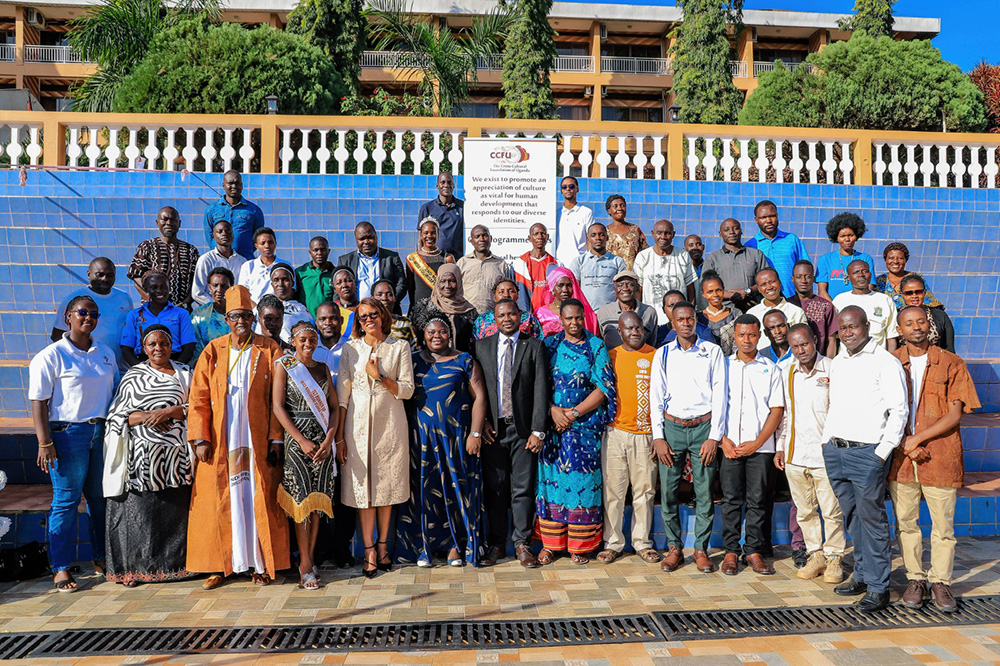
The bishop warned that some young people increasingly see culture and elderly people as outdated because of exposure to modern technology and foreign influences.
“Because they know smartphones and computers, they think elderly people are ignorant and useless in society,” he said.
He described culture as “the total way of life of a people,” saying it goes beyond ceremonies and dance to include values, beliefs, language, food, social practices and identity.
“It is the memory of a people and the soul of a nation,” he said.
He also praised CCFU for spending the last two decades promoting culture as a tool for justice, development and social transformation.
The organisation has supported over 238 heritage clubs in schools across Uganda and worked with universities and cultural institutions to promote heritage education and conservation.
Muhirwa particularly applauded efforts to preserve indigenous traditions such as Mpaako, the pet naming system practised among the Batooro, Banyoro and related communities, recognised by UNESCO as intangible cultural heritage.
“If you visit Toro, you cannot leave without receiving a Mpako name,” he said.
The bishop also commended the foundation’s work among marginalised indigenous communities and support for girls’ education in areas such as Ntoroko District.
However, he challenged harmful cultural practices that continue to undermine women and girls, including female genital mutilation, bride price exploitation and discrimination in access to food.
“There are cultural norms we need to critique because culture should promote harmony, dignity and human development,” he said.
Muhirwa repeatedly emphasised the importance of learning from elders, quoting Pope Francis, who describes elderly people as “walking encyclopedias” and custodians of memory.
“The elderly help us appreciate continuity between generations,” he said. “Those who break ties with the past lose their roots and eventually lose their future.”
Rediscovering the importance of culture
Senior Presidential Advisor on Tourism Lilly Ajarova described culture as one of Uganda’s greatest but underutilised tourism assets.
“Uganda can only be positioned as a distinctive global destination through our culture,” she said.
Ajarova revealed that Uganda’s tourism sector generated nearly $1.7b in foreign exchange earnings in 2025, surpassing pre-pandemic levels, with cultural tourism emerging as a key growth area.
She added that global tourism trends show that international travellers are increasingly looking for authentic cultural experiences.
“For Africa, wildlife comes first, but culture is already second,” she said. “And very soon, culture may become number one.”
Dressed in traditional Ugandan attire, Ajarova narrated how wearing cultural wear abroad often sparks conversations and curiosity about Uganda.
“Every time I travel out of this country wearing traditional attire, people stop me and ask where I am from,” she said. “Culture gives us identity.”
She also urged Ugandans to embrace community museums not simply as stores of old artefacts, but as living centres of education, dialogue and healing.
“Museums are places where communities gather to reflect, learn and reconnect,” she said.
Promoting unity
CCFU Executive Director Barbra Babweteera said the organisation’s work has focused on helping communities preserve their stories, traditions and collective memory.
“Museums are not merely spaces of preservation,” Babweteera said. “They are spaces of dialogue, education and inspiration.”
She added that cultural institutions play an important role in promoting unity in a world increasingly divided by violence, conflict and intolerance.
“Despite our different colours, tribes and geographical locations, we remain one humanity,” she said.
For Sr Dominique Dipio, chairperson of the CCFU board, one of the organisation’s greatest achievements has been changing how Ugandans think about culture itself.
“We used to reduce culture to performances and dances,” she said. “CCFU helped us understand that culture is the foundation upon which our development, identity and social life are built.”
Dipio praised the organisation for promoting respect among different cultures and advocating for marginalised indigenous communities.
“No culture is superior to another,” she said. “When we learn from each other’s cultures, we expand our understanding of humanity.”
What exhibitors say
Alice Basemera, founder of Koogere Foundation Uganda in Fort Portal, said young people are central to keeping culture alive.
“If we are not dealing with the younger generation, culture will die,” she said.
Her organisation runs heritage clubs in schools organises competitions, and promotes traditional cuisine as a way of attracting youth to culture while also creating livelihoods.
“We use culture in development processes,” she explained. “Even traditional foods are important because they are healthier and preserve our identity.”
She said one of the biggest challenges remains negative perceptions that culture is backward or satanic.
“When we started teaching people the meaning behind culture, they began loving it again,” she said.
Basemera appealed for support from government and cultural institutions to establish permanent cultural centres for preserving artefacts and indigenous knowledge.
Lubwama Steven Kimuli of Owaffe Cultural Village in Mukono said cultural events and exhibitions help community initiatives gain exposure and create networks.
“These events help us learn from each other and market our work,” he said.
Dan Katwesige of Bugungu Heritage and Information Centre said some people still wrongly associate culture with witchcraft or satanism, especially due to western influences.
“Culture creates social bonds and gives people identity,” he said.
Throughout the two-day celebrations, traditional music, storytelling and exhibitions transformed Hotel Africana into a showcase of Uganda’s cultural diversity.
The bishop, however, called on government, religious institutions, schools and development partners to invest more in preserving Uganda’s heritage.
“Culture must be treated as a strategic resource for national development, reconciliation, tourism, education and peace building,” he said.