
Tumusiime creates room for girls left behind to flourish
Susan’s counsel to working women is practical, shaped by years of navigating professional responsibilities, family life and public expectations. ▪️Value your family. Remember the people who will remain important when a job or career chapter ends. ▪️Respect your spouse. Communicate openly, avoid trying to control your partner and address problems together.
Susan with Karimojong young mothers during a community outreach. (Credit: Ritah Mukasa)
Susan Opok Tumusiime is a philanthropist who opens both her purse and her home to vulnerable children, and a leader whose career has been shaped by resilience and service.
As executive director of FAWE Uganda, she has dedicated her life to helping girls overcome barriers to education while balancing family life and a demanding career.
From navigating the challenges of humanitarian work in war-torn northern Uganda to nurturing girls whose futures hang in the balance, her story is one of purpose, faith and compassion. Ritah Mukasa caught up with her.
When a young, pregnant Karimojong woman escaped an abusive marriage, Susan Opok Tumusiime did more than offer her refuge.
She helped her return to school. When the baby arrived, Susan took on the work of raising the child, allowing the young mother to resume her education.
Such service has come to define Susan as a maker of room in her home and in her work, for girls whose futures have been narrowed by poverty, violence or circumstances beyond their control.
“I work to uplift the vulnerable,” she says. Every barrier removed, she adds, is an achievement and a dream fulfilled. For the past eight years, Susan has led the Forum for African Women Educationalists (FAWE) Uganda, part of a pan-African organisation working to expand girls’ access to education.
As executive director, she mobilises funding and oversees programmes designed to help girls and young women enter school, stay there and complete their studies. Through the Mastercard Foundation-funded Higher Education Access Programme, her team supports more than 1,600 students, including refugees, survivors of abuse, people with disabilities and young people from economically disadvantaged or historically underrepresented communities.
The assistance extends beyond tuition to counselling, guidance and mentorship. She also oversees the Social Initiative Educate Girls bursary programme, which supports 75 students, and a staff bursary scheme through which employees contribute up to sh100,000 a month to sponsor 35 girls. In 2024, Susan introduced the “20k for Transformation Campaign”, inviting well-wishers to contribute at least sh20,000 toward school-fee arrears for Senior Four and Senior Six candidates.
The campaign has raised more than sh32m and helped keep 23 girls in school since its launch. Over the years, Susan has opened her home to underprivileged children, sometimes taking on responsibilities that extend well beyond financial assistance.
Her husband, Hannington Kibeherere Tumusiime, a retired mechanical engineer, has supported her in this work. “My husband is a very good man,” she says. His kindness, she says, has made it possible to keep offering vulnerable girls a place in her life.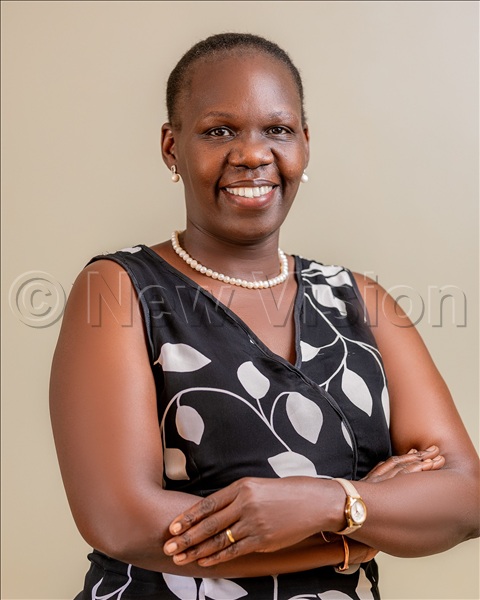
Susan Opok Tumusiime
Leadership in a war zone
Susan did not grow up in hardship. Her parents, the late Peter Paul Opok, an architect and engineer, and the late Alice Kakai, a secretary, provided a comfortable childhood. Her father worked with the East African Community in the 1970s and later served as permanent secretary at the Ministry of Housing and Urban Development.
The family moved between Uganda, Kenya and Tanzania as his career took him across the region.
Susan attended several institutions across East Africa, including St Theresa Namagunga Primary School, Aga Khan Primary School in Mombasa and Arusha International School. After the family returned to Uganda, her father enrolled her at Sacred Heart Girls School in Gulu, hoping to strengthen her connection to her country and its culture.
After graduating in 1993, she worked as a research assistant at the National Environment Information Centre, then as a loans officer at Centenary Bank. With encouragement from her former supervisor, Frank Turyatunga, she returned to Makerere for a master’s degree in environmental science.
A brief stint with the World Food Programme in Gulu followed. She then travelled to Norway for a second master’s degree in management of natural resources and sustainable agriculture, with support from the Norwegian government and its Ministry of Foreign Affairs.
Her research examined forced migration and the use of resources in conflict-affected areas. The subject would soon become more than an academic interest. After returning to Uganda, Susan taught development studies at Kyambogo University before joining Windle Trust in Northern Uganda as an assistant manager.
The Lord’s Resistance Army insurgency, led by Joseph Kony, was at its height, and the organisation was working amid the upheaval and human suffering caused by the war. “I had never been a manager before,” she says.
“But when the organisation was looking for someone to go to the North, I stepped up.”
For five years, Susan managed a large team and helped oversee the reintegration of more than 3,500 former child soldiers.
The work brought daunting responsibilities, including serious accountability problems that she says nearly landed her in prison. She credits three people with helping her navigate the crisis: her uncle, Stephen Okech, a former soldier who taught her the importance of meticulous record-keeping and doing the right thing; Norbert Mao, then Gulu district chairperson and current Minister of Justice and Constitutional Affairs; and the Dutch deputy ambassador at the time, who believed in her integrity.
The experience left its mark. Having grown up in relative comfort, she had entered a world where people’s lives had been devastated by conflict and displacement.
“I learnt that leadership demanded transparency, humility and empathy, especially when working with people whose suffering I had never personally experienced,” Susan says. After Windle Trust, she became country director of Promoting Equality in African Schools (PEAS), serving from 2012 to 2016.
In 2017, she briefly led Nurture Africa, overseeing educational support for young people infected or affected by HIV/AIDS. The following year, Susan joined FAWE Uganda, where her earlier experiences in research, humanitarian work and education converged.
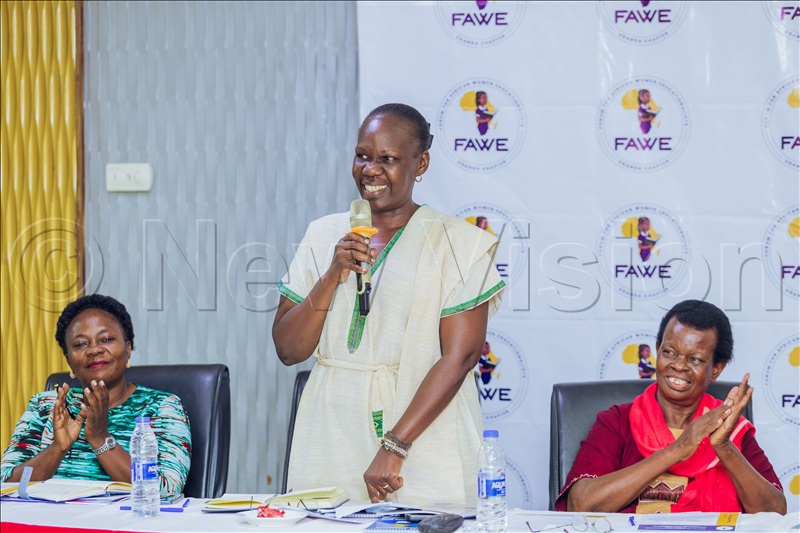
Susan speaking during a FAWE engagement. (Credit: Ritah Mukasa)
Love on a bus trip
Susan and her husband met on a bus travelling to Mbarara. She was on a work trip when she and Tumusiime found themselves seated together. They talked, became friends and eventually built a life together. They married in 2001, though the relationship initially met resistance.
Tumusiime, a Born-Again Christian from Ibanda district in western Uganda, faced expectations that he would marry within his faith. Some members of his family also objected to his marrying a woman from northern Uganda. Susan recalls that he ignored the criticism and went ahead with the marriage.
“We will grow old together,” he had promised her. The couple have three children. Their eldest is an engineer, the second a doctor, and the youngest hopes to study mechatronics engineering. Susan attributes the strength of their marriage to shared values, faith, friendship and the willingness to disagree without losing respect for each other.
She also speaks of the importance of forgiveness. “My husband has never insulted or beaten me.”
Susan describes their relationship as one in which each feels the other’s pain. When Tumusiime retired, they had to leave their institutional home and move into a rented house in a modest neighbourhood.
For two years, Susan’s salary barely covered their household expenses and school fees. “It was a tough time for us,” she recalls.
People mocked their circumstances and advised her to leave her husband. She stayed. “Faith helped us endure the uncertainty,” Susan narrates. She also had to win over some of her in-laws who initially kept their distance. Rather than withdraw, she responded with patience, love and respect
Keeping fit, future plans
Susan follows exercise routines on YouTube and takes long walks around the village with her husband. She also pays attention to what she eats, favouring a balanced diet that includes vegetables, fruits, nuts and plenty of water. Protecting her peace of mind matters, too.
She tries to avoid toxic environments and maintain a positive outlook, an approach that reflects the patience and emotional steadiness she believes leadership demands.
When retirement comes, the Tumusiimes hope to devote more time to farming on their more than 300 acres of land in Ibanda, where they keep cattle and goats. Susan also intends to continue helping vulnerable people.

The Tumusiimes
Balancing work and family
Susan does not pretend to be an early bird. On some mornings, her day begins at 7:00am with prayer, reading and preparations for work. On others, she turns to household chores or her studies for a diploma in governance.
She proudly describes herself as a working housewife, a title that comes with a broom as readily as a briefcase. “I am always with a broom. I love to clean, especially my bedroom,” she says.
Cooking, laundry and mopping are part of her routine, and she shares the work with her husband, who enjoys being hands-on around the house. On weekends, when she needs a rest, he sometimes brings her breakfast in bed. Dinner is another household ritual.
The family gathers to eat and catch up on the day’s events, a chance to remain connected despite busy schedules. Susan’s travels have taken her across Africa, Europe, Asia, North and South America.
She speaks at global conferences and regularly visits siblings living abroad. Yet the demands of a career have often required careful negotiation at home. When she worked in Gulu, her family remained in Kampala, and she and her husband sometimes travelled each weekend simply to see one another.
Susan credits her husband, siblings and in-laws with providing a dependable support system. She also acknowledges the contribution of household staff, some of whom have stayed with the family for as long as six years.
The Tumusiimes: “My husband, siblings, and in-laws stand by me through thick and thin,” she says.