
Teenage mothers receive postpartum care hampers in Uganda
“He tortured me both psychologically and physically. Whenever he wanted to abuse me, he would beat me and force me to have sex with him. He threatened to kill me if I told anyone,” Kizza said.
Members of WIMA togther with the Wakisa ministries standing in front of the Wakisa Maternity Centre. (Credit: Jovita Mirembe)
When Sheila Kizza's parents separated early last year, the 14-year-old was left with her two younger sisters in the care of their father in Masaka District. What initially appeared to be a stable family arrangement soon turned into a nightmare.
Two months after their mother left, Kizza's father began sexually abusing her, she said. He beat and threatened to kill her if she disclosed what was happening.
“He tortured me both psychologically and physically. Whenever he wanted to abuse me, he would beat me and force me to have sex with him. He threatened to kill me if I told anyone,” Kizza said.
Eventually, she found the courage to report her father to the police. A medical examination confirmed that she was four months pregnant. She was also fortunate not to have contracted a sexually transmitted infection, according to her account.
The police referred her to Wakisa Ministries, an organisation that supports pregnant teenagers and young mothers. Her father was arrested and detained.
For 15-year-old Fridah Mbambu, from Kasese District, the ordeal began during the Christmas holidays last year. She said she was sexually abused by her maternal uncle while visiting relatives.
Mbambu reported the abuse to the police, and a medical examination established that she was two months pregnant. Her uncle, however, was not arrested and remains at large, she said.
“I was lucky that the police connected me to Wakisa Ministries. I gave birth in September this year, and I am now under their care,” she said.
Kizza and Mbambu are among 29 teenage mothers who recently received postpartum care hampers from Women International Maternity Aid (WIMA), a Ugandan nonprofit organisation working to improve maternal and child healthcare.
The hampers were distributed at Wakisa Ministries in Wakiso on November 11. They contained washing and bathing soap, laundry detergent, sanitary pads, toothpaste, petroleum jelly for babies, buckets, diapers and baby wipes.
Miranda Bageine Musoke, WIMA's vice-chairperson, said the initiative was designed to help teenage mothers maintain personal hygiene while providing essential supplies during the early months after childbirth
“As an organisation, we believe in safe childbirth for all. We felt this would be a worthwhile partnership with Wakisa Ministries because we want to reach women who are giving birth and support them to have their children safely,” Musoke said
She said the initiative was consistent with WIMA's mission and vision and that the organisation had established partnerships with several health centres across Uganda to distribute similar supplies, particularly to teenage mothers, as part of its community outreach programme.
WIMA is a voluntary, nonprofit organisation dedicated to improving and expanding maternal and child healthcare services in Uganda.
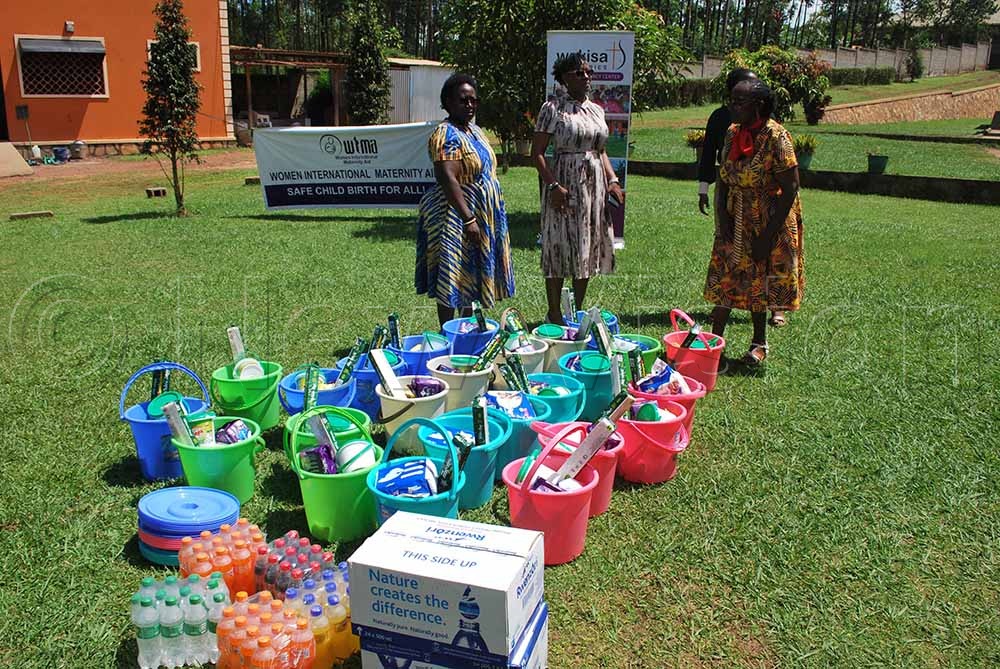
WIMA members standing behind the Postpartum Pamper hampers which they donated to the pregnant teenage girls. (Credit: Jovita Mirembe)
A place to begin again
At Wakisa Ministries, the support extends beyond providing basic necessities. The organisation also offers pregnant teenagers shelter, maternity services, counselling and opportunities to acquire skills that could help them rebuild their lives.
Paula Kisakye, the organisation's national director, said Wakisa had established a maternity centre at its premises to make childbirth safer and more accessible for the girls under its care.
The centre has so far conducted 24 normal deliveries, she said.
After giving birth, the young mothers remain at the centre for approximately three months before being resettled in safe environments, either with relatives or other trusted individuals.
Kisakye said the organisation takes care to ensure that the girls do not return to places where they experienced abuse or other circumstances that put their safety at risk.
Wakisa receives referrals from police stations, churches, mosques and communities across the country. However, girls seeking admission must present a police recommendation letter, be pregnant and fall between the ages of 10 and 17.
Once admitted, they receive vocational training in areas such as tailoring, weaving, gardening and catering.
The organisation also works with partners to support the girls' education, Kisakye said. Before leaving the centre, each girl is asked whether she would prefer to pursue formal education or vocational training.
Those who choose formal education receive financial support through their studies, including university, while those opting for vocational training are sponsored at relevant institutions until they complete their courses.
Looking beyond teenage motherhoog
For the young mothers, rebuilding their lives also means confronting the fear, stigma and uncertainty that can accompany early pregnancy, particularly when it results from sexual abuse.
During a counselling session with the girls, Hannah Namuyomba Owot, a transformation coach, encouraged them not to abandon their ambitions because of their circumstances.
She urged them to identify the professions they hoped to pursue and remain committed to achieving their goals despite the challenges they had experienced.
Owot also encouraged the teenagers to overcome fear and believe that early motherhood did not have to determine the rest of their lives.
For girls such as Kizza and Mbambu, the road ahead remains uncertain. But through shelter, healthcare, education and practical support, organisations such as Wakisa Ministries and WIMA are seeking to give young mothers an opportunity to rebuild their lives and imagine a future beyond the circumstances that brought them there.