
Social media fuelling child marriage, says report
“Child marriage is increasingly shaped by digital relationships where girls may feel empowered, perceiving their marriages to be based on love. They are choosing their partner, not their parents, yet they remain vulnerable,” the report authored by Plan International says.
Ronald Afidra Olema, Chairperson Parliamentary Forum, Phoebe Kasoga Country Director Plan International, Rev Nathan Mugalu and other officials pose for a group during the launch of the State of the world girls report at Kabira Country Club on October 7, 2025. (Photos by Nancy Nanyonga)
________________
Child marriage, long driven by poverty and cultural traditions, is now being intensified by the digital age, with social media emerging as a major pathway drawing girls into early unions, a new global report has revealed.
The State of the World’s Girls 2025 report, launched on October 7, 2025, at the Kabira Country Club in Kampala city under the theme: Let Me Be a Child, Not a Wife, found that many girls now enter marriages they perceive as “love relationships” initiated online, only to experience the same abuse, isolation and lost opportunities as in traditional forced marriages.
“Child marriage is increasingly shaped by digital relationships where girls may feel empowered, perceiving their marriages to be based on love. They are choosing their partner, not their parents, yet they remain vulnerable,” the report authored by Plan International says.
Plan International, a global humanitarian and development organization that advances children’s rights and gender equality, interviewed 251 girls and young women aged 15 to 24 across 15 countries, including Uganda, Ethiopia, Mozambique, Nigeria and Bangladesh.
The findings show that despite most countries having laws that prohibit marriage under 18, the practice remains widespread and increasingly hidden through informal unions.
Uganda's case
Uganda’s child marriage rate stands at 34%, one of the highest in East Africa. Across the region, long-held gender norms and economic hardships continue to push girls into early marriage, but the methods have evolved.
Online platforms are now enabling relationships between older men and young girls, often leading to early pregnancy and unregistered unions.
“The technology does not change the behaviour,” the report says, adding: “Online, older men may still exploit girls’ emotional and economic vulnerabilities, presenting marriage as an escape from hardship.
One Ugandan respondent, Dembe (false name), 23, says she left home because her family could no longer provide basic needs.
Ronald Afidra Olema Chairperson Parliamentary Forum on ending Child Marriage launching as Phoebe Kasoga Country Director Plan International looks on. This was during the launch of the State of the world girls report at Kabira Country Club on October 7, 2025. 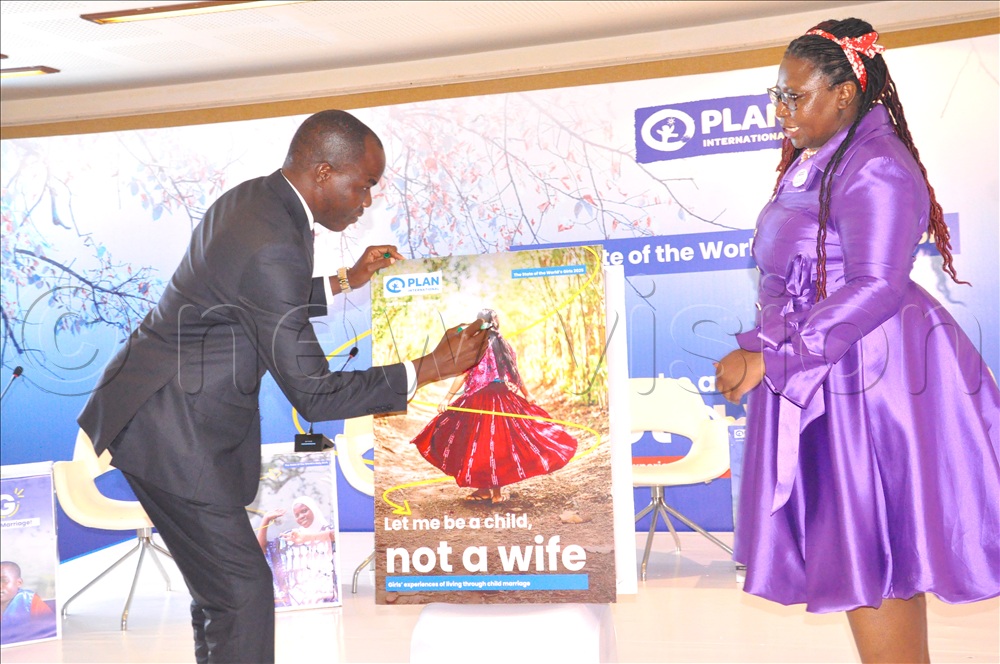
The report found that 72% of the girls surveyed already had at least one child, 63% were not in school or any form of employment, and 45% were married to men at least five years older. Nearly one in four said they had no say in their marriage decision, while 13% reported experiencing intimate partner violence.
When laws fail girls
Although nearly all 15 study countries have ratified international conventions such as the Convention on the Elimination of All Forms of Discrimination Against Women (CEDAW), Plan International found that national laws “fail both to protect girls from marriage and to uphold their rights within it.”
More than half of the activists interviewed identified customary and religious beliefs as the biggest obstacle to law enforcement. In some communities, parents falsify their daughters’ ages to make them appear older.
“Some parents do not accept it, most of them accept it, and some even change their daughter’s age to make it seem like she is over 18,” said an anonymous participant from Mozambique.
In Uganda and elsewhere, economic desperation remains a key driver. Families unable to afford school fees or daily needs often see marriage as a form of survival, yet, for most girls, it deepens their poverty and strips them of education and independence.
Crisis of divorced child brides
One of the report’s most striking insights is that many girls describe their unions as “love marriages.”
Social media has made it easier for young people to connect outside parental control, but also easier for older men to manipulate girls.
The study also highlighted a growing group of divorced child brides. Over 28% of respondents had left their marriages due to violence or neglect, only to face stigma, poverty, and social exclusion.
“Divorced girls can return to their education, work on business and lead another life,” said Fate (false name), 18, from Ethiopia.
However, most divorced girls remain trapped. The report noted that “many have no economically viable skills and no means of supporting themselves and their children,” leaving them dependent and vulnerable.
Call to action
At the report launch, Ronald Afidri Olema, chairperson of the Parliamentary Committee to End Child Marriage, urged government to strengthen enforcement of laws and address harmful cultural norms.
“78% of children under 18 have already had sexual encounters. Issues of child marriage and teenage pregnancies should no longer be sidelined. Let us invest in girls’ education and strengthen cultural systems,” Olema said.
The Rev. Nathan Mugalu, a counselling psychologist, described the rise in child marriage as “a moral failure,” urging religious leaders to take action.
“If animals can protect their young ones, then we as humans have failed as a species,” he remarked.
Plan International Uganda Country Director, Phoebe Kasoga, emphasized that change must come from the girls themselves.
“No girl we interviewed said she would want her own child to enter a child marriage,” Kasoga said.
The State of the World’s Girls 2025 report is part of Plan International’s annual global series examining the realities of girls’ rights. This year’s edition focused on various aspects that influence child marriage, social media being one of the emerging causes.