
From banana fibres to building blocks: why toys are best for child development
Experts agree that educative toys and games help children develop essential social skills such as sharing, taking turns, problem-solving, and effective communication.
Mutebi designing some of the wooden learning materials. (Photos by Fred Mubanda)
________________
For many children, playtime is more than just fun; it’s a world of imagination and discovery. Today, educators and parents understand that toys are not just for amusement, they are powerful learning tools.
Experts agree that educative toys and games help children develop essential social skills such as sharing, taking turns, problem-solving, and effective communication.
Research by Beigi (2022), Banana fibres and oil cans: Constructing pedagogical understandings of creativity through childhood play memories in a Ugandan context, shows that toys are important because they help children learn through play, even when they are made from simple local materials rather than bought from a shop.
The study describes how Ugandan children made toys from banana fibres, oil cans, sticks, bicycle wires, and other recycled materials. Making and playing with these toys encouraged creativity, imagination, problem-solving, and practical thinking. Beigi also found that children who made and played with toys together developed communication, cooperation, and friendship skills.
Through pretend play, such as cooking and caring for dolls, they learned everyday life skills and strengthened their connection to their culture and community. The study concludes that meaningful play does not depend on expensive manufactured toys; simple, locally available materials can equally support children's learning and overall development.
Similarly, Tahmores (2011), in the study Role of Play in Social Skills and Intelligence of Children, argues that toys play a key role in early childhood development. According to the study, toys encourage children to explore, imagine, and learn while developing creativity, language, problem-solving, and confidence.
Playing with toys also helps children build important social skills, including sharing, taking turns, cooperating, communicating, and resolving conflicts. Group play strengthens friendships, teaches children to understand others' feelings, and promotes positive social behaviour. Tahmores concludes that play with toys supports children's overall development by improving both their cognitive abilities and their social competence.
Building blocks designed from wood. 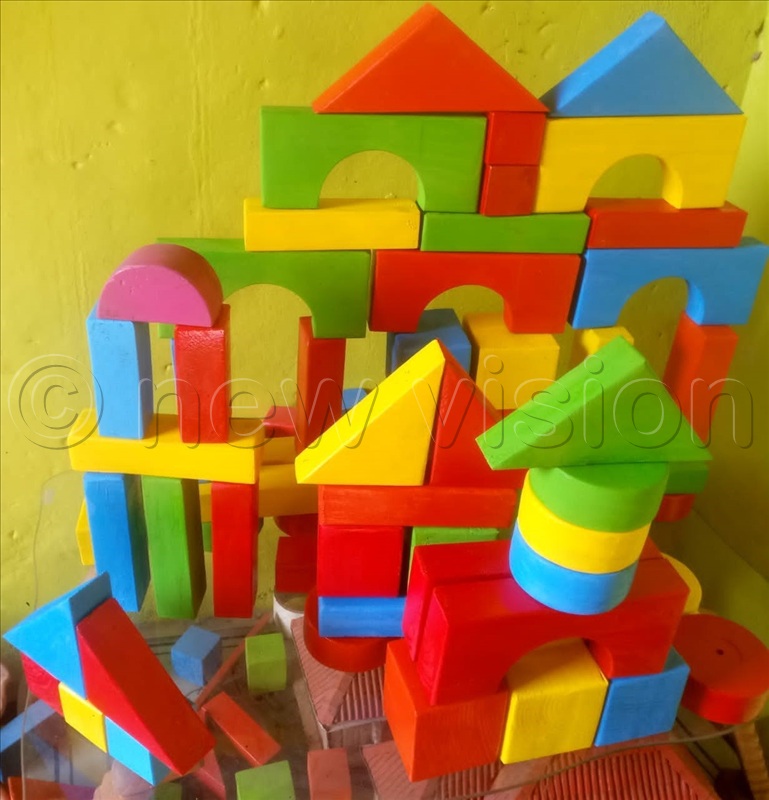
‘Do it yourself’ games such as building blocks, construction and tidying are considered especially educative.
More than playthings
"Toys contribute greatly to a child's growth and development. When children play with toys together, they interact, communicate, learn to share and build friendships," she says.
Safe play spaces
A good play environment is not only about having toys but also ensuring children are safe while using them. Shamus Nakato, a nursery teacher, advises parents and schools to inspect play areas from a child's perspective.
"Crawl or walk around the play area and check all entrances, exits and equipment for possible hazards before children begin playing," Nakato says.
Children will play wherever something captures their attention, whether indoors or outdoors. Indoors, they often engage with toys such as dolls, kitchen sets, puzzles and toy cars. Outdoors, they enjoy playground equipment, football fields, swimming pools and bouncing castles.
Learning through toys
Teachers say educational toys help children learn through exploration and discovery. Irene Nabutiti, a teacher at Prosper Junior School, Kitala, says learning materials help children develop colour recognition, imagination and independent learning.
"Educational toys encourage children to think creatively, generate new ideas and become innovative," she says.
Lailah Nantaba, another teacher, adds that learning materials also help children understand the difference between natural and man-made materials while strengthening their observation and thinking skills.
Making educational toys
Grace Mutebi, a toy designer, makes wooden learning materials for nursery and primary schools. He designs toys that promote hand-eye coordination, language development, music and movement, practical life skills, and art and craft activities.
Beyond manufacturing toys, Mutebi trains teachers and unemployed people, including persons with disabilities, in toy-making skills. He also designs playground equipment for schools, creating both educational opportunities and employment.
Why educational toys matter
According to Mutebi, wooden educational toys are durable, environmentally friendly and safe for children. Besides providing fun, they stimulate children's senses, strengthen imagination and encourage social interaction.
Building blocks and similar toys help children develop hand-eye coordination, fine motor skills, spatial awareness, language, imagination and early mathematical concepts. Bright colours and different shapes also support visual development and curiosity.
When children move beyond toys
Moreen Naluyigya, a teacher at Masooli Primary School in Kasangati Town Council, says children gradually reduce their reliance on toys between the ages of eight and 12.
"As children develop stronger cognitive abilities, they begin to understand more abstract concepts. Schoolwork becomes more structured, play becomes less central to learning, and children become more interested in projects, games and peer relationships," she explains.
She adds that older children often see traditional toys as something meant for younger children as they seek activities that match their growing maturity.
Designing for children
Mutebi says successful educational toys must match children's age, curiosity and developmental needs.
He continually researches new designs, improves existing products and prioritises quality to meet the expectations of schools.
"When children enjoy using the materials and teachers see the learning value, schools come back for more," he says.