
5,000 girls regain confidence through Menstrual hygiene programme in Eastern Uganda
“We now know how to make reusable sanitary pads,” Namudaka says with a smile. “Whenever we get our periods, we simply go to the safe room, clean up, change and confidently return to class.”
Officials from Amref Health Africa, Absa Bank Uganda and Mayuge district local government join the staff and learners of Lwanika Modern Primary School during the commissioning of a 10,000 litre water tank at the school. This was on June 30, 2026. (Credit: Lawrence Mulondo)
MAYUGE - For years, Celicita Namudaka, 13, dreaded the onset of her menstrual period. A Primary Six pupil at Lwanika Modern Primary School in Bukatube Sub-county, Mayuge District, she often missed classes because the school lacked facilities to support girls during menstruation.
“When my periods started at school, I would return home and stay away until they ended,” she recalls. "The boys laughed at us, and we were too embarrassed to remain in class."
Like many girls in her community, Namudaka used old clothes because her family could not afford disposable sanitary pads. During emergencies, girls had to fetch water from the nearby lake to clean themselves, exposing them to dirty water and the danger of crocodiles.
Namudaka is among more than 5,000 girls who have benefited from a Menstrual Hygiene Management programme under the Heroes for Gender Transformative Action, a six-year initiative implemented by Amref Health Africa Uganda with support from the Netherlands Embassy in Uganda, the Embassy of Iceland and Absa Bank.
The programme has reached schools in Mayuge, Mbale and Bukwo districts, equipping girls with reusable sanitary pads, menstrual health education and practical life skills that have significantly reduced absenteeism and school dropouts.
At Lwanika Modern Primary School, learners aged between nine and 14 were trained to make reusable sanitary pads and received health education on personal hygiene, reproductive health, child protection and positive behaviour.
The school also established a girls' safe room equipped with a bathroom, soap, water, spare uniforms, reusable pads, a mattress and first-aid supplies, enabling girls to change comfortably and return to class without disruption.
A 10,000-litre water storage tank donated through the programme has further improved access to clean water, an essential component of proper menstrual hygiene.
“We now know how to make reusable sanitary pads,” Namudaka says with a smile. “Whenever we get our periods, we simply go to the safe room, clean up, change and confidently return to class.”
She says senior women teachers now provide guidance and emergency sanitary pads whenever needed, eliminating the fear and shame that once forced girls to stay home.
“My performance has also improved,” she says. “Last term I scored Aggregate 12.”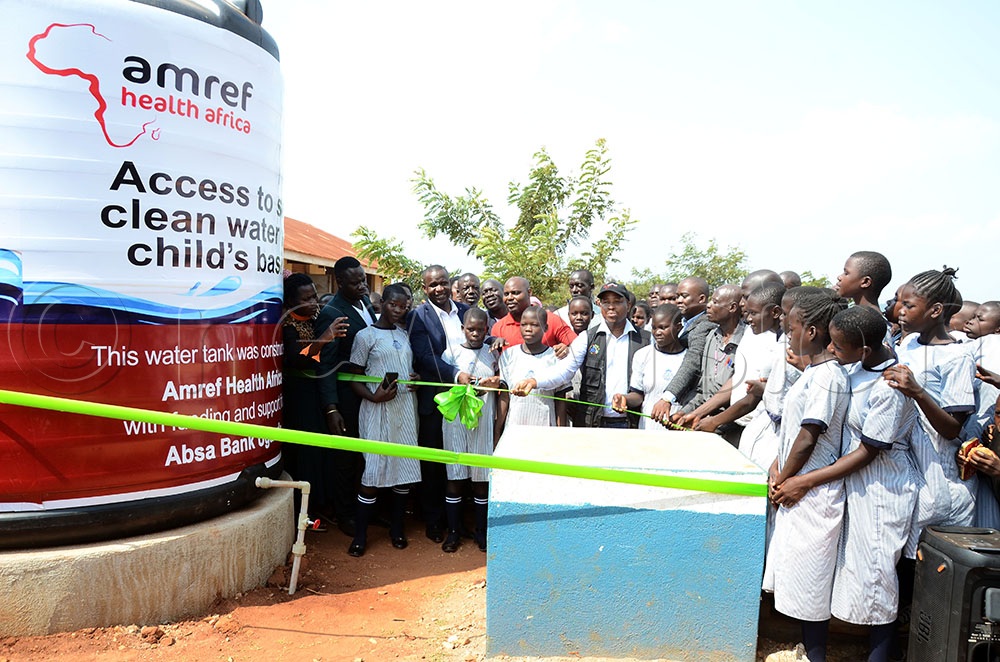
Dr Patrick Kagurusi (C) the Amref Health Africa Uganda Country Manager joins Julius Busingye (in red) the Absa Bank Relationship Manager for Development Organisations, Mayuge district leaders, teachers and learners of Lwanika Modern Primary School to commission a 10,000-litre tank at the school in Bukatube sub county Mayuge district on June 30, 2026. (Credit: Lawrence Mulondo)
Improved attendance and better learning
Lwanika Modern Primary School Headteacher Moses Mwase says the programme has transformed learning outcomes by improving attendance, enrolment and learner motivation.
He says school enrolment has grown from 583 learners in 2019 to 1,213 today, with girls making up 62% of the population.
“The programme strengthened menstrual hygiene management by training teachers, providing hygiene education materials and equipping the girls' safe room with essential supplies,” Mwase says.
He notes that both boys and girls were trained to make reusable sanitary pads, helping to reduce stigma while providing an affordable and sustainable solution to menstrual poverty.
“These interventions have improved girls' confidence, dignity and school attendance during menstruation,” he says.
The school's completion rate has also improved significantly, rising from only 16 candidates registered for Primary Leaving Examinations in 2019 to 101 candidates this year, 60 of them girls.
To sustain the gains, the school plans to allocate funds for materials used in making reusable sanitary pads.
Breaking barriers to girls' education
Amref Health Africa Uganda Country Manager Dr Patrick Kagurusi says menstrual hygiene remains one of the major barriers preventing girls from completing school.
“Many girls stay home simply because there is no water at school or they cannot afford sanitary pads,” he says. “This programme ensures menstruation is no longer a reason for missing class.”
He explains that Absa Bank initially provided sh30m to support about 2,000 girls before contributing an additional sh50m that expanded the programme to reach another 3,230 girls.
“Overall, more than 5,000 girls have directly benefited from the programme across 20 schools in eastern Uganda,” Kagurusi says.
He says collaboration between development partners and the private sector is increasingly important as donor funding declines, adding that local partnerships offer sustainable solutions to menstrual poverty.
“We must continue protecting girls and ensuring they remain in school because they are the future of our communities,” he says.
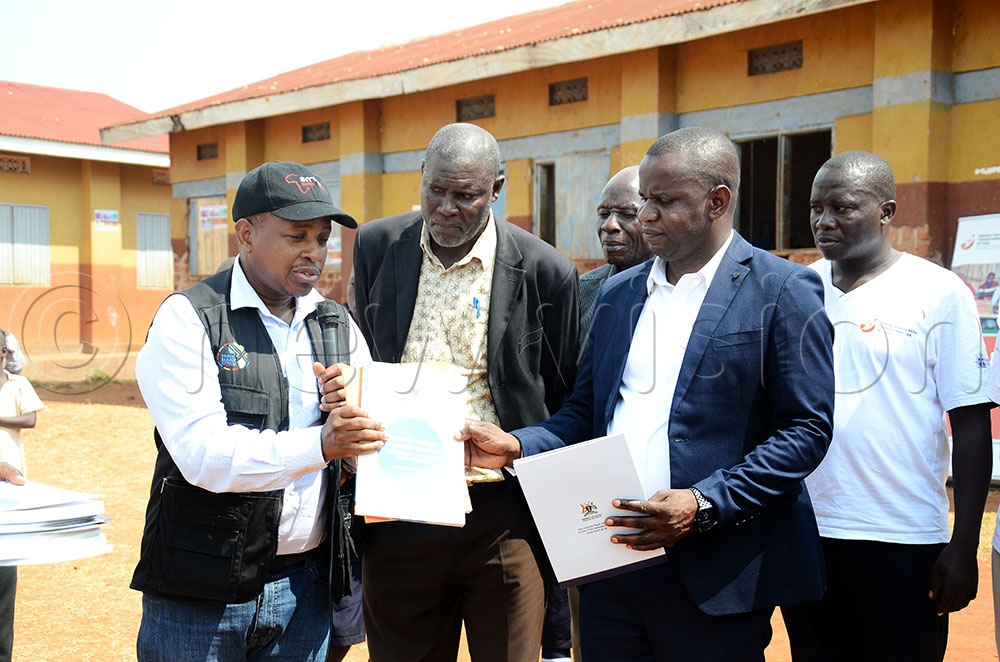
(L-R) Dr Patrick Kagurusi the Amref Health Africa Uganda Country Manager hands over copies of school health training manuals from ministry of health to Fred Muwubani the Mayuge District Inspector of Schools and David Ziija the Mayuge District Chairperson. This was during the commissioning of a 10,000-litre capacity water tank at Lwanika Modern Primary School in Bukatube sub county Mayuge district on June 30, 2026. (Credit: Lawrence Mulondo)
Private sector partnership making a difference
Absa Bank Relationship Manager for Development Organisations Julius Busingye says the partnership was inspired by the need to keep girls in school through practical interventions.
Funds raised during the annual Absa KH3 Seven Hills run support projects such as menstrual hygiene management in vulnerable communities.
“Access to clean water and a dignified learning environment ensures menstruation does not become a reason for girls to miss school, fall behind or drop out,” he says.
Besides donating reusable sanitary pads and supporting menstrual health education, Absa also provided school uniforms for vulnerable learners across participating schools.
Call for wider support
Mayuge District Inspector of Schools Fred Muwubani says the programme has equipped learners with life skills, improved sanitation and helped keep more girls in school.
However, he notes that many schools still lack adequate menstrual hygiene facilities, with fewer than 10 of the district's 143 government schools having proper infrastructure.
District Chairperson David Ziija says the new water tank will save girls from walking to the lake for water during menstruation, reducing absenteeism and restoring their dignity.
He called for greater investment in menstrual hygiene facilities across schools, saying improved access to clean water, safe spaces and reusable sanitary pads is critical to ensuring every girl completes her education with confidence and dignity.