
Buckingham Palace hosts "Queen Elizabeth II: Her Life in Style" expo
The sketch is one of about 300 items on display, some for the first time, at the exhibition "Queen Elizabeth II: Her Life in Style", which opens Friday at Buckingham Palace.
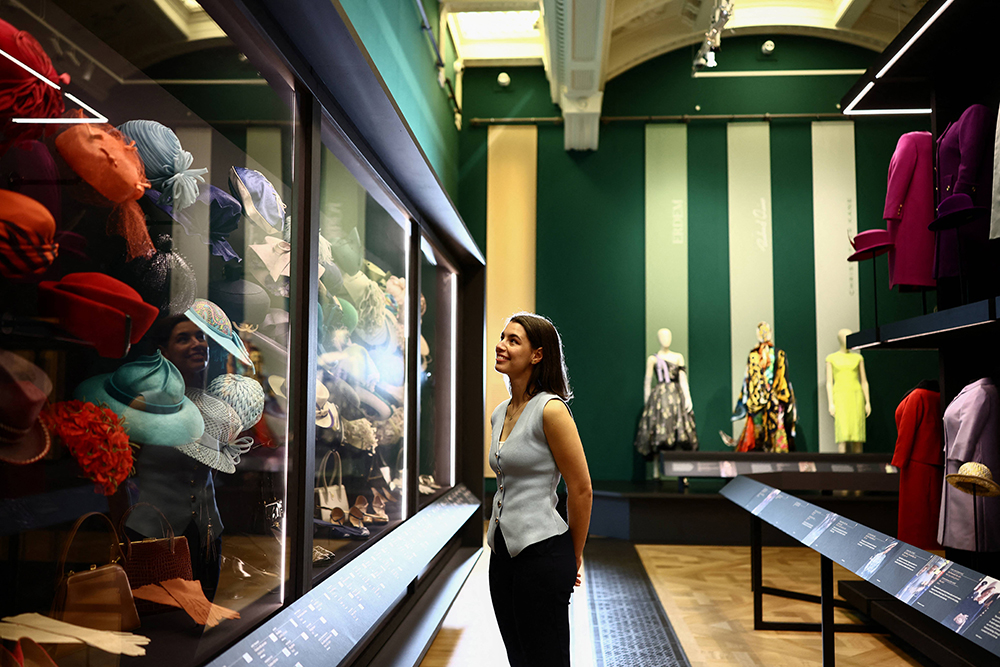
A member of the Royal Collection Trust staff poses with a display of evening gowns, during a media preview of the exhibition 'Queen Elizabeth II: Her Life in Style' at the King’s Gallery in Buckingham Palace in London on April 9, 2026. The largest exhibition showcasing Queen Elizabeth II’s fashion ever staged is being held from April 10 to October 18, 2026. (Photo by AFP)
________________
In a handwritten note on a sketch of an evening dress for her official visit to India and Pakistan in 1961, Queen Elizabeth II specified it should be sewn in "yellow satin", a colour symbolising health and prosperity in the region.
The sketch is one of about 300 items on display, some for the first time, at the exhibition "Queen Elizabeth II: Her Life in Style", which opens Friday at Buckingham Palace.
This unprecedented survey of the late UK monarch's wardrobe throughout her life (1926-2022) reveals the important diplomatic role she attached to her outfits.
The display in the King's Gallery at the London palace features sheath dresses sparkling with sequins and swirling outfits in vibrant colours from the 1960s.
There are also spectacular draped evening dresses straight from the atelier of Cristobal Balenciaga, maternity outfits and the military uniforms the princess wore during World War II.
In a section called "the finishing touch", the queen's signature colourful hats are pinned up on a wall opposite the coordinating outfits.
Tickets for the spectacular exhibition, which runs to October, have already sold out for April.
Highlights include Elizabeth's wedding dress dating from 1947 and the ornate embroidered gown she wore for her coronation, both created by British designer Norman Hartnell.
"We wanted to pay tribute not only to her style but also to British fashion and designers," stressed Caroline de Guitaut, the curator, who chose the outfits on display from an archive of some 4,000 items.
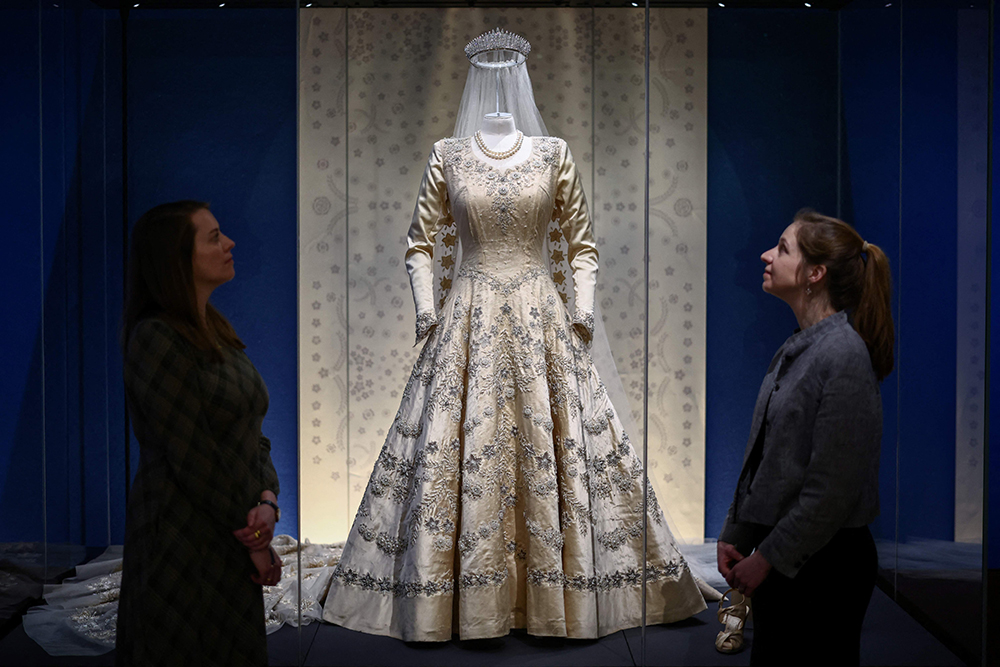
A key attribute of the royal's wardrobe was its political aims, the exhibition reveals, with fashion choices also playing a diplomatic role.
The coronation gown illustrates this, perfectly decorated with the national emblems of the nations of the United Kingdom: the English rose, the Welsh leek and the Scottish thistle, as well as flowers symbolising the Commonwealth countries.
This diplomatic dimension was a recurring theme of Elizabeth's wardrobe through her record-breaking 70-year reign.
In 1954, while travelling in Australia, she wore a yellow stole delicately embroidered with the golden wattle, the national floral emblem.
And in 1961, on a visit to Pakistan, she dined with President Mohammad Ayub Khan wearing a satin dress in the colours of the national flag of the country, a former British colony.
"She was the undisputed queen of sartorial diplomacy," said de Guitaut.
'Eye for everything'
This broke with the ancient tradition of royal clothing as a way to display wealth and power, historian Lisa Hackett told AFP.
Now confined to ceremonial roles, monarchs "no longer use their clothing to display their power" but instead want to convey respect and courtesy, said the academic from the University of New England in Australia.
These were dress codes that Elizabeth mastered to perfection.
"She was educated from an early age about her role and her wardrobe," Hackett said.
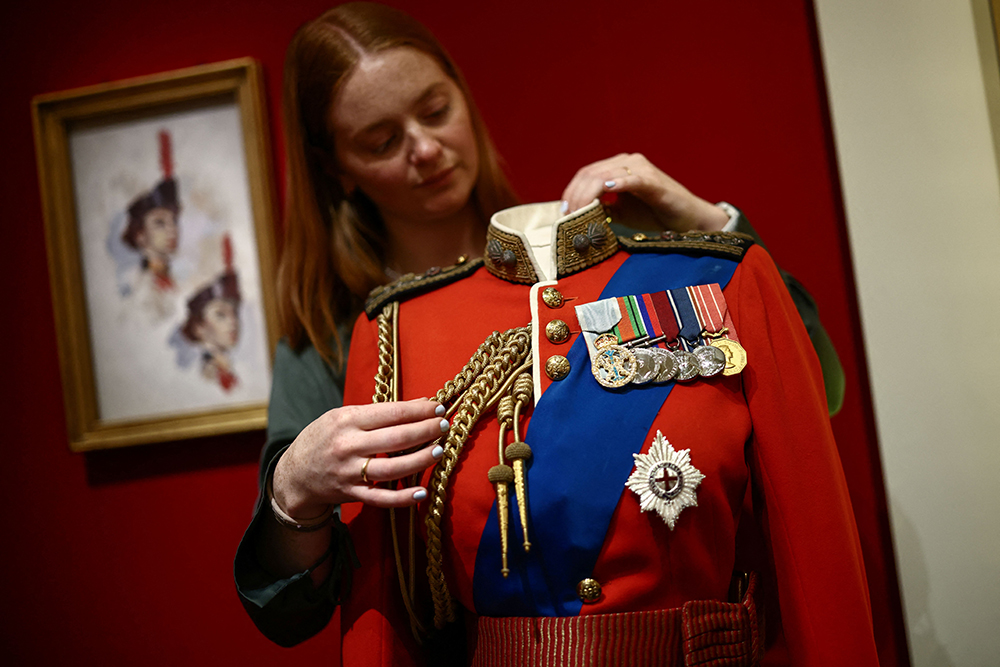
A member of the Royal Collection Trust staff poses with a full dress tunic of the Colonel-in-Chief of the Grenadier Guards, 1952, during a media preview of the exhibition 'Queen Elizabeth II: Her Life in Style' at the King’s Gallery in Buckingham Palace in London on April 9, 2026.
Elizabeth was also very involved in the design of her outfits.
"She decided what she wanted to wear, chose her designers, and even selected her suppliers," said de Guitaut.
Her handwritten note on the dress sketch for the trip to India and Pakistan was not exceptional: the exhibition shows that she added comments on several occasions.
"She had an eye for everything. I think it's fair to say she had almost complete mastery of her style," said the curator.