
Writing competition launched to preserve Uganda’s traditional folk tales
Nsamba said ten of the best stories will be selected from the submissions, with their writers invited to a five-day writers’ residency where they will receive mentorship from renowned authors. After the mentorship, the young writers will rewrite and refine their stories before one or three winners are selected. Their stories will subsequently be published.
A pupil of Bunjako Primary School in Lwengo district shows off his copy of the Jesse’s Wet Bed during a reading session at the launch of the Writers Program at the school in Lwengo district. (Credit: Lawrence Mulondo)
Around evening fires and under fruit trees, elders once turned lessons about honesty, respect and courage into stories of talking tortoises, cunning hares and foolish kings. These traditional folk tales were society’s first classrooms, shaping generations into a responsible society long before textbooks arrived.
Today, that classroom is slowly closing. Many of the elders who carry these stories are still with us, but few are passing them on, and even fewer have written them down.
With no recordings and no documentation, the country risks losing a vital moral library, leaving children to learn values from only the internet.
Children tasked to document stories
To help document and preserve the folk tales, Cotton On Foundation, in partnership with Lwengo and Rakai district local governments, has launched the Rising Writers Program.
The initiative requires children to listen to traditional stories from their parents, grandparents, guardians and other elders before writing and submitting them as properly structured stories.
Speaking at the launch held at Bunjako Primary School in Lwengo District on July 30, Martin Nsamba, a teacher trainer at Cotton On Foundation, said the programme was introduced to support learners who are still developing their writing skills while preserving the communities’ oral heritage.
“We believe that in the communities we have several folktales and we don’t want these folktales to go away with the elders that know them. We want to document and preserve them for future generations,” he said.
Nsamba said traditional knowledge, just like folktales, was also at risk of disappearing. He cited the knowledge of making bark cloth, saying some people who possessed the skill had died without passing it on to younger generations.
“These folktales can be a source of learning to improve the communities, even the children at large,” he said.
The schools include Ntebe Za Ddungu Primary School, Kyalulangira Primary School, Nabunga Primary School, St Nicholas Primary School, Namabaale Primary School, Busibo Primary School, Kalyamenvu Primary School, Bunjako Primary School and Kyaterekera Primary School, among others.
After listening to the stories, the learners will write and organise them into coherent narratives and submit them to their respective schools. The schools will then forward the entries to the foundation by the end of September.
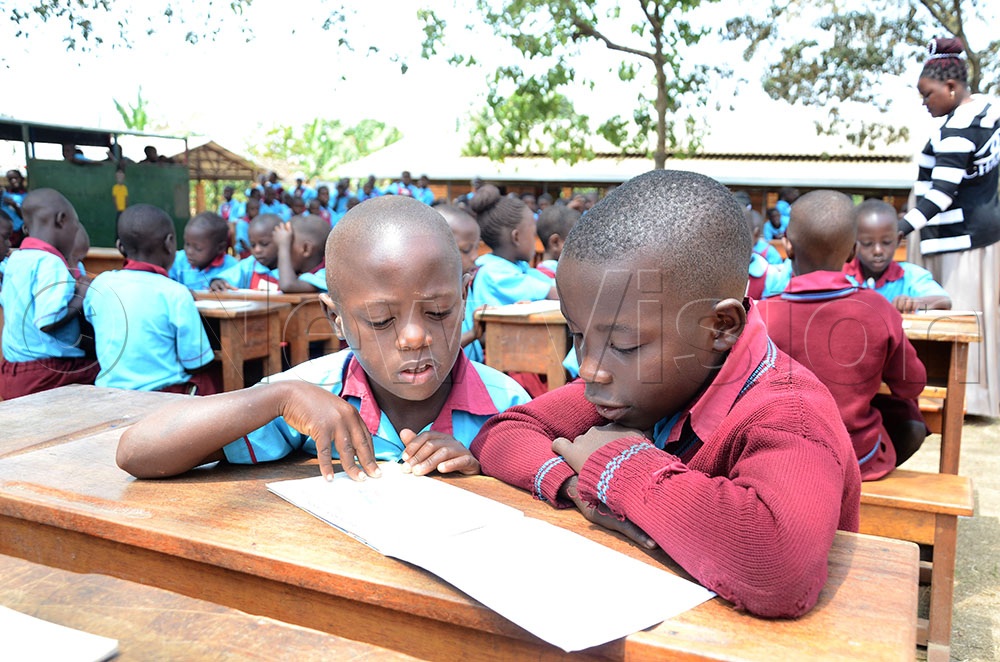
Children reading a story book during the launch of the Writers Program at the school in Lwengo district. (Credit: Lawrence Mulondo)
Winners to receive mentorship
Nsamba said ten of the best stories will be selected from the submissions, with their writers invited to a five-day writers’ residency where they will receive mentorship from renowned authors.
After the mentorship, the young writers will rewrite and refine their stories before one or three winners are selected. Their stories will subsequently be published.
He said the main objective of the programme was to promote literacy, particularly reading and writing.
He explained that while the organisation’s Reading Program had previously focused largely on reading, the Rising Writers Program was intended to strengthen writing and create a more complete literacy programme in schools.
The first season is open to learners aged 10 and above in primary schools.
Lwengo District Inspector of Schools Godfrey Kyambadde said literacy was the foundation of learning because learners cannot effectively interpret or understand information without reading skills.
He commended the programme, saying traditional stories are interesting and can encourage children to develop a passion for reading and writing.
Abu Sekujju, the Education Programs Manager at the foundation, said the organisation supports teacher training and literacy activities in the 15 schools.
He said the foundation had provided reading materials to school libraries since 2024, established reading clubs and introduced reading buddy systems to encourage children to read both at school and at home.
Sekujju said the organisation had identified children with untapped writing abilities and brought celebrated children’s writer Oscar Ranzo on board to mentor young writers.
He said the supported schools currently have 6,784 learners and 246 teachers, adding that improvements were already being seen in children’s reading abilities and academic performance.
He encouraged parents, regardless of their own literacy levels, to support children’s reading and writing at home.
Betty Nalubega, a parent in Lwengo District, said folk tales were the original ethics classes because they taught children about honesty, hard work, respect for elders and the consequences of wrongdoing.
She said documenting the stories would also protect local languages and cultural identity because many folk tales contain proverbs, songs and expressions unique to particular communities.
The chairperson of the Parents Teachers Association at Bunjako Primary School welcomed the writing programme, saying it would help children uncover their hidden talents and express their feelings through storytelling.