
Ugandan students urge AU on tougher action on violence against children
Comfort Ikaidu, 16, highlighted the challenges learners continue to face both at school and within their communities, including bullying and peer violence, sexual harassment and exploitation, corporal punishment and emotional abuse, online abuse and cyberbullying, as well as child neglect and discrimination.
Ikaidu (4th left) with her colleagues during a class discussion. (Credit: Ritah Mukasa)
Three Ugandan students have called on world leaders and policymakers to adopt a tougher stance on violence against children, especially in schools where corporal punishment persists.
Comfort Ikaidu from PEAS Horizon High School in Luweero District, Mukooza Mark from Kingstone High School, Kawempe, and Emma Mudoko from Kololo Senior Secondary School made the call during the Second African Union (AU) Member States Validation Meeting on the Common African Position on Ending Violence Against Children. The virtual event was held from Addis Ababa, Ethiopia, on Friday, July 17, 2026.
The trio, who were among the child delegates from across Africa, urged world leaders to push for a stronger continental commitment to ending violence against children.
Comfort Ikaidu, 16, highlighted the challenges learners continue to face both at school and within their communities, including bullying and peer violence, sexual harassment and exploitation, corporal punishment and emotional abuse, online abuse and cyberbullying, as well as child neglect and discrimination.
According to Ikaidu, these forms of violence not only cause physical injuries but also lead to anxiety and depression among learners, reducing concentration and academic performance. They also contribute to increased absenteeism and school dropouts. Yet many children fear reporting abuse.
"Children learn best where they feel safe, respected and listened to," she said, urging governments to invest more in child-friendly reporting systems, mental health support, and stronger safeguarding measures within schools.
Meanwhile, the students' call follows a landmark ruling on July 14, 2026, in which the Civil Division of the High Court of Uganda declared corporal punishment in schools unconstitutional and illegal.
The recommendations developed during the meeting, coordinated through the African Committee of Experts on the Rights and Welfare of the Child (ACERWC) under the Arise Africa Campaign, will inform Africa's position at the Second Global Ministerial Conference on Ending Violence Against Children, scheduled for October in Manila, Philippines.
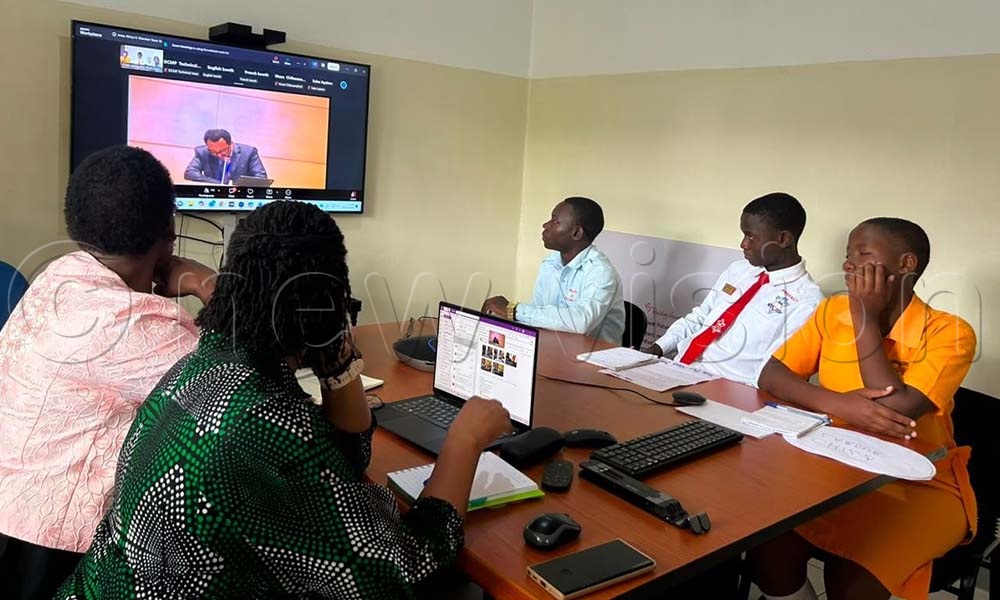
Ikaidu and her colleagues during the AU meeting. (Credit: Ritah Mukasa)
A call to end violence against children
Lawrence Kiggundu, head teacher of St. Pauline High School, Mityana, said safeguarding remains a non-negotiable responsibility for every school.
"Many institutions still underestimate children's safety despite clear legal and moral obligations," he said.
"Employers and employees must understand that protecting children is everyone's responsibility. Schools must become places where every child is protected, respected and empowered to reach their full potential."
"Parents and caregivers should empower children to stand up for themselves, know their rights, recognise unsafe situations and confidently report abuse."
She added: "Children's voices must be heard if safeguarding systems are to work effectively."
Kizito warned that children who grow up in unsafe learning environments often carry the emotional consequences into adulthood. Exposure to violence can damage self-esteem, reduce trust in authority, affect learning outcomes, and increase the likelihood of normalising violence later in life.
Appalling statistics
UNICEF estimates that more than one billion children worldwide experience some form of violence each year, while the World Health Organisation (WHO) identifies violence against children as one of the leading causes of lifelong physical, psychological, and social harm.
Similarly, the Global Status Report on Preventing Violence Against Children 2024 found that although many countries have adopted child protection laws, implementation remains inconsistent, particularly in schools and communities.
According to the Uganda Police Force Annual Crime Report 2025, child-related offences and rights violations decreased by 14.3%, dropping to 8,064 reported cases in 2025 from 9,408 in 2024.
Despite this statistical decline, children remain one of the most vulnerable populations, with severe violations continuing to occur in homes, schools, and communities.