
Students challenged to resist pressure over career choices
“You should examine your personality before settling on a career, while also considering the changing demands of the labour market,” Ajilong noted.
The Fair drew A-level students, filling the hall to the brim as they learned about different career paths. (Photos by Richard Ategeka)
________________
Students have been urged to build careers around their interests, abilities and skills to enable them to solve community problems with passion.
The call was made during the District Career and Pathway Fair at St Mark’s College Namagoma in Wakiso district on September 26, 2026.
Mary Harriet Ajilong, the commissioner for guidance and counselling at the Ministry of Education and Sports, warned students against entering professions simply because their parents or society have chosen them.
“You should examine your personality before settling on a career, while also considering the changing demands of the labour market,” she noted.
The event, organised by the Rotary Club to provide information to learners seeking guidance on what to do after school, attracted hundreds of A-level students who filled the hall.
In her presentation, Ajilong grouped career options into four broad pathways: knowledge-based, skills-based, entrepreneurship-based, and freelance. She encouraged learners to understand the abilities required for each.
Students interested in knowledge-based careers, for example, need to develop strong analytical and reading skills, she said, while those considering hands-on professions should deliberately build practical skills.
Mary Harriet Ajilong, the Commissioner for Guidance, speaking to students from St Mark's College Namagoma during the District Career and Pathway Fair. 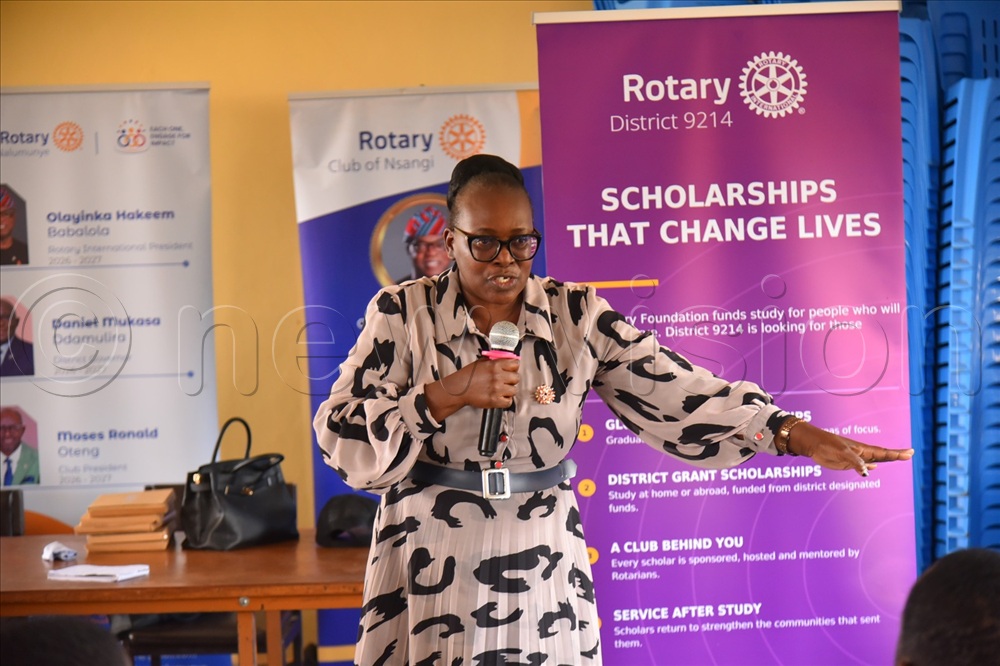
For entrepreneurs, she emphasised self-drive, focus and a willingness to take risks.
It is our future
Hanifa Nakiyembe, who wants to become a neurosurgeon, said her parents have supported her ambition from the beginning.
“They always lead me to what I want because it’s overall my future, not anyone else’s future,” she said.
She advised parents to encourage their children rather than push them into careers they do not want.
“Everyone needs to be given a chance to do what they believe they can do best,” she said.
For Timothy Mukiza, a PCM student who wants to pursue medicine and eventually specialise in dermatology, the situation was different.
His parents initially wanted him to become an engineer, but he said he lacked passion for the profession and eventually chose medicine.
The same tension emerged in the experience of David Murinda, another Senior Six student who originally wanted to study law but was pushed towards sciences by his parents.
His experience illustrates the uncertainty some students face when their interests collide with family expectations.
Rotary’s intervention
Florence Mugoya Malinga, president of the Rotary Club of Muyenga Bukasa and chairperson of the District Scholarships programme, said the fair was organised as part of Rotary’s September focus on Basic Education and Literacy.
Rotarians had spent the month visiting schools and participating in reading activities before concluding with the career fair at St Mark’s College Namagoma.
Malinga said the intention was to expose students to real experiences from professionals rather than leaving them to make career decisions based on limited information.
“There are always challenges among children when they are selecting careers,” she said.
About 40 Rotarians from different professional backgrounds participated, according to the school.
Qualifications vs employability
Justine Nassimbwa Mayanja, Director of Studies at St Mark’s College Namagoma, said the school already has a careers department and organises career activities, but bringing large numbers of experienced professionals to interact directly with students is difficult.
She said the Rotary initiative gave students an opportunity to ask questions about courses and professions from people who had spent years working in those fields.
But the conversations also went beyond university qualifications.
Joseph Lwevuze, an IT expert in digital pedagogy, instructional design and cybersecurity, told students that academic qualifications alone do not guarantee employment.
“Academics simply give you a foundation,” he said. “But we need to have a skill. You need to have social skills.”
Graphic designer Jackline Kyomukama made a similar point from an employer’s perspective, saying some graduates arrive at workplaces without the self-drive and practical skills employers expect.
Kyomukama herself studied accounting and finance before discovering that her real strength was in art.
“I did industrial art later on after realising that actually that’s where my passion and talent is,” she said.
She now runs a graphic design, printing and branding company and employs other people.
For students such as Alvera Ankunda, who wants to study medicine and specialise in dermatology, the fair broadened her understanding of what it means to prepare for a career.
She said she learnt that creativity and specialisation could help create opportunities in a competitive field.