
Poor hygiene in schools fuelling dropouts among girls
Ombere revealed that in West Nile, a pit-latrine is shared by an average of 81 girls, double the national standard of 40.
(L-R) Cleophus Mugenyi, the Director Basic and secondary Education at Ministry of Education interacting with Joyce Moriku Kaducu, the State Minister of Education and Mary Goretti Nakabugo, the Executive Director UWEZO Uganda during the conference at Hilton Garden Inn on October 1, 2025.(Photos by Mary Kansiime)
________________
In many Ugandan schools, poor hygiene remains one of the silent barriers pushing girls out of classrooms. From crowded toilets to lack of water and privacy, the problem continues to undermine the country’s efforts to keep more girls in school.
According to Raymond Ombere Obiayi, the Inspector of Schools in Arua Municipal Council, the situation is dire. While speaking to New Vision Online, he said limited funding has left schools dependent on unwashed pit latrines, creating health and safety concerns.
“Girls are exposed to urinary tract infections, and some prefer to relieve themselves outside rather than use dirty facilities,” he explained.
Ombere revealed that in West Nile, a pit-latrine is shared by an average of 81 girls, double the national standard of 40.
He noted that while the introduction of reusable sanitary pads has helped, their use remains limited in rural areas due to poverty and lack of awareness.
“In one case here in my district recently, a girl was told by her mother to marry once the girl told her she had started her menstruation. The mother told the girl that she too got married when her periods began,” he added, describing how early puberty, poverty, and cultural beliefs combine to cut short many girls’ education.
Persistent sanitation gaps in schools
Education inspectors across the country say poor sanitation has been a long-standing issue. Ombere says the growing number of learners has overwhelmed existing facilities, while the Public Health Act’s standards are rarely met.
He also linked delayed enrolment to higher risks of sexual violence, noting that over-aged girls in lower classes are often more vulnerable.
A 2024 health and sanitation report from Lugazi municipality showed that several schools still lack proper waste disposal systems, exposing learners to infections and driving absenteeism.
Rosette Nanyanzi, the Gender Technical Advisor at Ministry of Education addressing the delegates about girl child education during the conference at Hilton Garden Inn on October 1, 2025.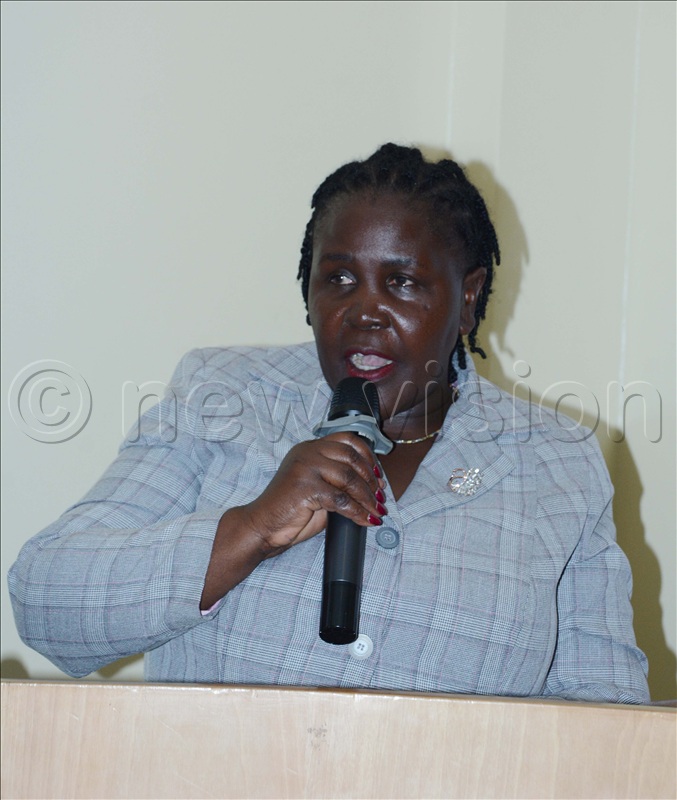
Local authorities admitted that efforts to build gender-sensitive toilets and water sources stalled because of funding gaps.
These concerns dominated discussions at the National Conference on Girls’ Education, organized by Uwezo Uganda in partnership with Kyambogo University’s School of Education, the University of Cambridge’s REAL Centre, and RELI-Africa Uganda Chapter.
The three-day conference, themed “Breaking Barriers, Building Futures: Evidence and Action for Girls’ Education,” brought together educators, policymakers, and gender advocates to explore how sanitation, mindset change, and mentorship can improve girls’ learning outcomes.
Education ministry director of education standards Frances Atima said despite improvements in gender sensitivity among teachers, poor hygiene remains a major obstacle.
“The level of hygiene in schools is very worrying, both in dormitories and toilets. We are currently doing an ongoing inspection, and the pictures my team is sending are quite concerning. These are barriers we must tackle head-on if we want to nurture responsible women and mothers of the future,” she said.
Her remarks mirror the experiences of students in Buliisa district. In April 2025, Senior Five student Lynet Karungi told New Vision Online that 400 learners share a few latrine stances at her school.
Gender activists have too long demanded stronger government intervention. At a 2024 women’s rights dialogue in Kampala, advocate Nadia Matovu urged authorities to fund separate washrooms for girls equipped with water, soap, and proper disposal points.
Government promises action
Primary education state minister Dr Joyce Moriku Kaducu acknowledged that while girls’ enrolment under Universal Primary Education has improved, accounting for 52.5% of those completing primary school, quality and retention remain concerns.
She said boys continue to outperform girls in science and mathematics, urging greater investment in mentorship and skills training.
“The majority of girls drop out after PLE, with many getting married early. We need to build the bridge to secondary and tertiary education if we are to empower the girl child,” she noted.
Kaducu called for co-ordinated action among teachers, parents, and local leaders.
“It is time to move away from endless statements to action-oriented solutions. Teachers and administrators are our frontline soldiers, but we must all play our part to ensure no child is left behind,” she added.
Call for inclusion
Statistics from the World Bank (2024) show that about five million Ugandan girls lose up to 18% of their annual school time due to menstruation-related challenges. Education experts agree that improving sanitation is no longer optional, it is essential for achieving equitable learning.
The stories from Buliisa, Lugazi, and Arua all highlight a shared truth: girls cannot learn with dignity in schools that lack clean toilets, water, and safe spaces.