
Overseas scholars drawn to China's scientific clout, funding
China's official enticements have typically targeted eminent researchers in science, technology, engineering and mathematics (STEM) fields that could help Beijing achieve its goal of becoming the global leader in technology and innovation.
Chinese students walking at Beijing Foreign Studies University in Beijing. (AFP)
________________
SHANGHAI - China's government has long made efforts to tempt top scientists from abroad, but researchers say its institutions themselves are increasingly attracting talent thanks to their generous funding and growing prestige.
State-backed initiatives like the Thousand Talents Plan have dangled fast-tracked hiring and bountiful grants to lure overseas experts in strategically important fields, as China and the United States vie for technological supremacy.
But academics told AFP the country is becoming a popular destination even among those not targeted by Beijing, especially at the start of their careers.
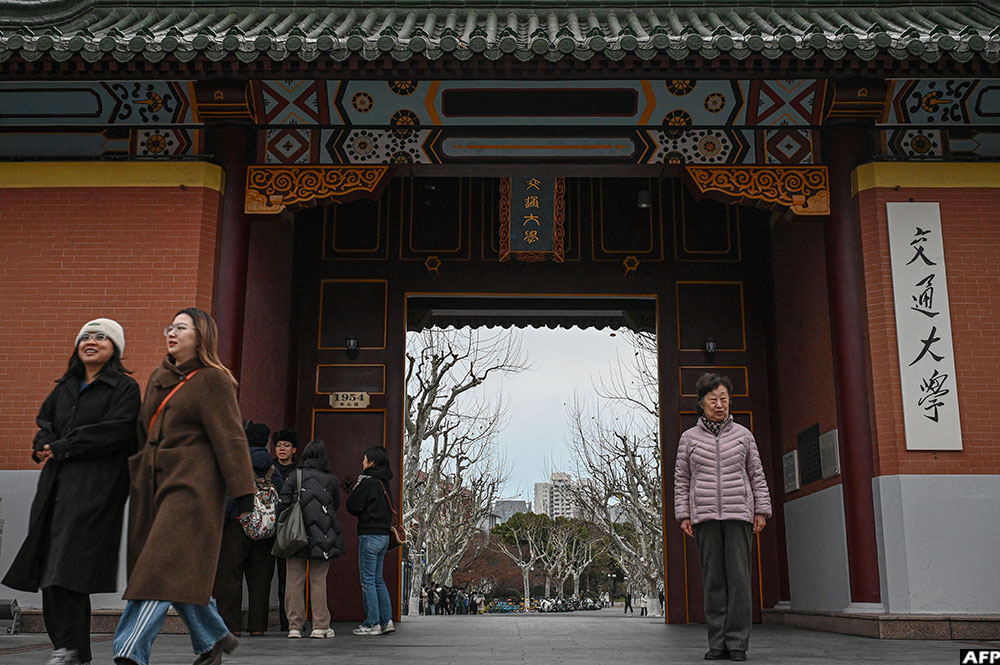
An elderly woman (R) poses for a photo at an entrance of the Shanghai Jiao Tong University in Shanghai
"You hear about these amazing advanced labs and the government providing money for things like AI and quantum research," said Mejed Jebali, an artificial intelligence PhD candidate from Tunisia at Shanghai Jiao Tong University.
"The scale of the research and how fast things get built is really amazing."
China's official enticements have typically targeted eminent researchers in science, technology, engineering and mathematics (STEM) fields that could help Beijing achieve its goal of becoming the global leader in technology and innovation.
There is no official database of foreign or returnee scientists moving to China, but at least 20 prominent STEM experts have done so in the past year, according to university and personal announcements reviewed by AFP.
They included cancer expert Feng Gensheng, who left a tenured University of California role for Shenzhen Bay Laboratory, and German medical scientist Roland Eils, now part-time at Shanghai's Fudan University.
"It appears that a significantly greater number of overseas scientists -- particularly those of Chinese origin -- have returned to work in China compared with around 10 years ago," said Futao Huang, a professor at Japan's Hiroshima University.
Academics cited access to rapidly developing industries in China's massive market as a draw.
Lingling Zhang, who joined the China Europe International Business School after two decades in the United States, told AFP she was drawn to more "pragmatic" research.
She said career considerations drove her decision more than the specific prospect of moving back to China.
"I actually have great access to a large number of entrepreneurs and business people," she said.
The pace of industrial development means more opportunities for "academically grounded but application-oriented research", said a materials scientist who moved to China from a European university, who asked to remain anonymous.
"The quality of papers produced by top Chinese institutions today is in no way inferior to that of leading US or European universities, and in some areas is highly competitive or even leading," he said.
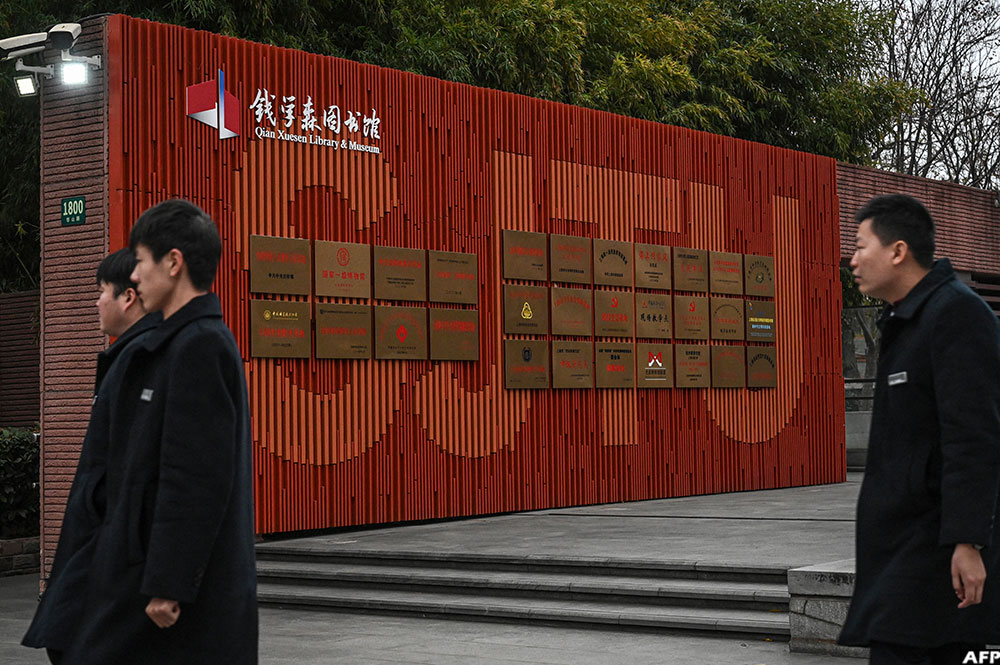
Security guards walk past signage for the Qian Xuesen Library at Shanghai Jiao Tong University in Shanghai
China's reputation for academic prowess in many fields has become undeniable. Four of the top five leading research institutions in natural and health sciences in 2025 were Chinese, according to an index by the journal Nature.
That is a change from the past, when US and European institutions held sway.
But in the last five years, "the funding, resources and support" available -- far more than overseas -- changed the calculus.
Cultural divide
For academics of Chinese descent working in the United States, there are push factors, Hiroshima University's Huang said.
"The tightening of research security regulations, visa scrutiny, and political sensitivities in the United States has created uncertainty."
A 2023 study found that following a 2018 Trump administration policy to investigate potential Chinese spies in research, departures of China-born, US-based scientists increased by 75 percent.
But challenges remain for those who relocate to China.
Huang pointed to concerns over academic freedom and autonomy, and "geopolitical uncertainties that influence international perception and mobility decisions".
China tightly controls the flow of sensitive information -- for example, a European natural scientist told AFP he could not collaborate with Chinese institutes linked with military research due to the potential political sensitivity.
Markku Larjavaara, a Finnish forestry expert who until recently worked at Peking University, said he did not feel that censorship was a major issue in his field.
But he grew uncomfortable with Beijing's political climate after Russia's 2022 full-scale invasion of Ukraine, due to China's close relationship with Moscow.
Interviewees also described having to overcome cultural differences.
The materials scientist said it took time to adjust to a Chinese academic environment that emphasised personal relationships and social interaction, compared to a Western environment "where processes tend to be more impersonal and rule-based".
Still, "for young faculty who are motivated to build a research programme and make tangible progress, returning (or moving) to China is a very reasonable -- and in many cases attractive -- option", he said.