
Over 700 education experts to gather in Uganda for curriculum conference
According to Dr Richard Irumba, deputy director at NCDC and chairperson of the conference organising team, the response to the conference has been encouraging, with participants expected from more than 20 countries.
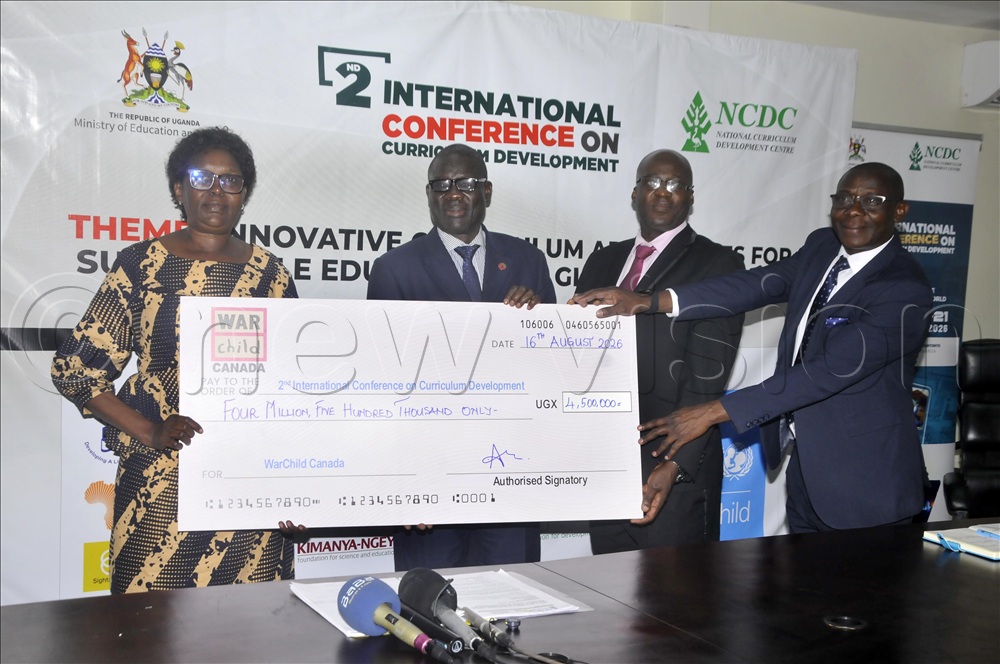
NCDC Officials (L-R) Angela Kyagaba (Manager Quality Assurance), Dr Richard Irumba (Deputy Director), Prof George Ladaah Openjuru (Chairperson NCDC Council), Dr Patrice Ssembirige (Acting Director), and Dr Pamela Nizeyimana (Manager Research) pose for a group photo after addressing a press conference at Kyambogo 16 August 2026. (Photos by Wilfred Sanya)
________________
More than 700 delegates are expected to attend the Second International Conference on Curriculum Development, the National Curriculum Development Centre (NCDC) has announced.
The announcement was made on Sunday (August 16) at NCDC headquarters in Kyambogo during a press briefing ahead of the international conference, which is expected to bring together education policymakers, researchers, teachers, curriculum specialists and other stakeholders to discuss the future of education and curriculum development in Uganda.
According to Dr Richard Irumba, deputy director at NCDC and chairperson of the conference organising team, the response to the conference has been encouraging, with participants expected from more than 20 countries.
“We have received submissions from educators, researchers, practitioners, and other stakeholders from more than 20 countries. More than 700 delegates have confirmed their attendance, both physically and online,” Dr Irumba said.
He said the conference comes at a time when education systems are facing rapid changes driven by technology, artificial intelligence and evolving demands in the labour market.
“We are living in an era in which education must rapidly adapt to meet the demands of the twenty-first century. Technological advancements, including artificial intelligence, are transforming societies and changing expectations of what education systems should deliver,” he said.
He said the conference will focus on a broad range of issues, including ICT and digital transformation, education for sustainable development, global citizenship, climate education, competency-based education, vocational education and training, skills development, entrepreneurship, inclusive education and teacher training.
Other areas will include innovation in instructional materials, curriculum development, early childhood care and education, as well as emerging approaches to teaching and learning.
Dr Irumba said NCDC received more than 130 abstracts for consideration, which underwent a peer-review and quality-assurance process before papers were selected for presentation.
Delegates are expected from countries including the United Kingdom, United States, Australia, the Netherlands, India, Kenya, Tanzania, Mozambique and Nigeria, among others.
The conference will also feature keynote presentations, exhibitions of educational materials and innovations, research presentations and networking opportunities.
Professor George Ladaah Openjuru, chairperson of the NCDC Council and vice chancellor of Gulu University, said the conference provides an important opportunity for Uganda to learn from international experiences while also sharing its own knowledge and innovations.
“Education is not only about knowledge and skills. It is also about developing values, attitudes, competencies, and the capacity to contribute meaningfully to society,” Prof. Openjuru said.
He stressed that Uganda's curriculum must remain responsive to the aspirations of the country and changes taking place globally.
“Our curriculum must therefore remain responsive to the aspirations of our people and to the changes taking place internationally,” he said.
Prof. Openjuru said international curriculum conferences provide an important platform for research, exchange of ideas and collaboration among education professionals.
“As we learn from others, they also learn from us. The impact of such engagement is therefore international,” he said.
He added that curriculum development should be guided by evidence, stakeholder experiences and Uganda's development priorities.
“The conference will generate evidence, practical recommendations, and partnerships that can help strengthen curriculum development and its implementation,” he said.
Openjuru commended the Government, through the Ministry of Education and Sports, for its continued support for curriculum development and reform.
Changes in curriculum
Dr Patrice Ssembirige, deputy director in charge of curriculum review and instructional materials development at NCDC, said the ongoing curriculum reforms are intended to equip learners with competencies needed to succeed in a rapidly changing world.
He said the curriculum places greater emphasis on learner-centred approaches, critical thinking, creativity, problem-solving and the practical application of knowledge.
“The competency-based curriculum is intended to equip learners with the skills they need to compete effectively in a rapidly changing world and in the global economy,” Dr Ssembirige said.
“All curriculum materials therefore have to go through the appropriate approval processes to ensure that they are aligned with national priorities and the direction in which we want to take Uganda's education system,” he said.
Dr Ssembirige said NCDC has already undertaken several curriculum reforms and is working on further reviews at different levels of education.
Childhood education
The NCDC official highlighted the importance of ensuring that early childhood education is appropriate to children's developmental needs.
Dr Ssembirige said the curriculum for young learners focuses on areas including physical, cognitive, language and social-emotional development.
“Learning activities at this age therefore need to be appropriate to the children's developmental stage. Young children should not be expected to spend the same amount of time in school as older learners,” he said.
He added that teachers need to be adequately equipped to understand the learning needs of children at different stages of development.
AI and ICT usage
Responding to queries from journalists, NCDC officials acknowledged that access to ICT remains uneven among schools and learners but said government programmes are being implemented to expand digital infrastructure.
Dr Irumba pointed to initiatives by the Government, through institutions including the Uganda Communications Commission and the Ministry of ICT and National Guidance, aimed at increasing access to ICT facilities.
Dr Irumba said the conference will also examine how different countries are responding to the rapid development of artificial intelligence and other technologies in education.
He noted that while AI presents opportunities for improving education, countries are adopting different approaches to its regulation and use.
The education expert said the conference is ultimately intended to provide a platform for education stakeholders to share evidence, experiences and innovations that can contribute to strengthening Uganda's education system.
Dr Irumba urged participants and stakeholders to use the conference to build partnerships and share knowledge.
“Together, we can create a dynamic platform where ideas flourish, partnerships grow, and meaningful change takes place,” he said.