
Newspapers serve as readers, learning aids in Nwoya school
The school receives 25 copies of the Weekend Vision and Toto Magazine every week under the Newspapers in Education (NiE) programme implemented by Save the Children, an organisation that saves and cares for children around the world.
Pupils expressing the joy of owning a copy of the newspaper. (Photo by Ritah Mukasa)
__________________
“Whenever I enter the Primary Four class on Tuesday for the English lesson, I find the pupils engrossed in Toto Magazine activities. Some don’t even realise that I have entered the class,” Mildred Alok Anena, head teacher of Kamguru Primary School located in Lungulu sub-county in Nwoya district, says.
The school receives 25 copies of the Weekend Vision and Toto Magazine every week under the Newspapers in Education (NiE) programme implemented by Save the Children, an organisation that saves and cares for children around the world.
To Anena, these newspapers are not only instructional materials for the teachers but also good learning aids for the children who use them regularly.
In lower primary, she says, children learn from seeing the cartoons, reading stories, matching and filling in the puzzles. And the pictures are not just about painting. They bolster creativity in the children as well. But also, some stories, especially about the environment and personal hygiene, inspire the learners to maintain personal hygiene. For example, some of her pupils now put on shoes and stockings. They ensure to bathe and wash their uniforms in order to be smart like the children they see in the papers.
Most importantly, Anena points out that newspapers can be used as an enticement to keep the children in school. This trick has worked for her. When she was posted to this school two years ago, she found the total enrolment at 100 pupils. Some classes had less than 20 pupils.
However, instead of looking on with folded hands, Anena initiated a campaign of sending children to school. Together with teachers and well-wishers, they went door to door, persuading parents to enrol their children. Then, partners, including Save the Children, supported the campaign by offering donations, such as newspapers, which Anena says have partly helped retain children in school.
“Our campaign has paid off. We now have 245 pupils and expect more by the end of the year,” she says.
Similarly, their 39 candidates are banking on PASS PLE questions and answers to pass.
“We don’t have the money to print weekly tests for candidates like the case in urban schools. We rely on PASS PLE, and I am optimistic it will help them to pass,” Anena says.
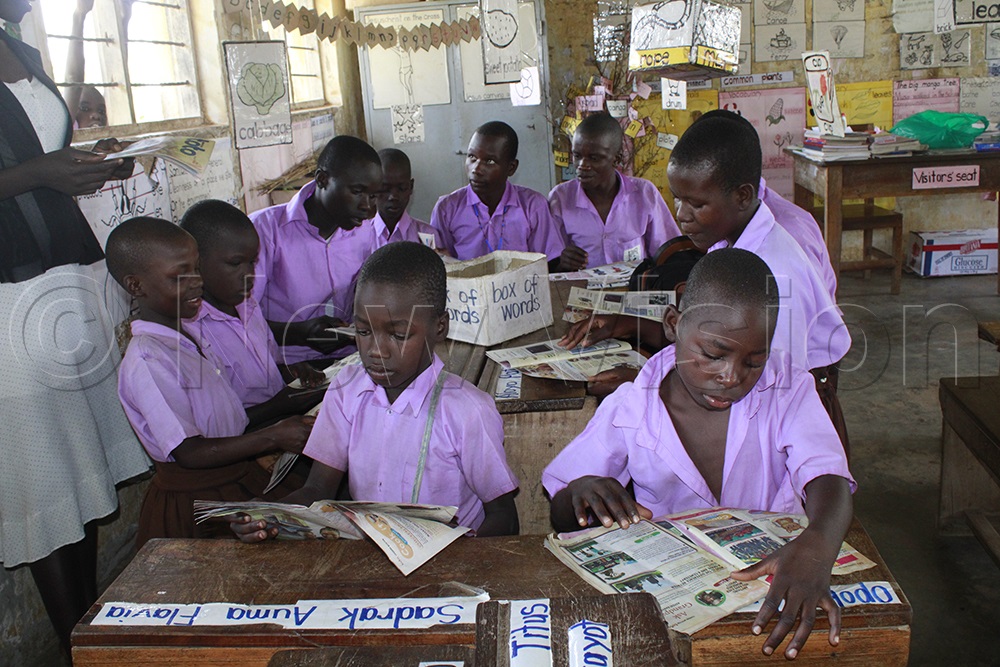
Pupils of Kamguru Primary School in Nwoya District read stories in Toto Magazine. (Photo by Ritah Mukasa)
In the same vein, Mercy Angerwot, class teacher, Primary One, thanks Save the Children for the Toto Magazines, which she says simplify her work and at the same time, they make learning exciting and engaging for her pupils.
Every week, Angerwot distributes the magazines among her 43 learners and assigns them work to do depending on the activities therein. They join dots to form pictures and letters, find missing letters, search for words and fill in the puzzles. They also read out stories, match words to pictures, pictures to letters and pictures to pictures.
She also used to spend a lot of time preparing homework in the pupils’ books, but these days, they copy questions from the magazine, answer them from home and take the books for marking. Children are also given the magazines to take to their parents and siblings.
About the NiE program
The Newspapers in Education (NiE) programme is being funded by the Norwegian Agency for Development Cooperation (NORAD) through Save the Children in partnership with New Vision. NORAD is implementing a five-year programme from 2024 to 2028 called “Transforming the Future-For and with Children” in the Acholi and Karamoja regions. The program aims to ensure that all children enjoy their rights to survival, protection, development and participation in a safe, inclusive, accountable and resilient environment.