
Muyingo credits education reforms for shrinking reliance on expatriates
According to the minister, sustained investment in education has significantly strengthened local capacity, enabling Ugandans to take charge of roles once dominated by expatriates.
(L-R): Nathan Itungo, Dr Samuel Abimerech Luboga, Dr Violet Kajubiri Froelich, Dr John C Muyingo, Jacob Richards Opolot, Justice Dauglas Singiza and James Kubeketerya during the Education Service Commission Annual Performance Review at the Serena Hotel, Kigo on March 30, 2026. (Photo by David Lukiiza)
________________
Uganda is steadily reducing its reliance on foreign expertise and is nearing self-sufficiency in managing critical sectors, higher education state minister Dr John Chrysostom Muyingo has said.
According to the minister, sustained investment in education has significantly strengthened local capacity, enabling Ugandans to take charge of roles once dominated by expatriates.
“At one time, we depended heavily on foreign experts to manage key government functions, including the Uganda Revenue Authority. But today, because of deliberate investment in education, Ugandans are fully managing critical sectors of the economy,” Muyingo said.
He was speaking at the opening of the Education Service Commission (ESC) Annual Performance Review meeting at Serena Hotel, Kigo, on March 30, 2026.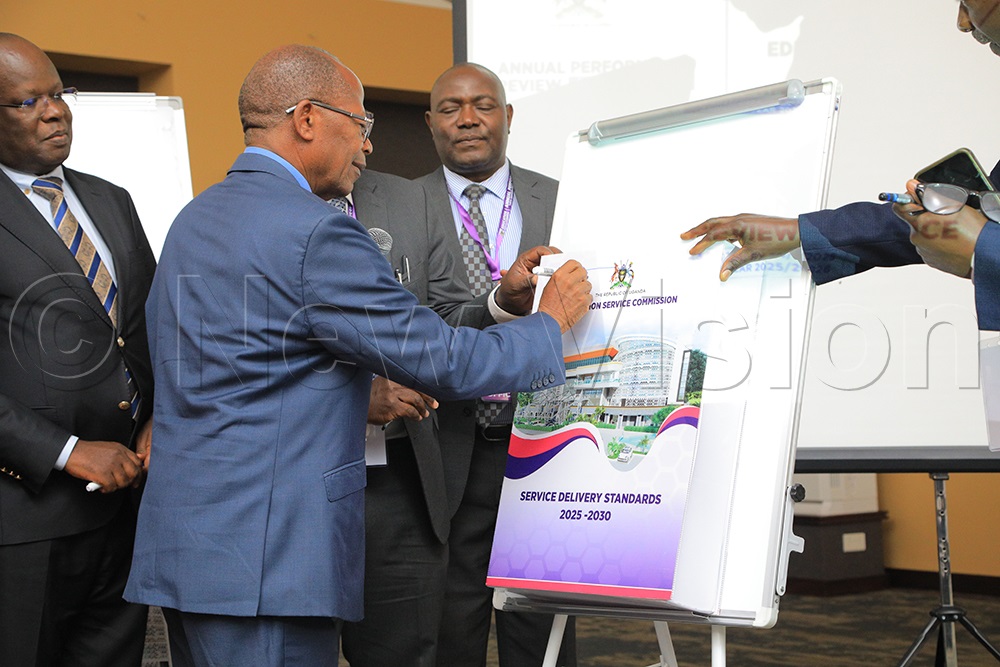
Dr John Chrysostom Muyingo signing on the Education Service Commission on Service Delivery Standards during the Annual Performance Review report on March 30, 2026, at Serena Hotel Kigo in Wakiso. (Photo by David Lukiiza)
The three-day retreat has drawn more than 200 stakeholders, including commissioners, newly appointed headteachers, and senior government officials.
Representing the First Lady and Minister of Education and Sports, Janet Museveni, Muyingo underscored the central role of education in sustaining Uganda’s transition towards self-reliance.
“Government’s investment in education remains the most powerful engine for propelling Uganda towards a modernised society,” he said.
Muyingo said Uganda’s progress in localising expertise must now be consolidated through deliberate reforms aimed at strengthening the quality, relevance, and inclusivity of education.
He outlined three key pillars guiding the sector, including access, quality, and balance, noting that these are essential to producing graduates capable of driving national development without external support.
Under access, he said the government continues to expand Universal Primary and Secondary Education, including the rollout of seed secondary schools in every sub-county under the Uganda Intergovernmental Fiscal Transfers Programme (UGIFT).
On quality, the minister highlighted reforms in technical and vocational education to equip learners with practical, job-ready skills that meet the country’s labour market demands.
The third pillar, balance, focuses on holistic education, ensuring learners acquire not only academic knowledge but also critical thinking, social skills, and practical competencies.
Headteachers tasked
Muyingo challenged newly appointed headteachers to play a central role in delivering this vision, warning that school leadership must shift from routine administration to results-oriented management.
“Your appointment is not just an honour; it is a responsibility and an opportunity to innovate. The future will demand results,” he said.
He called for integrity, professionalism, and accountability in managing schools, alongside effective curriculum implementation and transparent use of resources.
Muyingo commended the ESC for aligning its work with the National Development Plan IV and the NRM manifesto, noting that performance reviews are critical in ensuring that investments in education translate into tangible outcomes.
“Without rigorous assessment, government would be investing blindly, which is unacceptable,” he said.
ESC chairperson Prof. Samuel Luboga said the commission has reinforced transparency and responsiveness in its operations, particularly in recruitment.
“When we interact with the people we serve, we must be accountable. Letters are responded to promptly, phone calls are returned, and every concern is addressed—or we commit to finding an answer,” he said.
He emphasised that recruitment into the teaching service is strictly merit-based to ensure that competent professionals lead Uganda’s classrooms.
“We are committed to merit so that those who perform well are not overtaken by those who do not,” he said, adding that the commission promotes gender balance and inclusion of persons with disabilities.
Funding gaps
Despite the gains, Prof. Luboga acknowledged that limited funding remains a major constraint to achieving quality education.
“Studies on the unit cost of educating a child clearly show that current allocations are insufficient. Government plans to raise capitation grants to at least three times the current levels over the next few years,” he said.
He noted that increased funding would help address persistent gaps in staffing, infrastructure, and learning materials. These, he said, are key elements in sustaining Uganda’s skills base.
National priorities
ESC deputy chairperson Violet Kajubiri said the commission’s strategy remains aligned with the National Development Plan IV and broader economic growth frameworks.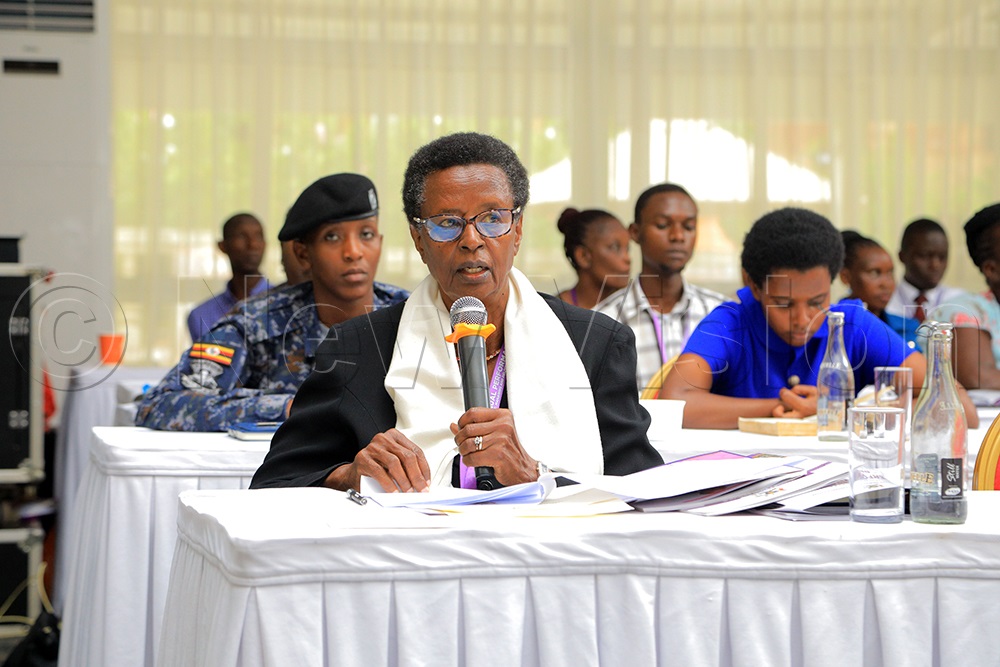
Dr Violet Kajubiri Froelich addressing headteachers during the Education Service Commission Annual Performance Review at Serena Hotel, Kigo on March 30, 2026. (Photo by David Lukiiza)
“Our strategy, certified by the National Planning Authority, is fully aligned with NDP IV, the 10-point GDP growth strategy, and other frameworks,” she said.
She added that programmes such as UGIFT II will streamline recruitment, particularly for seed secondary schools, improving efficiency and coordination.
“This is not just a review—it is a moment to reflect, reset, and recommit ourselves to excellence in service delivery,” Kajubiri said.