
Muni University teaching, research hospital groundbreaking set for Friday
“The money was deposited on our account at the Central Bank. So there is no doubt about it. On the 21st, when the groundbreaking ceremony will be held, we expect work to start,” Prof. Anguma said in an interview on August 18.
Muni University Vice Chancellor Prof. Simon Anguma Katrini (C) said the university has received Shs20 billion of the Shs30 billion initially expected for the project, putting the institution in a position to commence works. (Credit: Joh Paul Opio)
ARUA - Preparations are in high gear at Muni University ahead of the groundbreaking ceremony for the long-awaited Muni University Teaching and Research Hospital on Friday, August 21, 2026.
University officials say the project is intended to strengthen medical education, clinical training and health research while responding to the growing demand for doctors and specialised medical services in West Nile.
Different district officials in Arua City expect President Yoweri Museveni to preside over the events.
The ceremony is expected to bring together government officials, university leaders, health professionals, local leaders and other dignitaries as the institution formally begins construction of the facility.
Muni University Vice Chancellor Prof. Simon Anguma Katrini said the university has received Shs20 billion of the Shs30 billion initially expected for the project, putting the institution in a position to commence works.
“The money was deposited on our account at the Central Bank. So there is no doubt about it. On the 21st, when the groundbreaking ceremony will be held, we expect work to start,” Prof. Anguma said in an interview on August 18.
Regional health gap
For patients requiring specialised services, referral to larger hospitals outside the region can mean additional costs, long journeys and delays in accessing care.
A teaching and research hospital attached to a university could potentially reduce some of these pressures while providing a clinical environment for training future health professionals.
Prof. Anguma said the shortage of doctors and specialists remains one of the major challenges facing Uganda's health sector.
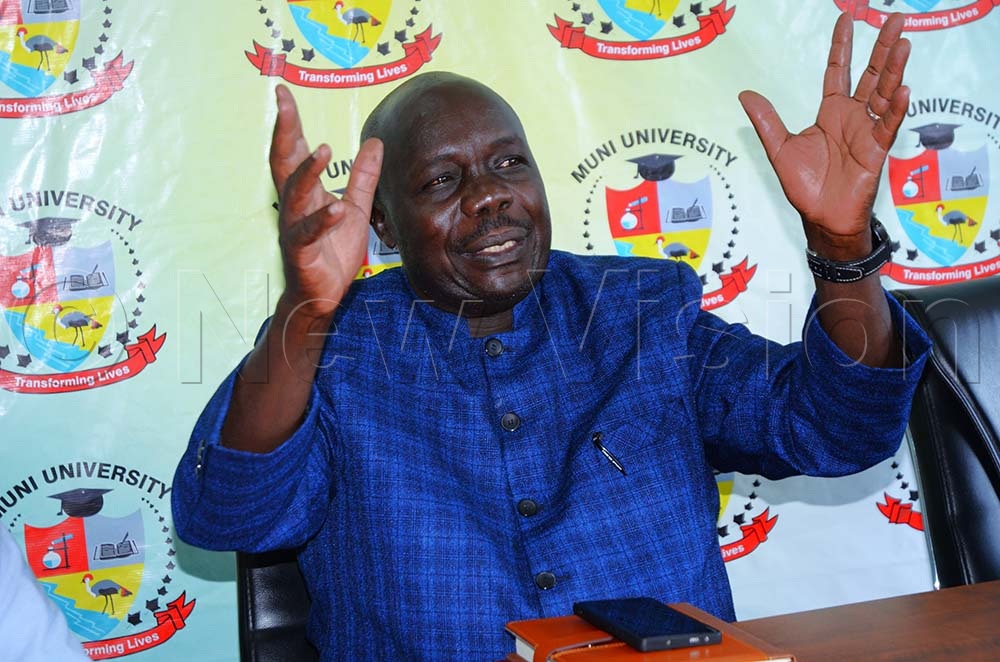
“The money was deposited on our account at the Central Bank. So there is no doubt about it. On the 21st, when the groundbreaking ceremony will be held, we expect work to start,” Prof. Anguma said in an interview on August 18. (Credit: John Paul Opio)
He cited what he described as a significant gap between the number of doctors available and the population requiring their services, particularly in specialised areas of medicine.
“Doctors are not enough. The situation worsens n when it comes to specialised fields of medicine,” Anguma lamented.
He pointed to fields such as urology and dermatology as examples of specialist services that remain difficult to access in many parts of the country.
The university therefore sees the teaching hospital not merely as another healthcare facility, but as part of the infrastructure required to train doctors and other health professionals in specialised disciplines.
From classroom to clinical practice
Rev. Fr. Prof. Odubuker Picho Epiphany, the Deputy Vice Chancellor for Finance and Administration at Muni University, said effective medical training requires students to work in a properly equipped clinical environment.
He said the proposed facility is expected to bridge the gap between classroom-based instruction and practical clinical training.
“In order to be able to give good medical care, a lot of research is needed, which the ordinary hospital does not do. Equally, you need properly qualified personnel,” Prof. Picho said.
He added that medical professionals cannot acquire all the competencies required to treat patients through classroom teaching alone.
“They must have a clinical environment, which makes their quality worthy of working on human beings,” he said.
The university argues that the hospital will consequently serve three connected purposes: providing healthcare, supporting medical education and creating an environment for health research.
Background
Muni University is a public university located in Arua, West Nile. Its development has been closely linked to efforts to expand higher education and professional training in the sub-region.
The proposed teaching and research hospital is expected to strengthen the university's health sciences training and research capacity while providing an additional platform for clinical services in the region.