
Learners urged to embrace spirit of Pan-Africanism
The call was made during the 8th Inter University Symposium on Pan Africanism and Reparatory Justice at Makerere University's main campus in Kampala on Thursday.
His Highness Papa Paul Egandaa with his wife Queen Grace Eganda alongside Prof. Henry Alinaitwe, the Deputy Vice Chancellor Finance and Administration at Makerere University and other leaders pose for a photo. (Photo by Derrick Muduku)
_________________
Learners have been encouraged to prioritise the Pan-African values of solidarity and cultural identity in their academic endeavours, a move seen as one to brighten the continent’s future prospects.
The call was made during the 8th Inter University Symposium on Pan Africanism and Reparatory Justice at Makerere University's main campus in Kampala on Thursday.
It was held under the theme, ‘Pan African Intellectualism: The Urgency to Defend the Dignity and Future of the African People’.
Led by His Highness Papa Paul Jones Eganda, the Founder and Global President of Aido International Network, a team of traditional leaders from as far as the Caribbean and the Americas convened to take part in the event to mark the celebrations of the 63rd African Liberation Day.
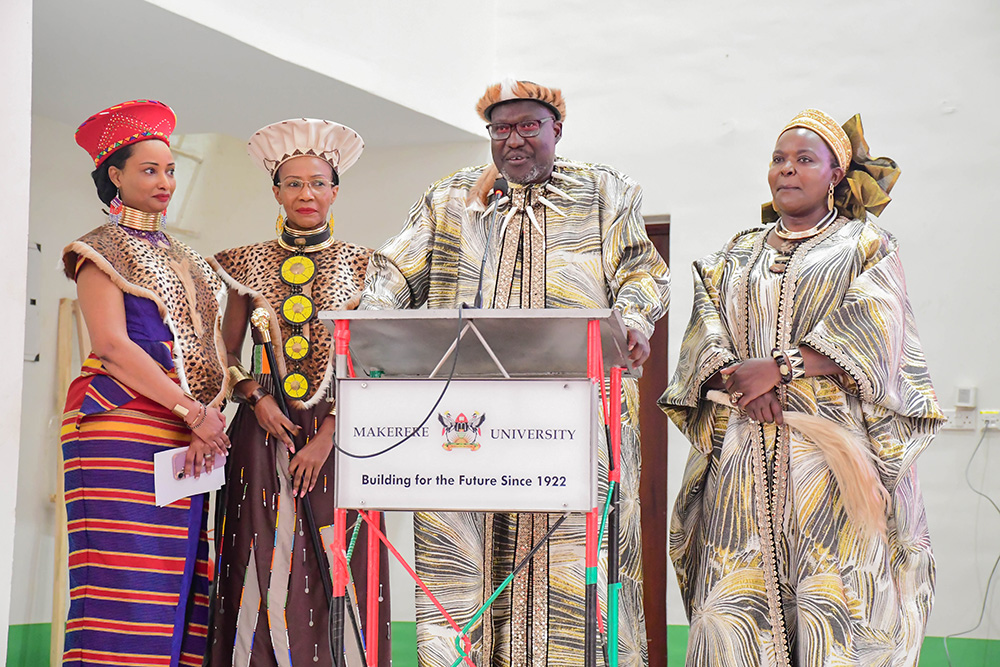
His Highness Papa Paul Eganda, the Founder and Global President of Aido Network International(C), his wife Queen Grace Eganda(L) alongside other royal members, speaks at the event. (Photo by Derrick Muduku)
Prof. Henry Mwanaki Alinaitwe, the Deputy Vice Chancellor in charge of finance and administration, represented Vice Chancellor Prof Barnabas Nawangwe.
He re-echoed the role of institutions in promoting the Pan-African doctrines among learners.
“This comes at a time when Africa is redefining its place in a rapidly changing multipolar world. Our institutions of higher learning must rise to this responsibility by generating African-centred knowledge."
Alinaitwe noted that through research, collaboration, and innovation and cultural diplomacy, Africa has an opportunity to strengthen the intellectual and moral foundation of Pan-Africanism for present and future generations.
He appealed for strong continental and diaspora solidarity and created practical pathways for justice, innovation and collective development through knowledge, freedom and cooperation.
Technology
Neo-colonial global trends continue to affect developing countries, and according to Prof. Eria Hisale, a lecturer at Makerere University, giving Africa aid continuously keeps it under the surveillance and authority of developed nations.
For Africa to bridge the gap and realise self-sustainability, he recommended technological development and innovation as the way to break the dependence syndrome, as the continent will be able to produce more of its own instead of heavily relying on foreign aid.
Neo-colonial global trends continue to affect developing countries, and according to Hisale, giving Africa aid continuously keeps it under the surveillance and authority of developed nations.
“They appear to be giving us quick and simple solutions to our problems. You want a market for your goods you export the raw materials. But in the process, independence issues and lack of self-reliance cripples in."