
Japan injects sh282m into Kiryandongo school expansion
The project, valued at approximately $82,765 (sh282.8m), was unveiled during a Grant Contract Signing Ceremony held at the Embassy of Japan on Kyadondo Road in Kampala on Monday (November 9).
The Japanese Ambassador to Uganda, Takuya Sasayama (left), and the chief administrative officer of Kiryandongo, Anselm Kyaligonza, displaying copies of agreements to fund water and education in Kiryandongo district during the pact signing ceremony at the Embassy of Japan in Kampala on Monday Novemeber 9, 2026. (Photo by Francis Emorut)
_________________
More than 2,000 learners at Kigumba Church of Uganda Primary School in Kiryandongo District are set to benefit from the construction of two new classroom blocks and school furniture.
These interventions, provided under the Japanese government grant, aim to ease chronic classroom congestion and improve learning conditions.
The project, valued at approximately $82,765 (sh282.8m), was unveiled during a Grant Contract Signing Ceremony held at the Embassy of Japan on Kyadondo Road in Kampala on Monday (November 9).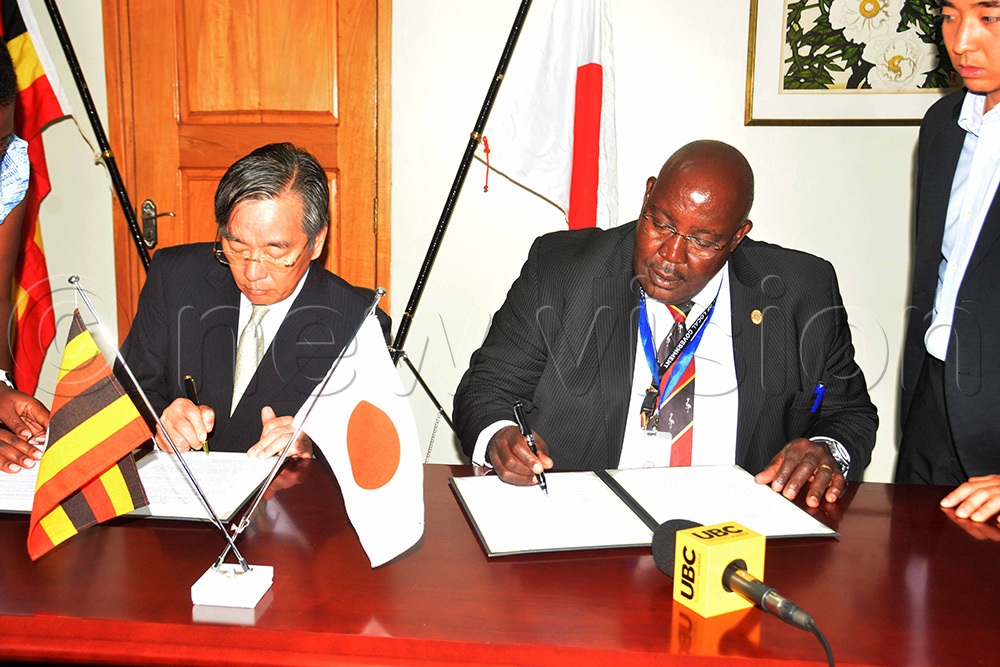
The Japanese Ambassador to Uganda, Takuya Sasayama (left), and the chief administrative officer of Kiryandongo, Anselm Kyaligonza, signing copies of agreements to fund water and education in Kiryandongo District during the pact signing ceremony at the Embassy of Japan in Kampala on Monday, November 9, 2026. (Photo by Francis Emorut)
Kigumba Church of Uganda Primary School currently has an enrolment of 2,136 pupils, including 176 refugee learners, making it one of the largest primary schools in the district.
However, the school operates with only 14 classrooms, resulting in severe congestion, with an average of 180 pupils per classroom, nearly three times Uganda's recommended standard of 54 learners per class.
Shortage of classroom space has for years affected teaching and learning in many schools in Uganda, especially in refugee host districts, forcing as many as six pupils to share a desk designed for three learners.
"On average, we have over 180 learners in a classroom, which is very challenging for teachers in terms of service delivery. I am hopeful that after completion of this project, many classrooms will be decongested. Teachers will be able to move around freely, supervise learners' work and deliver instruction more effectively, which will ultimately improve performance," Baguma said.
Once completed, the new classroom blocks are expected to significantly reduce congestion, improve classroom management and create a more conducive environment for teaching and learning.
Speaking during the signing ceremony, Japan's Ambassador to Uganda, Sasayama Takuya, described education as one of the most effective tools for empowering individuals and strengthening societies.
"Education is one of the most powerful tools for empowering individuals and strengthening societies. Through this assistance, Japan is supporting education as one of the principles of human security, where education is rooted in the principle of human dignity and free from fear and want," Amb. Takuya said.
The Ambassador noted that the project forms part of Japan's continued efforts to support refugee-hosting communities in Uganda by investing in critical social infrastructure that benefits both refugees and host populations.
The Kigumba initiative was one of two community development projects supported under the latest round of Japan's Grant Assistance for Grassroots Human Security Projects programme.
In addition to the education project in Kiryandongo, the Government of Japan also extended support to improve access to clean and safe water in Rakai District through a partnership with Africa Community Technical Services (ACTS) Uganda.
Under the water project, Japan will fund the construction of a gravity-flow water system serving seven villages in Rakai. The project includes installation of 37 water points and the introduction of a water user payment management system in collaboration with the Japanese company called SUNDA.
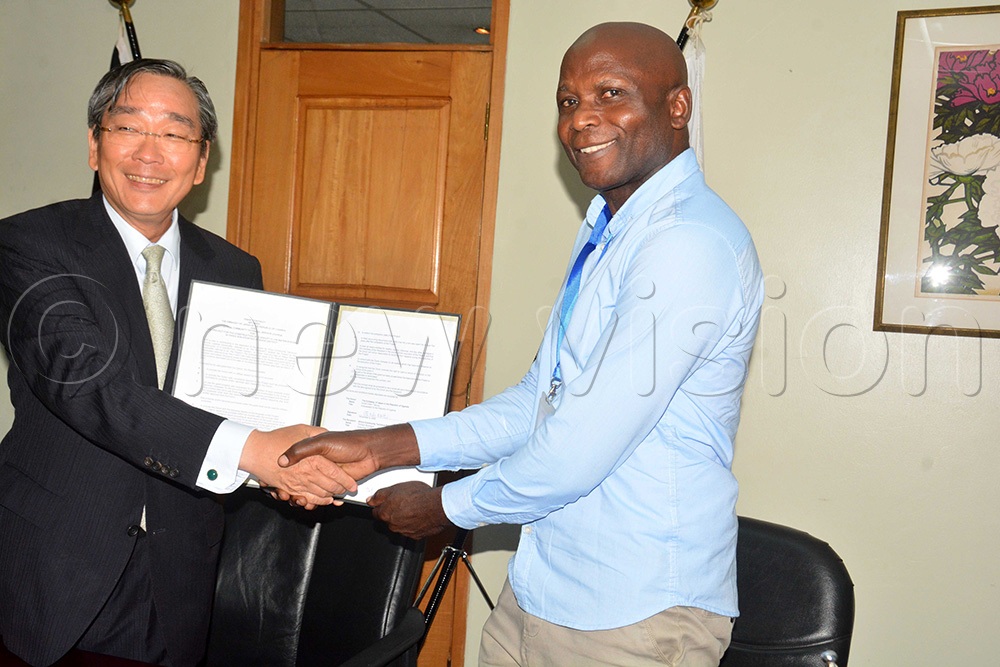
The Japanese Ambassador to Uganda, Takuya Sasayama (left), and the executive director of Africa Community Technical Service, Richard Musinguzi, exchange a copy of an agreement to fund water and education in Rakai district during the pact signing ceremony at the embassy of Japan in Kampala on Monday, November 9, 2026. (Photo by Francis Emorut)
The water initiative is expected to benefit approximately 9,800 residents in villages of; Kabale, Mbirizi, Kyewanyana, Kalongo, Tolero, Kibaale and Kiswaaga, who depend on open wells, springs and nearby rivers as their water sources.
Mathew Dickson Sebyala, the culture minister for Kooki chiefdom in Rakai, said the project will help reduce the burden of water collection on households while contributing to the prevention of waterborne diseases and improving sanitation standards in the affected communities.
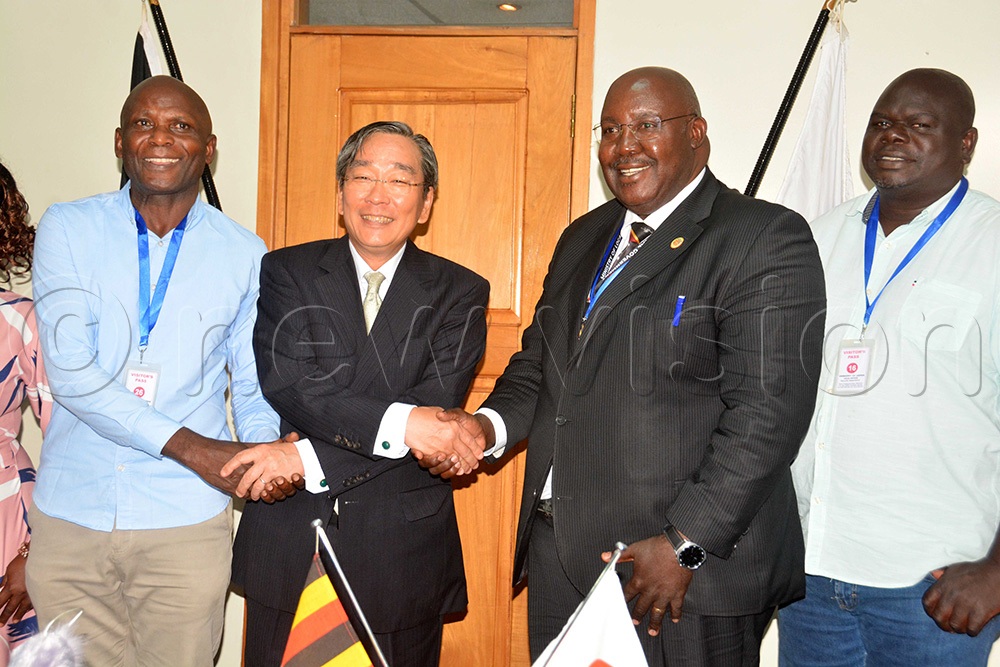
The Japanese Ambassador to Uganda, Takuya Sasayama (centre), the chief administrative officer of Kiryandongo, Anselm Kyaligonza (second right) and the executive director of Africa Community Service, Richard Musinguzi, holding hands together as symbol of cooperation during the agreement signing ceremony to fund water and education in Kiryandongo District at the v of Japan in Kampala on Monday, November 9, 2026. (Photo by Francis Emorut)
"Our people still depend on open wells, rivers and springs as water sources, most of which are dirty and are found in long distances. This project is going to control waterborne diseases that are rampant in the area,” Sebyala noted, adding that the community had welcomed the project by allowing water pipes to pass through their land without compensation.
Amb. Takuya said the two projects reflect Japan's commitment to advancing human security by addressing fundamental community needs such as education and access to clean water.