
How Nakapiripirit teachers use newspapers to promote incidental learning
“We task the learners to read and share new words, places and news they have discovered,” Musani says.
Every week, the school receives 25 copies of Weekend Vision and TOTO magazines, which the teachers distribute among the learners to read, answer questions and also discover the unknown.
NAKAPIRIPIRIT - “For the last two years, we have been using New Vision newspapers and TOTO magazine to promote incidental learning and to beautify our classroom environments as well,” Cheboyi Musani, head teacher of Acherer Community Primary School located in Moruita Sub-County, Nakapiripirit district in Karamoja Sub-Region, says.
Every week, the school receives 25 copies of Weekend Vision and TOTO magazines, which the teachers distribute among the learners to read, answer questions and also discover the unknown.
This is under the Newspapers in Education (NiE) project implemented by Save the Children, an organization that saves and cares for children around the world.
“We task the learners to read and share new words, places and news they have discovered,” Musani says.
Incidental learning is knowledge acquisition that occurs unintentionally from everyday activities. It happens through observation, exploration and experience rather than through formal instruction or deliberate study.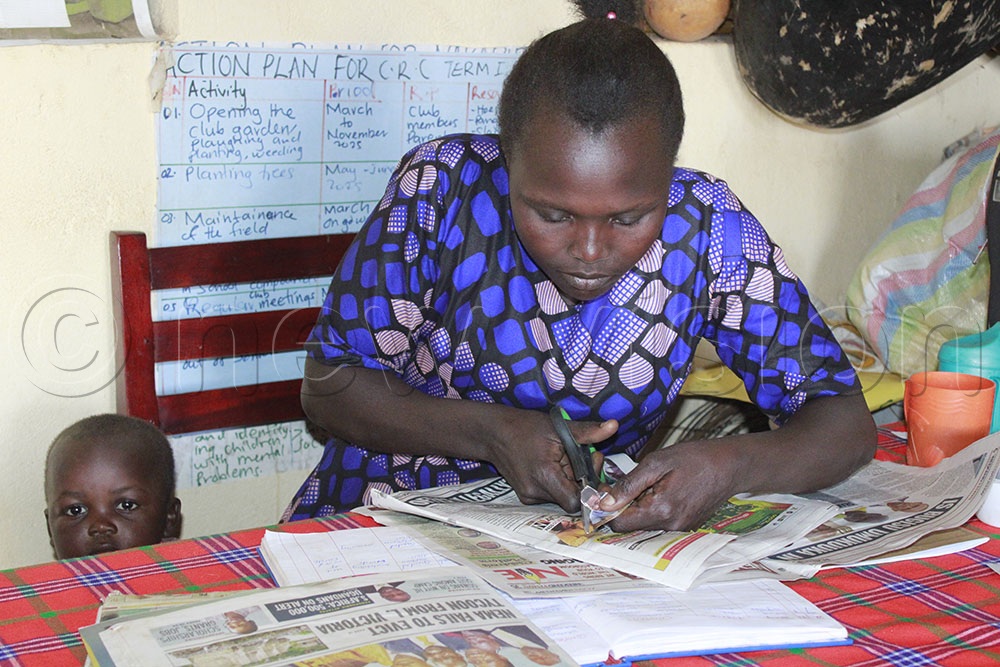
Teacher Topista Cherotin cuts out pictures to use in class at Acherer Primary school in Nakapiripirit district.
Using newspapers to deliver impactful lessons
The school has an enrollment of 253 pupils. However, Musani points out that being a gold mining area, some learners dodge school and go to the mines to make money. This is compounded by teacher shortage (the school has only three teachers including the head teacher) and lack of instructional materials.
“The newspapers saved us a great deal. We used to teach without aids, making it hard for us to deliver meaningful lessons,” he says.
Topista Cheroni, the English teacher for lower Primary and ECD, agrees, adding that Instructional materials help the learners to easily understand what is being taught.
“I always cut out pictures from the New Vision, stick them on a manila paper and use them to illustrate during the lesson,” she explains.
Without instructional materials, Cheroni says, the teaching and learning process cannot register positive results. She cites an example of a teacher who goes to class to teach about family members but doesn’t carry pictures to show what those family members look like.
“The children will recite the names and forget them when they move out of class, but when they see the pictures, they relate and that sticks with them.”
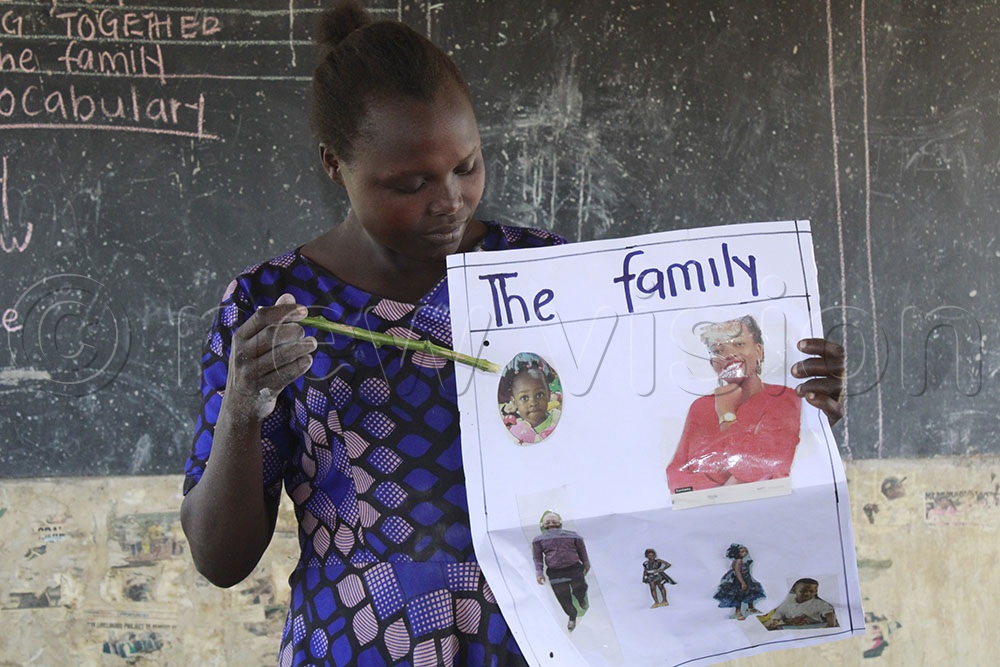
Cherotin uses pictures to show children what the family members look like.
Aside from that, Cheroni also uses the activities in TOTO Magazine to give the children homework. They take the magazines home, answer the questions and take them back the following day for marking.
In addition, Francis Koriang uses the newspapers to deliver mathematics, social studies and literacy lessons in Primary Three and Four. To him, these instructional materials promote collaborative learning all while motivating learners to attend school.
Most importantly, the children get closer to the people, animals and things that are far away from them. For example, from the papers, they see the wild animals without necessarily going to the zoo. They also see the President, ministers and other celebrities they admire but cannot meet at that particular time.
About the project
The NiE programme is being funded by the Norwegian Agency for Development Cooperation (NORAD) through Save the Children in partnership with New Vision.
NORAD is implementing a five-year programme from 2024 to 2028 called “Transforming the Future-For and with Children” in Acholi and Karamoja regions.
The program aims to ensure that all children enjoy their rights to survival, protection, development and participation in a safe, inclusive, accountable and resilient environment.