
Govt warns schools of funding cuts over delayed learner registration
Vincent Ssozi, the assistant commissioner for statistics, monitoring and evaluation at the ministry, warned that schools that delay registration risk missing out on critical government support.
Vincent Ssozi, the assistant commissioner for statistics, monitoring and evaluation at the ministry addressing during the dissemination of education management information system guidelines at Nakawa ICT Hub on June 8, 2026. (Photos by Nancy Nanyonga)
________________
The Ministry of Education and Sports has warned that schools that fail to complete institutional and learner registration under the national Education Management Information System (EMIS) risk losing access to government funding.
The ministry said there is no automatic reservation of statutory allocations, including capitation grants, for schools that fail to meet registration requirements. It noted that unspent funds are forfeited at the end of the annual budget cycle and cannot be carried forward.
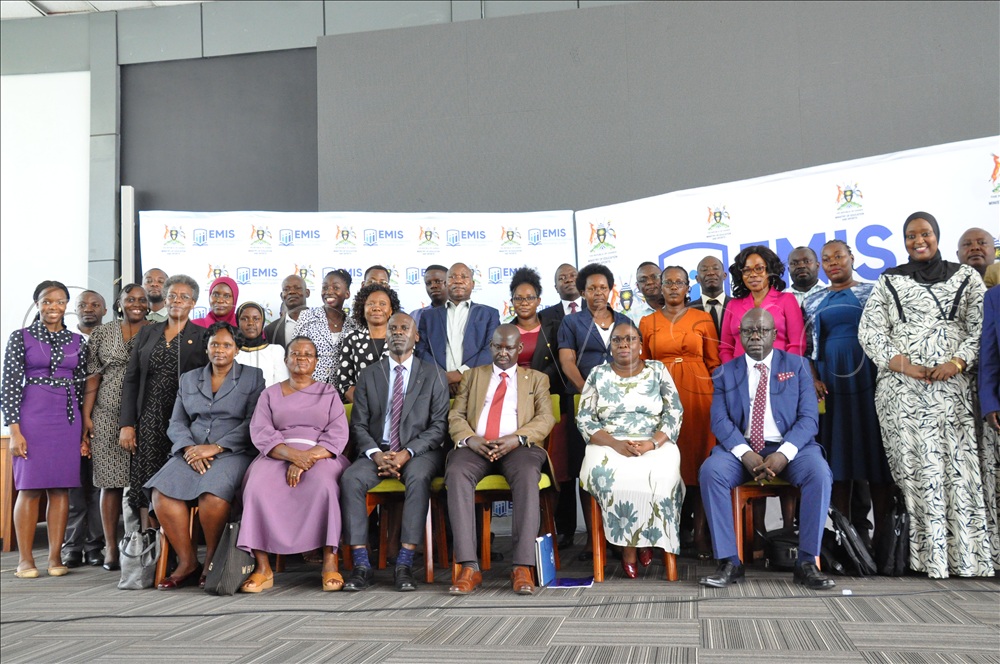
The warning was issued on June 8, 2026, during the launch of the EMIS Guidelines at the National ICT Innovation Hub in Nakawa, Kampala.
EMIS is a centralised digital platform developed by government to collect, store and process data from schools across the country.
Under the system, every learner is assigned a unique Learner Identification Number (LIN), while institutions are required to submit detailed information, including their location, ownership status and governance structure.
The Ministry of Education and Sports uses EMIS data to determine capitation grants and guide resource allocation to public and government-aided schools. Registration on the platform is mandatory for both public and private institutions.
The government redeveloped and rolled out EMIS in July 2022 to replace the Annual School Census. The system enables the online tracking of learners and teachers, supports licensing processes and facilitates the verification of students across all levels of education.
Vincent Ssozi, the assistant commissioner for statistics, monitoring and evaluation at the ministry, warned that schools that delay registration risk missing out on critical government support. He urged both public and private institutions to update their records promptly.
"There is no automatic reservation of money for the state when an appropriation ends; that money is forfeited," Ssozi said. "The incentive is for you to ensure that the register for that school is updated to benefit."
He also urged school administrators to comply with legal and regulatory requirements, particularly the Education Act, which outlines the responsibilities of school management committees, proprietors and government.
The ministry further raised concerns about persistent data inconsistencies within the system.
Officials said some schools and stakeholders remain reluctant to provide accurate personal information because of misconceptions and fears, while others deliberately manipulate registration processes.
To address these challenges, Ssozi said the ministry is harmonising EMIS to improve data accuracy and detect anomalies. The upgraded system is designed to identify learners registered in multiple institutions, helping to eliminate duplication and strengthen data integrity.
During the stakeholder engagement, Mukono district inspector of schools Anita Namayanja welcomed the guidelines but called for clearer sanctions against institutions that fail to comply.
She also raised concerns about data utilisation, noting that schools are sometimes required to resubmit information that is already available in EMIS.
Namayanja added that the challenge has contributed to repeated applications by private schools seeking changes in names and locations.
Francis Mukasa, a headteacher in Mukono, called for increased digital literacy training to improve effective use of the system.
“When EMIS was introduced, it found most of us limited in skills. That is why most of the problems have arisen,” he said.
He added that challenges such as duplicate Learner Identification Numbers emerged because of tight implementation timelines and limited guidance during the rollout phase.
Inspectors also highlighted difficulties in registering refugee learners, particularly because of language barriers, with some students unable to speak English or local languages.
Participants further raised concerns about delays by local governments and the ministry in reviewing and approving submitted school data, saying the bureaucratic process often slows the release of capitation grants and other funding.
Private school representatives noted that frequent leadership changes require continuous training of new headteachers on the EMIS platform, affecting overall system efficiency at the district level.
In response, ministry officials said system upgrades and enforcement of the newly launched EMIS guidelines would continue. They urged local authorities to expedite approvals and ensure timely submission of data to avoid disruptions to school funding and operations.